
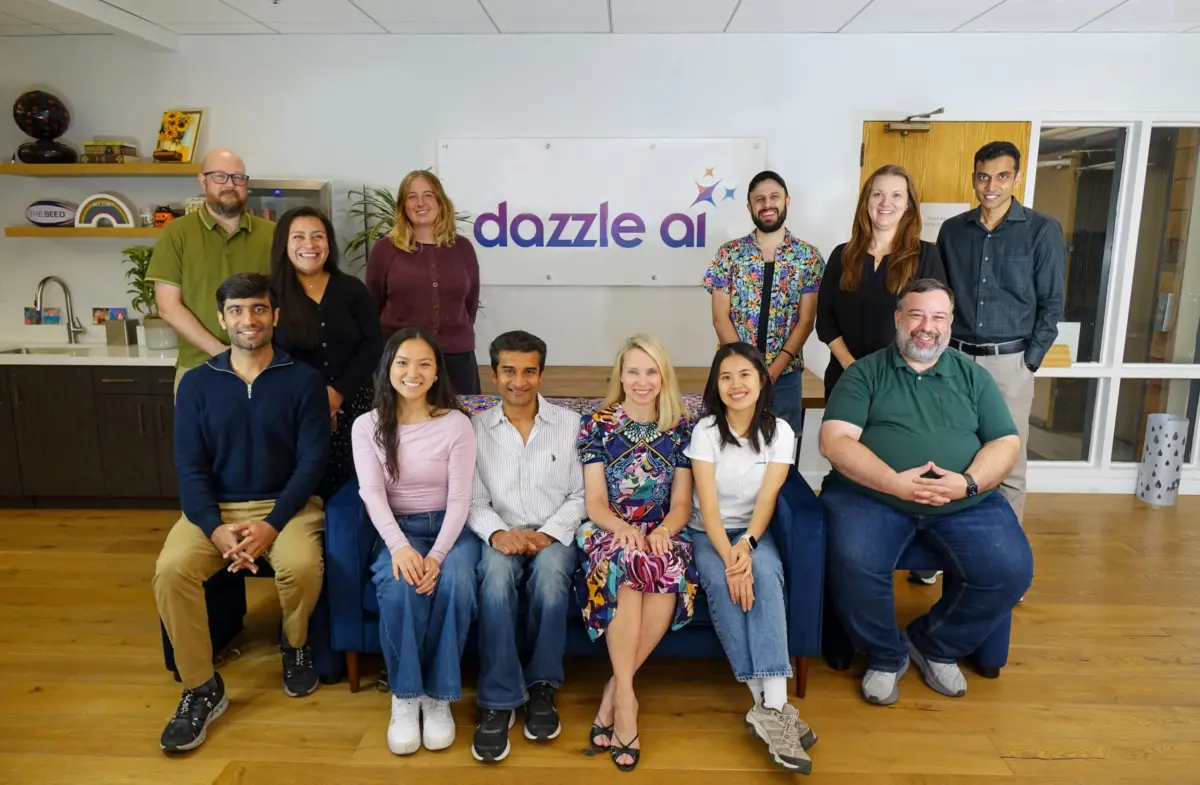
When former Yahoo CEO Marissa Mayer recently revealed that she was finally ready to unveil Dazzle—the personal AI assistant startup that successfully raised an $8 million seed round last December led by Forerunner’s Kirsten Green—it was easy to wonder if she was simply following the crowd. After all, the tech industry has spent the past month watching a massive wave of similar tools flood the market, including Meta’s Muse and Instinct, all vying to become the definitive personal assistant for consumers.
However, when Mayer provided a live demonstration of the product, Dazzle quickly proved that it is taking a fundamentally different approach to artificial intelligence. Instead of building a comprehensive context about your life by scraping text-heavy applications like emails, calendar invites, and shopping histories, Dazzle’s AI assistant derives all of its understanding from a single, highly visual source: your smartphone’s camera roll.
“I think that photos are an underappreciated source of information,” Mayer said during the demonstration. “You’ll be surprised what we can learn about you and how good a job we can do with your photos.”
Mayer argues that while a picture may be worth a thousand words, an entire camera roll is easily worth millions. By analyzing the complete repository of images stored on a user’s phone, Dazzle claims it can accurately understand a person’s hobbies, personal interests, food and style preferences, how they like to spend their free time, and the important people they spend it with.
“We understand whether or not you like to ski, where your most recent trip was, what types of things your kids are into,” Mayer explained, highlighting the depth of insight that can be extracted from visual data alone.
It comes as little surprise that Mayer has ultimately chosen to build an assistant centered entirely around photography. Her previous entrepreneurial venture, Sunshine, previously launched an AI-powered photo-sharing and event-planning tool called Shine in 2024. While that particular product faced widespread criticism for its outdated design, struggled to attract a large user base, and was eventually shut down in late 2025 with its assets sold to her new startup, Mayer insists that the endeavor successfully laid the groundwork by building “interesting IP.”
Interacting with Dazzle is designed to be seamless, with users able to communicate through either a dedicated mobile app or text messaging. The functionality of the assistant is split into two core user experiences. For immediate, everyday tasks, Dazzle can scan recent photographs to extract actionable details. For example, it can automatically populate a user’s calendar based on a photograph of an event flyer, or help track down a local repair professional after spotting a broken garage door somewhere in the user’s camera library.
The second core experience delves deeper into long-term planning, mining a user’s extensive photo library to generate highly personalized ideas for everything from holiday vacations to thoughtful birthday gifts.

Given that plenty of existing technology tools are already capable of parsing pictures—such as looking up where to buy a specific retail product or searching for detailed information on an interesting art piece—testers were naturally far more curious to see what Dazzle could learn from a lifetime of personal photo history.
For instance, Mayer herself utilizes Dazzle to brainstorm creative family outings. By scanning her personal photo archive, she notes that the assistant successfully deduced that her family genuinely enjoys escape rooms, subsequently suggesting multiple San Francisco Bay Area locations that she had never even heard of before.
When reporters tested Dazzle with a request for tailored vacation recommendations, the system suggested several Mediterranean destinations, likely picking up on historical travel photos from past trips to Spain and Greece. Interestingly, it also threw in Sicily, which caught the tester by surprise since that trip had occurred four years prior. However, further tinkering revealed that the system still has noticeable blind spots. During a test involving gift ideas, the assistant failed to remember that the user’s daughter already knows how to roller skate, even when asked if a pair of skates would make a good upcoming birthday present.
Despite these occasional hiccups, testers generally appreciated Dazzle’s imaginative suggestions for local activities, such as recommending a neighborhood pottery studio or a bioluminescent kayak tour in Tomales Bay.
While the product will undoubtedly continue to improve over time, and users remain undecided on whether it will secure a permanent spot in their daily routines, there is a distinct appeal in suggestions that feel genuinely personal rather than the generic output one might receive from an AI assistant relying solely on calendar entries and email threads.
Furthermore, Mayer contends that given growing consumer security and privacy concerns surrounding products like Instinct and Muse, users may ultimately feel much safer handing over their photo libraries to an AI system rather than granting it broad, invasive access to sensitive text-based data like personal emails and private messages.
She emphasized that Dazzle places a heavy emphasis on privacy, actively discarding any personal information that the AI flags as sensitive during its processing phases.
This ongoing flurry of new AI assistants represents an exciting era for everyday consumers. And while Dazzle may not be as broadly utilitarian as other major offerings on the market quite yet, it offers a fascinating glimpse into a future where artificial intelligence can do far more than simply execute isolated tasks—it can actually understand who you are.