
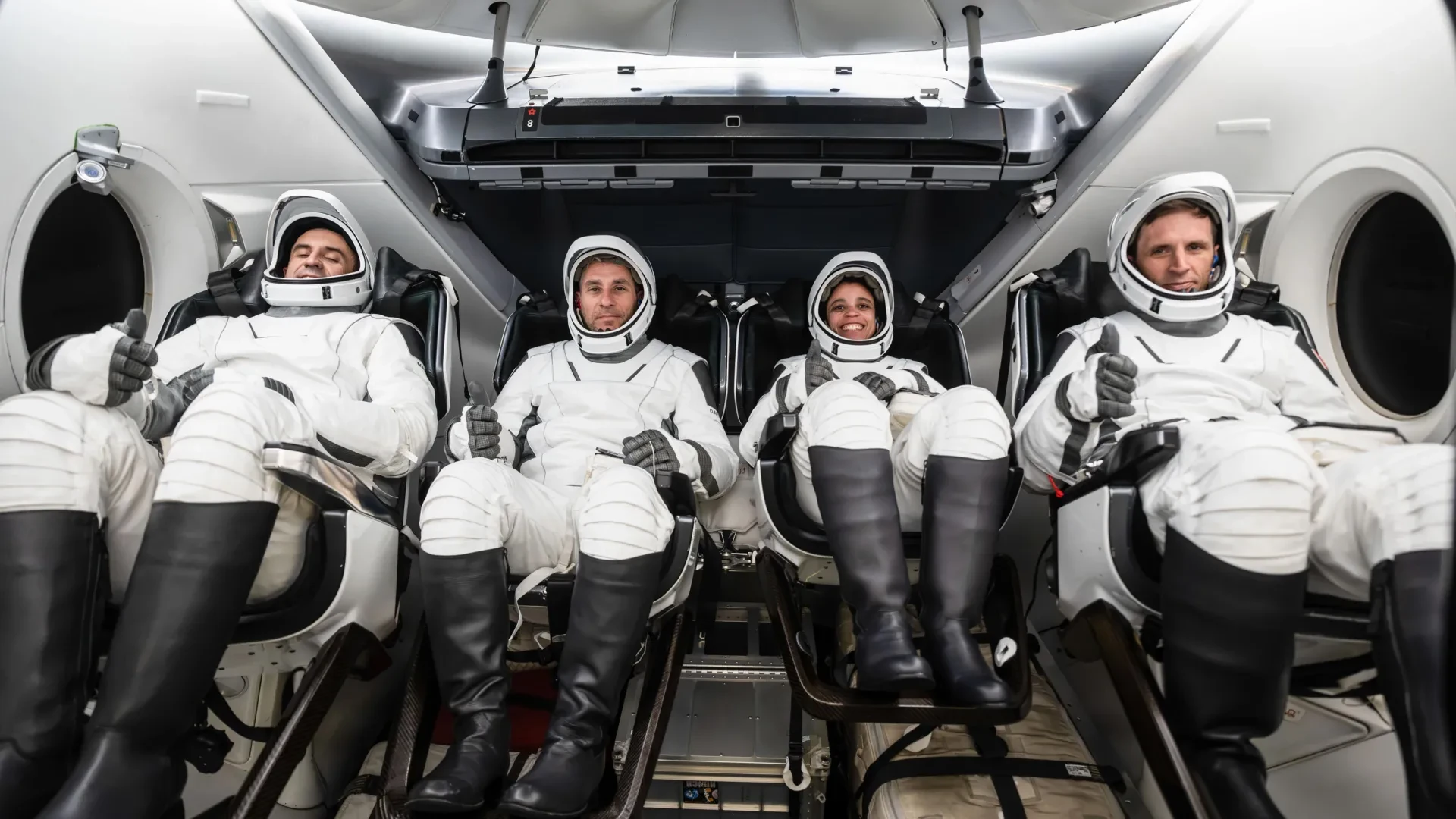
NASA and SpaceX are officially targeting 11:10 a.m. EDT on Thursday, October 1, as the earliest opportunity to launch the highly anticipated Crew-13 mission to the orbiting International Space Station. The upcoming flight represents another vital chapter in the ongoing commercial crew partnership between the United States space agency and the private aerospace manufacturer, maintaining a steady cadence of human spaceflight missions to and from the orbiting laboratory.
In the days leading up to liftoff, specialized teams across multiple NASA and SpaceX facilities will complete a rigorous series of final preparations and formal readiness reviews. These comprehensive evaluations are designed to confirm beyond a shadow of a doubt that the astronauts, the expansive space station, SpaceX’s advanced Dragon spacecraft, and the workhorse Falcon 9 rocket are thoroughly prepared for flight. The mission is scheduled to lift off from Space Launch Complex 40 at Cape Canaveral Space Force Station along Florida’s dynamic Space Coast, a historic site that has hosted numerous critical orbital launches over the decades.
If all goes according to plan and the countdown proceeds without interruption on October 1, the Crew-13 mission will feature an exceptionally fast transit profile. The Dragon spacecraft is expected to reach the International Space Station in less than nine hours following liftoff. Rendezvous and docking procedures are carefully planned for approximately 8 p.m. on the same day, with the spacecraft slated to attach securely to the forward-facing port of the station’s Harmony module.
The journey to orbit begins when the Falcon 9 rocket ignites its primary engines at Space Launch Complex 40, punching through the atmosphere and carrying the Dragon spacecraft into low-Earth orbit. Once separation occurs and Dragon is flying freely, the spacecraft will execute a series of precise orbital maneuvers designed to match the precise path and speed of the space station, which travels around the Earth at roughly 17,500 miles per hour. Docking is a meticulously controlled, automated process backed by manual override capabilities, in which Dragon aligns itself perfectly with the designated station port and secures a hermetic seal.
The Harmony module, where Dragon is scheduled to dock, serves as one of the primary interconnecting nodes of the International Space Station. Often referred to as a utility hub, Harmony links the United States laboratory module, the European Space Agency’s Columbus laboratory, and the Japanese Aerospace Exploration Agency’s Kibo laboratory, while also providing critical docking locations for visiting cargo and crew spacecraft.
The international makeup of the Crew-13 flight highlights the continued cooperation of global space partners in low-Earth orbit. NASA astronaut Jessica Watkins will serve as the spacecraft commander, taking the lead on flight operations and mission milestones. She will be joined by fellow NASA astronaut Luke Delaney, who will serve as the pilot, assisting the commander with flight controls, system monitoring, and spacecraft navigation. Rounding out the four-person flight crew are Canadian Space Agency (CSA) astronaut Joshua Kutryk and Roscosmos cosmonaut Sergey Teteryatnikov, both of whom will serve as mission specialists, bringing specialized expertise to the complex operations aboard the orbital outpost.
Upon successfully arriving at the station and completing the standard ingress procedures—which involve equalizing pressure and checking atmospheric integrity—the four incoming astronauts will officially transition into becoming members of Expedition 75. Space station expeditions are long-duration increments during which rotating crews live and work in microgravity for several months at a time. Throughout their tenure on Expedition 75, the crew members will be responsible for conducting a wide array of advanced scientific research, performing essential maintenance to keep the aging orbiting laboratory running smoothly, and supporting ongoing technology demonstrations alongside various commercial operations that benefit both life on Earth and future deep-space exploration efforts.
As the launch date draws closer, operational safety remains a top priority for mission planners. Crew-13 is currently residing in strict quarantine at NASA’s Johnson Space Center in Houston, Texas. This preflight health stabilization is a standard precaution designed to reduce the risk of illness or infection before launch, ensuring that no harmful pathogens are inadvertently introduced into the isolated environment of the space station. As part of the final ground timeline, the crew is scheduled to travel to NASA’s Kennedy Space Center in Florida on Saturday, September 26. This arrival marks the transition into the final days of preflight preparations, system checkouts, and rehearsals leading up to the planned October 1 liftoff.