
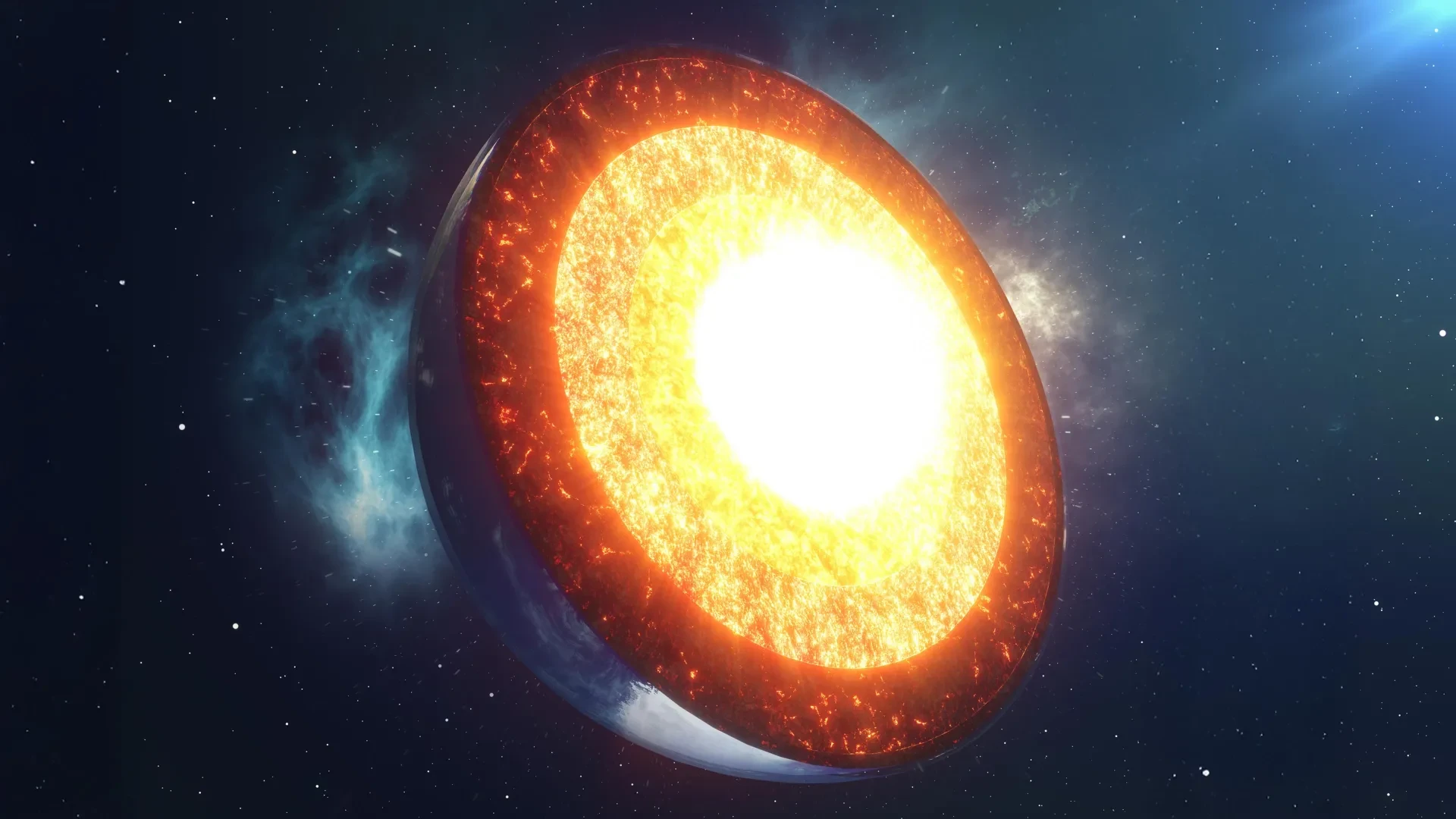
Most of us view a day as a rigid, unyielding unit of time: exactly 24 hours, dictated with absolute precision by the clockwork rotation of our world. Yet, beneath our feet, the reality is far more fluid. Earth’s rotation is not perfectly constant, and the true length of a day is constantly undergoing subtle, microscopic fluctuations.
While these differences are so minute that they are measured merely in milliseconds, modern physicists and geophysicists possess the instrumentation required to detect them. Over extended periods, some days become fractionally shorter while others stretch slightly longer. These imperceptible variations are driven by complex, powerful forces operating deep inside the planet, far beyond the reach of human eyes or conventional exploration.
Earth’s Core and Mantle Trade Momentum
For roughly three decades, the scientific community has understood that Earth’s liquid outer core does not always rotate at the exact same rate as the rest of the planet. Through careful tracking of changes in Earth’s global magnetic field, researchers have revealed that this vast, churning ocean of molten metal can gradually accelerate over the span of several decades, only to decelerate during the subsequent decades in a continuous, shifting cycle.
At the same time, the mantle—the colossal, roughly 3,000-kilometer-thick rocky layer that surrounds the core and extends upward to include the planet’s brittle crust—responds in the opposite direction. When the liquid core speeds up in one direction, the mantle must compensate by slowing down slightly. Conversely, when the core loses speed, the mantle accelerates to balance the system.
This dynamic push-and-pull happens because of fundamental laws of physics. Specifically, Earth’s total angular momentum—the quantity of rotation an object has, taking into account its mass and speed—must remain conserved and constant as a closed system.
Because the mantle accounts for the vast majority of the planet’s mass near the surface, even very small changes in its rotational speed are enough to alter the overall length of a day by a few milliseconds. To humanity, a millisecond is a fleeting blink of an eye, but to scientists monitoring satellite telemetry and atomic clocks, it represents a massive mechanical transfer of energy happening deep within the globe.
A Hidden Gravitational Tug Inside Earth
Despite knowing that this momentum trade-off occurs, scientists have long struggled to explain the exact mechanical mechanism behind how the core and mantle exchange this rotational momentum across the boundary that separates them.
In a new study published September 23 in the scientific journal Nature, University of Alberta physics PhD student Huifeng Zhang and professor Mathieu Dumberry have presented a compelling possible answer to this enduring geophysical puzzle.
Their detailed theoretical work shows that small changes in the rotational speed of Earth’s inner core—the ultra-dense, solid metal region at the absolute center of our planet—can create what geophysicists refer to as a "gravitational torque." Because the solid inner core is not a perfectly spherical object, changes in its motion and orientation mean that its mass is unevenly distributed relative to the mantle above it. Consequently, variations in its motion can gravitationally interact with uneven distributions of mass within the mantle itself.
That invisible gravitational interaction can slightly alter how quickly the mantle rotates relative to the rest of the planet, producing the small, measurable changes in the length of a day that researchers record on the surface. It is a celestial-style mechanical ballet playing out at the very center of the Earth, where gravity acts as the invisible tether binding the motion of the solid inner core to the rocky mantle.
Competing Forces Control Earth’s Rotation
However, the gravitational interaction between the inner core and the mantle is not operating in a vacuum. Another competing force also acts simultaneously at the boundary between the fluid outer core and the rocky mantle.
Known to geophysicists as core-mantle boundary torque, this secondary phenomenon produces intense friction and electromagnetic drag that directly oppose the gravitational pull described in the new study. This electrical and mechanical resistance acts as a crucial check on the system, helping to limit how much Earth’s day length can fluctuate over time. Without this counterbalancing friction, the rotational shifts might be far more erratic.
According to the researchers, the small, observed variations in the length of a day that we experience on Earth arise from these subtle, shifting balances between the gravitational torque acting on the inner core and the electromagnetic and frictional core-mantle boundary torque. It is a delicate equilibrium between opposing physical forces operating thousands of kilometers beneath our feet.
Earth’s Inner Core May Be More Dynamic Than Expected
Beyond helping to explain a long-standing mystery about why Earth’s day length constantly shifts by fractions of a millisecond, the new findings also offer profound, unprecedented insight into what is happening in the most remote and inaccessible regions of our planet.
Zhang and Dumberry note that their calculations suggest the solid inner core appears to "deform viscously" on a time scale of about 10 years. This implies that Earth’s deepest interior may change shape and respond to physical forces far more dynamically than its solid, iron-nickel composition might traditionally imply to surface observers.
By linking surface-level measurements of time and rotation with deep-Earth structural dynamics, the study opens a new window into understanding the complex mechanical life of our planet’s interior.