
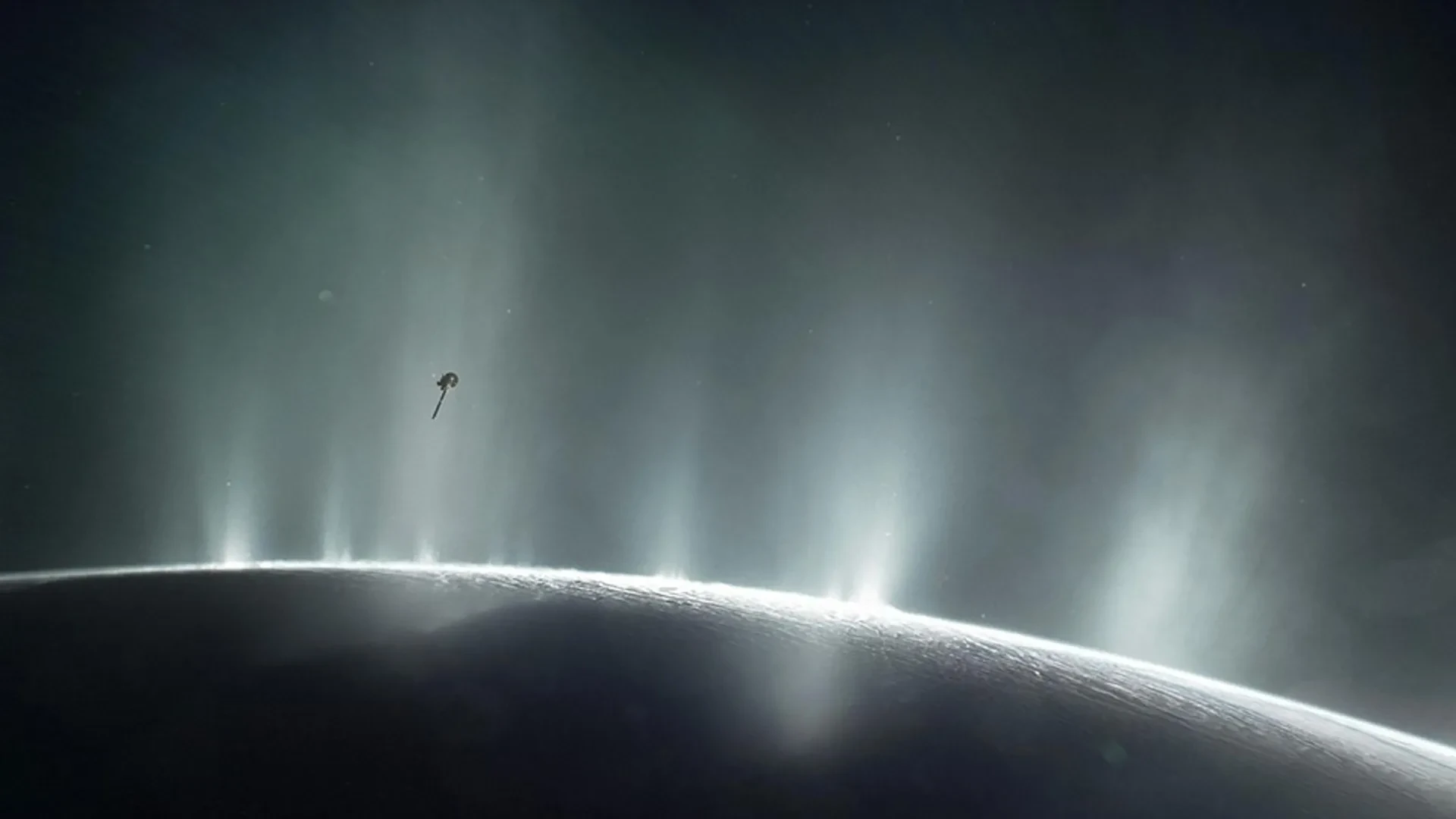
Saturn’s moon Enceladus is widely recognized as one of the most enigmatic worlds in our solar system. Outwardly, it appears as a cold, desolate sphere completely covered in a thick, unyielding shell of ice. Yet, beneath that frozen exterior lies a global, liquid saltwater ocean. Near the moon’s dynamic south pole, immense tectonic fractures in the icy crust act as natural geysers, forcefully venting water vapor and tiny ice particles directly out into the vacuum of space.
This ongoing geological activity offers scientists an unprecedented opportunity. It gives researchers a direct window into an alien ocean without the monumental engineering challenge of landing a spacecraft and drilling through kilometers of solid ice. Instead, they can simply fly through the plumes and collect the materials nature has already launched into orbit.
An international team of researchers, including scientists from the Earth-Life Science Institute (ELSI) at the Institute of Science Tokyo, has now investigated what happens to that subterranean ocean water from the moment it leaves the liquid reservoir beneath the crust until it eventually transforms into the tiny ice grains detected soaring through space. Their findings shed light not only on the physical mechanics of the moon’s cryovolcanic vents, but also on how future robotic missions might hunt for signs of habitability and prebiotic chemistry.
Cassini Found Surprisingly Diverse Ice Grains
Between 2004 and 2017, NASA’s Cassini spacecraft performed historic flybys of the Saturnian system. During these operations, the Cosmic Dust Analyzer instrument onboard the spacecraft meticulously measured the chemical composition of individual ice particles drifting through Saturn’s vast E-ring. That glowing ring is not a permanent, static feature of the gas giant; rather, it is continually supplied, replenished, and maintained by the material perpetually erupting from the active south polar fractures of Enceladus.
A research team led by Professor Frank Postberg at Freie Universität Berlin decided to examine a specific subset of this data, focusing on 961 individual mass spectra gathered from salt-rich grains known to scientists as Type 3 particles. If these microscopic grains were simply uniform, direct micro-samples of the underlying ocean water, researchers would naturally expect them to contain broadly similar mixtures of salts, mirroring the homogeneous composition of the liquid reservoir from which they supposedly came.
Instead, the analysis revealed that the grains varied dramatically in their makeup.
Some of the captured particles were exceptionally rich in sodium chloride, commonly known as table salt, while others contained markedly higher amounts of carbonates, potassium chloride, or complex phosphates. One particularly striking and puzzling pattern stood out during the data evaluation: chloride and carbonate compounds rarely appeared together within the same sodium-rich particle.
This unexpected chemical variance raised a fundamental puzzle for planetary scientists. If all of these grains originated from the exact same global ocean, why did their chemical compositions differ so drastically from one another?
Recreating Enceladus’ Ocean Droplets in the Lab
To explore and test potential explanations for this chemical diversity, Professor Yasuhito Sekine and his colleagues at ELSI devised a series of physical experiments. They created specialized laboratory droplets containing the primary chemical salts believed to be present in the subsurface ocean of Enceladus.
The researchers froze droplets of various sizes under a wide range of controlled cooling conditions, observing closely how different chemical elements were distributed throughout the liquid as the phase change occurred and the droplets solidified into ice.
The results of these laboratory simulations demonstrated that the precise speed at which freezing takes place plays a major role in shaping chemical distribution.
In droplets measuring roughly 200 micrometres across, dissolved salts naturally separated into distinct, localized regions when the freezing process occurred relatively slowly, at a rate of approximately 10 Kelvin per minute or less. Conversely, when comparable droplets were subjected to rapid freezing conditions, their chemical ingredients remained thoroughly and evenly mixed throughout the resulting solid grain.
"What surprised us was that the diversity seen by Cassini could emerge from droplets originating from essentially the same ocean water," Professor Sekine explained, discussing the implications of the laboratory work. "Our experiments show that when relatively large ocean droplets freeze slowly, different salts can separate within them. If those frozen droplets are later broken apart, they can produce much smaller ice grains, each with very different chemical compositions."
A Slower Journey Through Enceladus’ Ice
These new experimental findings may also reveal critical insights regarding the internal geological and physical processes occurring deep inside the moon’s complex icy crust.
Earlier theoretical studies generally assumed that seawater spray erupting from Enceladus’ liquid ocean freezes almost instantly and moves rapidly toward the vacuum of space soon after departing the liquid environment. However, the new laboratory experiments point toward a fundamentally different scenario.
The data suggests that the ocean spray may initially move much more slowly through the underground vent system, navigating complicated, tortuous pathways through deep fractures in the ice long before they approach the surface environment.
The research team suggests that the subsurface ocean spray initially forms droplets ranging anywhere from tens to hundreds of micrometers in size. As these larger droplets drift slowly upward through the deeper, warmer sections of the venting channels, they freeze gradually. This unhurried timeline provides dissolved salts with enough necessary time to segregate and separate into distinct regional pockets within the forming ice.
Closer to the moon’s surface, physical conditions change dramatically. Escaping gases begin moving at much higher velocities, and the partially or fully frozen droplets can slam into the rigid walls of narrower icy channels at high speeds. Those violent collisions can fracture and shatter the larger droplets into much smaller physical pieces.
Each resulting fragment can originate from a completely different salt-rich region within the original frozen droplet, creating a population of individual grains with widely disparate chemical compositions. Those fractured fragments can then escape entirely into space, joining the stream of plume material and becoming permanent components of Saturn’s E-ring.
"The Cassini data showed us that these salt-rich grains are far more chemically diverse than an average ocean composition would suggest," Professor Postberg noted. "Combining those observations with the freezing experiments gives us a physical explanation: Cassini may have sampled fragments of larger frozen ocean droplets, each preserving different components that became separated during their journey towards the surface. The abundance of each individual component in the ocean is then reflected in the number of fragments in which a particular component is found."
Enceladus May Naturally Concentrate Key Compounds
This physical discovery could carry significant implications for future robotic missions destined to return to the Saturnian system to study Enceladus in greater detail.
As ocean droplets freeze and subsequently break apart into smaller fragments, individual chemical compounds can become heavily concentrated inside particular grains. This natural sorting process does not simply separate various mineral salts from one another. Previous scientific work has also demonstrated that complex organic substances can experience similar segregation, appearing at elevated, concentrated levels within specific ice particles.
Such a natural mechanism could make future analytical work considerably easier for scientists studying returned samples or performing in-situ measurements.
Chemical compounds that might be heavily diluted within the vast expanses of Enceladus’ hidden ocean and thoroughly mixed with many other background substances could become much easier to detect when naturally concentrated into individual ice grains by physical fractionation.
On Earth, analytical laboratories often spend considerable time, effort, and resources physically separating and concentrating chemical components before attempting to analyze a complex sample. Remarkably, Enceladus appears to perform both of these vital sample preparation steps entirely on its own: chemical components become systematically separated during transit, and specific fractions end up heavily concentrated within a fraction of the ejected ice particles.
Possible Implications for Prebiotic Chemistry
The physics of slow freezing could also have another profound consequence for the chemistry occurring within the moon’s interior plumbing system.
As water molecules crystallize and ice structures grow, tiny microscopic pockets of liquid brine can remain trapped between the expanding ice crystals. Within these confined, liquid-rich micro-environments, dissolved mineral salts and organic compounds can become extraordinarily concentrated.
This localized concentration mechanism could matter significantly for prebiotic chemistry—the complex chemical reactions and pathways that are thought to precede the actual emergence of biological life. One of the greatest challenges in studying prebiotic chemistry is finding natural ways to bring organic molecules that are normally dilute in an open body of water into close, sustained physical contact with one another so that more complex reactions can take place.
Because a substantial portion of the material violently erupted from Enceladus eventually falls back down onto the moon’s icy surface via gravity, this recurring cycle of freezing, internal concentration, and surface recycling could potentially repeat over and over again through geological time.
Understanding how Enceladus forms its distinctive ice grains therefore accomplishes much more than simply explaining the unusual and puzzling measurements collected by the Cassini spacecraft years ago. It offers fresh, tangible clues about the hidden environment operating beneath the moon’s frozen crust and may ultimately help future spacecraft correctly interpret the delicate particles they collect as they continue searching for definitive evidence of habitability and potential signs of life in the outer solar system.