
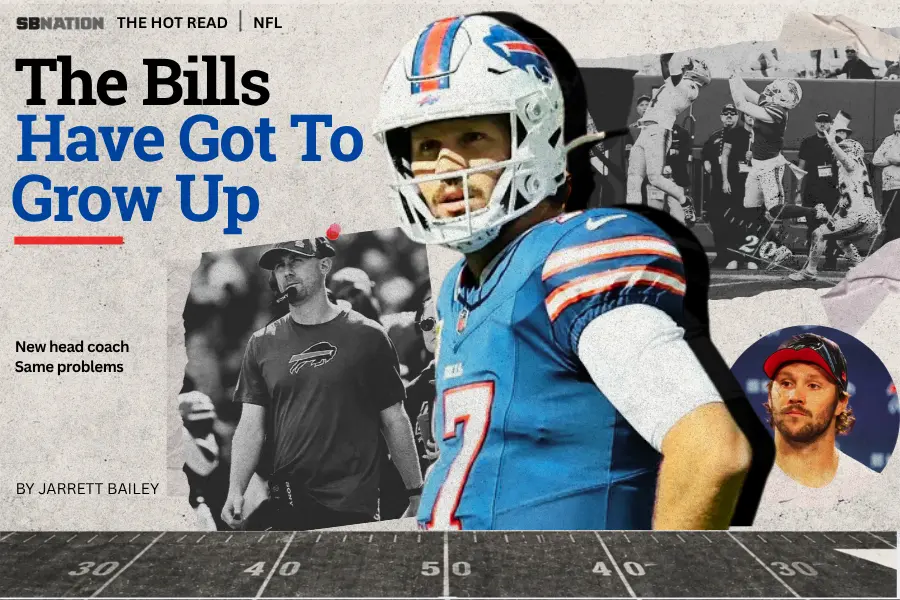
The Buffalo Bills remain the quintessential Buffalo Bills. In some ways, that characteristic makes them one of the premier franchises in the National Football League; in other ways, it terrifies their loyal fanbase.
This campaign was supposed to serve as a period of genuine transformation for Buffalo. Unfortunately for the passionate members of Bills Mafia, Sunday provided a stark reminder of the old adage that the more things change, the more they stay the same. Following a promising 3-0 start, the Bills entered a crucial matchup with an opportunity to effectively deal an early knockout blow to the rival New England Patriots. Instead, Buffalo allowed their divisional adversaries to not only secure a victory, but to find their offensive rhythm entirely.
The Patriots had managed a meager 19 total points across their first three games of the season entering the Week 4 contest. Yet, they erupted for 29 points against a Buffalo defense that new defensive coordinator Jim Leonhard was brought in to elevate. What has materialized instead is a defensive unit ranking 30th in Expected Points Added (EPA) per play, having surrendered the second-most touchdown passes in the league and the seventh-most total points. No one realistically expected the Bills to boast the single best defense in the NFL, but to perform statistically as one of the absolute worst units is a disheartening echo of the struggles fans witnessed under former regimes.
On the offensive side of the ball, coordinator Joe Brady moved away from virtually everything that yielded success during the team’s opening three-week surge. The Bills generated the third-highest EPA per play utilizing 12 personnel packages during Weeks 1 through 3, yet they dialed up only nine such plays against New England. Running back James Cook had been averaging over six yards per carry, but he was handed the ball just 12 times. Brady even reverted to frustrating play-calling patterns, highlighted by a screen pass on a third-and-long that was easily diagnosed and forced a punt. Tight end Dalton Kincaid sat fourth in EPA per target among tight ends with at least 50 routes run entering Week 4, yet he was targeted a mere two times. Why the Bills abruptly diverted from the very schematic formulas that fueled their 3-0 start remains as baffling as it is familiar.
While Brady and Leonhard rightfully shoulder the lion’s share of the criticism, franchise quarterback Josh Allen is far from blameless. Despite the myriad of shortcomings around him, with just over a minute remaining on the clock and all three timeouts safely in his pocket, Allen scrambled to evade a sack and launched an ill-advised pass into double coverage intended for Josh Palmer. Safety Craig Woodson intercepted the errant throw to seal the game. Allen had viable alternatives: he could have tucked the ball and gained a modest chunk of yardage on the ground, targeted the wide-open checkdown option to his left, or attempted to extend the play methodically to let routes develop.
To be fair, his defense struggled mightily, and Allen had just engineered a brilliant drive culminating in a pinpoint, game-leading touchdown pass to Keon Coleman with less than five minutes remaining. All of those factors can be acknowledged simultaneously while recognizing a lingering trend. We are now firmly in the ninth year of Allen’s professional career, and observers can still reliably anticipate a postgame press conference where the star quarterback looks visibly distraught following a remarkably immature throw that he had no business attempting.
One can easily recall similar moments from the past, such as the 2022 regular-season contest featuring a pair of costly red-zone interceptions against the Minnesota Vikings, the second of which came in overtime on a heavily contested throw when an underneath outlet was wide open. There was also Week 1 of the 2023 season against the New York Jets, featuring three interceptions in a loss to a Jets squad led by backup Zach Wilson after Aaron Rodgers suffered a season-ending Achilles injury on opening night.
"Same s—t, same place, different day," Allen famously remarked following that 2023 opener.
Now, Sunday brought a familiar script when Allen possessed all the necessary physical tools and ample time to guide Buffalo at minimum into field-goal range, or ideally into the end zone to secure a 4-0 start. After the final whistle, he once again shouldered the responsibility for a detrimental decision that ultimately cost his team the game. It is admirable that Allen consistently faces the media and owns his mistakes, but at some juncture, his decision-making in high-leverage moments must mature. Every NFL team drops games over the course of a gruelling 17-game schedule, and no one expects the Bills to orchestrate a flawless 17-0 campaign. However, these are precisely the types of avoidable losses that return to haunt contenders come January.
Last season, the Bills suffered losses to the Atlanta Falcons and Miami Dolphins—two franchises that subsequently dismissed their head coaches and initiated wholesale rebuilds. Had Buffalo managed to win those specific contests, they would have finished the year with a stellar 14-3 record and secured the coveted No. 1 seed in the AFC. Should they finish this season with a 12-5 record and find themselves sitting a game out of the top seed, or if the resilient Patriots manage to capture the AFC East crown, this early-season stumble will undoubtedly linger.
None of this is to suggest that Josh Allen is uniquely responsible for all of Buffalo’s systemic issues, because he is not. Nor does it diminish his generational athletic gifts or his undeniable greatness. Rather, it highlights an urgent need for the organization to mature. Joe Brady must prove he can institute genuine, lasting adjustments. Jim Leonhard needs to tighten the screws on a defensive unit that, outside of its formidable front four, has proven alarmingly easy to dissect. And Allen must exhibit greater poise and maturity in the game’s defining moments. In order to finally conquer their postseason demons and get over the proverbial hump, Allen and his teammates must definitively prove that the Bills are not still the Bills.
The Broncos Don’t Trust Bo Nix
Actions consistently speak louder than words, and the messaging coming from the Denver Broncos suggests a profound lack of confidence in their starting quarterback. Bo Nix concluded Denver’s Week 4 loss to the San Francisco 49ers completing 25 of 42 pass attempts for 214 yards and a single touchdown. Out of those 25 completions, a staggering realization emerges: only six traveled further than five yards downfield. Furthermore, Nix posted an average depth of target of just 6.01 yards, while his average air yards relative to the line to gain sat at -3.48 yards. This indicates that his typical pass attempt finished roughly 3.5 yards short of the first-down marker—both of which rank as the lowest figures in the entire NFL among 33 quarterbacks with at least 50 dropbacks. His short passing percentage sits at a league-leading 77 percent.
These statistics do not belong to a coaching staff that trusts its signal-caller to execute explosive plays downfield. The visual evidence from Denver’s passing charts highlights an offense operating from a place of fear. Swing passes, screen routes, and quick underneath throws are the tactical signatures of an offense designed to protect a quarterback rather than unleash him.

It is difficult to place the blame entirely on head coach Sean Payton and offensive coordinator Davis Webb, as Nix’s individual performance has fallen short. His EPA per play trails that of veteran Jacoby Brissett, while his overall success rate sits behind Cam Ward. Nix has largely exhibited the same limitations that defined his collegiate tape at Auburn and Oregon. While a heavy diet of screens and short throws helped jump-start the deep passing game a season ago, that dynamic has vanished this year, leaving Nix ranked 21st in the league in EPA per play on deep throws. Opposing defenses have also realized that applying defensive pressure causes Nix to unravel, as he currently ranks 26th in pass success rate when facing pressure.
This appears to be the current reality for Nix: a middle-of-the-pack quarterback at his ceiling, and a struggling starter at his floor. Compounding the offensive woes, Denver’s defense has failed to reach its elite standard through the first four games, leaving little margin for error when the offense remains stagnant. This iteration of the Broncos likely peaked last season during an improbable run to the AFC Championship Game, and replicating those heights appears increasingly unlikely.
The Atlanta Falcons Might Be a Wagon
The offensive explosion in Atlanta over the past two weeks has caught many analysts by surprise, fueled primarily by a dominant ground game. Across Weeks 3 and 4, the Falcons lead the NFL in EPA per play, and their remarkable 0.28 EPA per rush towers over the second-place Indianapolis Colts, who managed a 0.1 mark. Their rushing success rate of 58.2 percent outpaces the Detroit Lions by nearly five percent, complementing a league-leading 447 rushing yards alongside dominance in rushing touchdowns and yards after contact.
This resurgence coincides with the return of quarterback Michael Penix Jr., who has performed admirably since reentering the lineup. Penix is averaging 10.6 yards per attempt with four touchdown passes across two starts. Having a healthy and capable starting quarterback changes the offensive ceiling dramatically. Following a dismal 0-2 start, the Falcons suddenly field one of the most potent offenses in professional football, transforming their upcoming Sunday night showdown against the Baltimore Ravens into a compelling national television matchup.
The Houston Texans’ Identity Has Become Its Impotence
Entering the season, numerous analysts projected the Houston Texans to field the premier defense in professional football. That projection carried substantial weight, given that Houston ranked second in defensive EPA per play and success rate during the previous campaign. Through four games, however, the reality has proven starkly different.
The Texans currently sit 24th in defensive EPA per play and are surrendering the third-most passing yards in the league. The statistical regression extends beyond raw numbers into a troubling inability to close out tight contests. Quarterback C.J. Stroud and the offense held up their end of the bargain against the Dallas Cowboys, providing a lead with just over two minutes remaining after Stroud threw for 347 yards and two touchdowns to a returning Nico Collins. The defense responded by permitting a 73-yard, 11-play drive that culminated in CeeDee Lamb hauling in his 17th reception of the afternoon for the game-winning score.
Having already surrendered 30 or more points twice in their first four outings—a threshold they reached only once total in 2025—what was once the defining strength of the team has morphed into its primary vulnerability, contributing directly to an uncharacteristic 0-4 start.
One Play That Changed Everything
The Kansas City Chiefs found themselves trailing the Las Vegas Raiders 19-17 with under four minutes remaining in the fourth quarter. Kenneth Walker subsequently plunged into the end zone for a two-yard rushing score to swing the advantage to 24-19 in favor of Kansas City. However, the subsequent sequence completely altered the game’s trajectory. Raiders kick returner Dareke Young fumbled the ensuing kickoff, allowing Jack Cochrane of the Chiefs to recover the loose ball. On the very first play of the ensuing offensive possession, Walker scored his second consecutive touchdown, extending the lead to 30-19 and effectively sealing a 40-23 victory that advanced the Chiefs to a spotless 4-0 record.
Buy or Sell
Buy: Chicago Bears Defense
Projected by analytical forecasters to house the league’s weakest defensive unit entering the autumn, the Chicago Bears have proven their doubters wrong through the first month of the season. The Bears currently sit tied for fourth in defensive EPA per play while resting comfortably in the upper half of the league in defensive success rate. They have surrendered just four passing touchdowns—the second-fewest in the NFL—alongside 282.3 total yards per game and a paltry 65 total points, good for the fourth-fewest allowed league-wide. Furthermore, since Week 2, Chicago has yielded a mere 28 points, representing the stingiest defensive stretch in the entire NFL over that timeframe. Credit belongs to Dennis Allen for stabilizing a unit that absorbed the departure of five major starters from the previous year, transforming a perceived weakness into a thriving strength.
Sell: The Minnesota Vikings
While the Minnesota Vikings boast an unblemished 4-0 record, their underlying metrics suggest they are a paper tiger among the league’s undefeated contingent. Elite squads like the San Francisco 49ers and Kansas City Chiefs have dominated opponents offensively while maintaining top-tier defenses. Conversely, while Minnesota features the league’s top-ranked defense by EPA and success rate metrics, their offense remains severely limited, sitting 31st in success rate ahead of only the Miami Dolphins. While backup Carson Wentz stabilized the offense briefly, starting quarterback Kyler Murray has struggled significantly. Among 41 quarterbacks with at least 25 snaps played, Murray ranks 38th in EPA per play and 39th in success rate, having thrown just one touchdown against two interceptions. While a favorable schedule could carry Minnesota toward double-digit victories, this roster lacks the offensive firepower to pose a legitimate threat once the postseason arrives.
Buy: Rams Resilience
The Los Angeles Rams appeared bound for a disappointing 1-3 start, trailing the Philadelphia Eagles 20-10 late in the third quarter after entering the year heralded as Super Bowl favorites. However, head coach Sean McVay rallied his squad on the sideline, igniting a second-half resurgence. A pair of fourth-quarter rushing touchdowns from Kyren Williams sparked a 10-point fourth-quarter comeback on the road, evening both teams’ records at 2-2. While Matthew Stafford has experienced an uneven start marked by six interceptions—second-most in the league—the Rams understand that a professional football season is a marathon rather than a sprint. With reinforcements like Myles Garrett and Aaron Donald eventually returning to bolster the front seven, the true potential of Los Angeles’ roster remains on the horizon.
Sell: The New York Jets
Optimism surrounded the New York Jets ahead of their road trip to Soldier Field to face the Bears, particularly following strong competitive performances against the Detroit Lions and Green Bay Packers in preceding weeks. Instead, the matchup unfolded into one of the most lopsided games in recent memory regarding time of possession and play volume. The Bears ran an astonishing 89 offensive plays compared to just 32 for the Jets, maintaining possession for 42 minutes and 45 seconds. While New York’s defense managed to secure its first interception since 2024, the inability to get off the field or alter the game’s tempo highlighted deeper structural concerns. If this performance signals a reversion to past struggles, the Jets face a steep uphill battle, though an upcoming matchup against the Cleveland Browns in Week 5 offers an immediate opportunity for a bounce-back effort.