
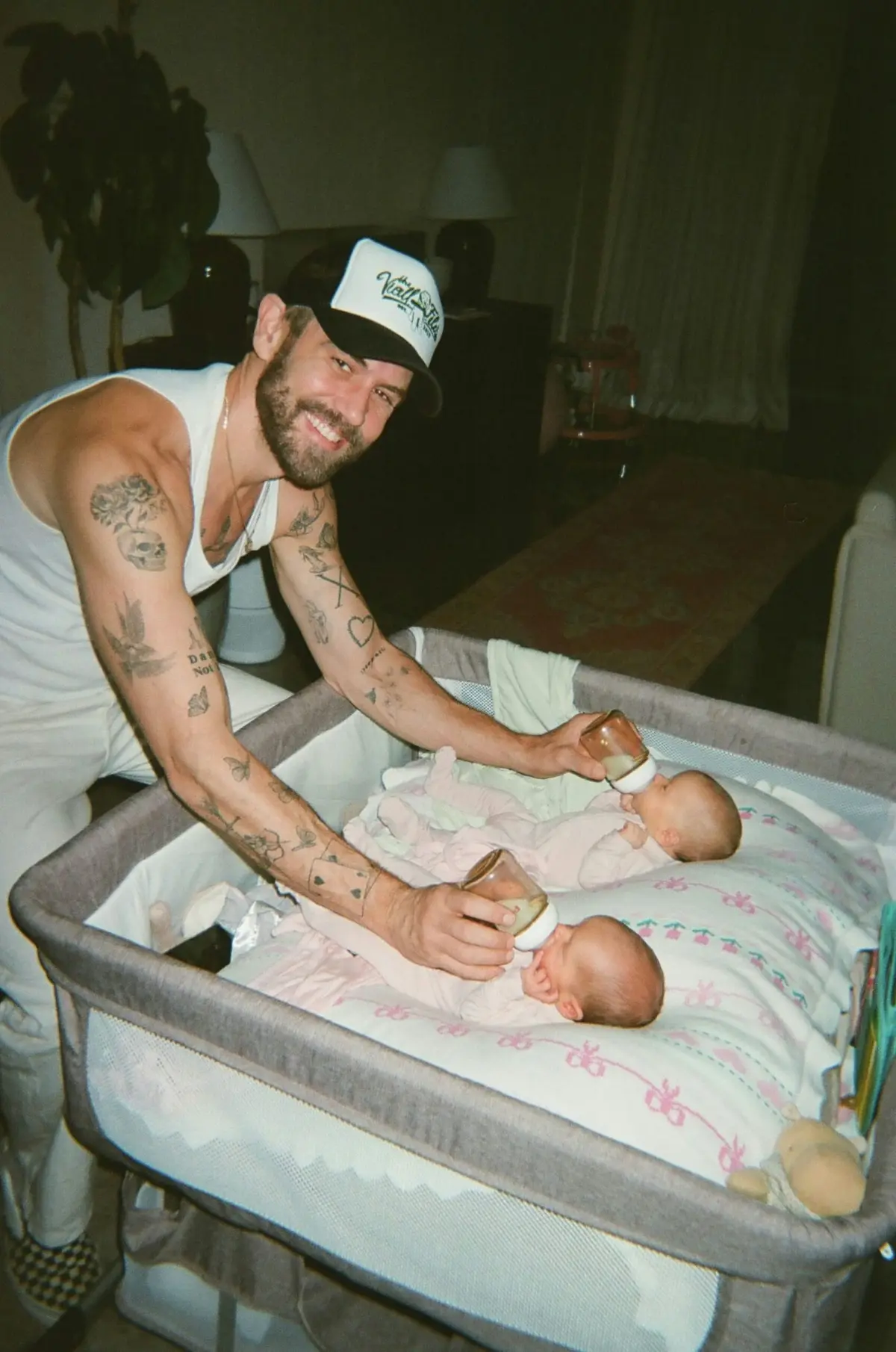
For more than a decade, Nick Viall has been a fixture on reality television screens across America. First capturing audiences’ attention 12 years ago on The Bachelorette, Viall built a robust franchise legacy with subsequent appearances on Bachelor in Paradise, Dancing with the Stars, and The Masked Singer. Today, he remains a prominent media personality, co-hosting the dating series Age of Attraction alongside his wife, Natalie Joy Viall, and doling out weekly relationship advice on The Viall Files, one of Apple’s most popular relationship podcasts.
Yet, behind the television cameras, studio microphones, and public spotlight, Viall is navigating a profoundly different kind of daily routine. Hailing originally from Wisconsin and coming from a large, blue-collar family as the second oldest of 11 siblings, Viall is now a father of three children under the age of three. Following the birth of their older daughter, River, the couple welcomed twin infants this past July.
Reflecting on his transition into life as a father of twins, Viall recently shared candid insights into the realities of modern parenting, the myths surrounding welcoming multiples, and how his upbringing continues to shape his deeply hands-on approach at home.
Navigating Twin Dad Life and Dispelling "Doomsday" Advice
When expecting twins, expectant parents are frequently greeted by well-meaning friends and acquaintances offering cautionary tales. Viall admits that he and Natalie received their fair share of intimidating warnings prior to the arrival of the twins.
"When you tell people you’re expecting… people are more prone to just kind of give what I call doomsday advice, where it’s like, ‘Oh, get ready for hell,’ or something like that," Viall explains.
However, once the infants arrived, those fears quickly dissipated, replaced by a sense of profound gratitude. Viall notes that while the newborn phase involves inevitable challenges, such as round-the-clock feedings and disrupted sleep, the daily reality has been far more manageable than anticipated. Describing the newborn stage, he compares the early weeks to caring for "little potatoes," noting that outside of the expected middle-of-the-night wake-up calls, the experience feels like a joyful blessing rather than a trial.
"And then it happens, and you’re so happy and everything feels like a blessing," Viall says. Comparing the arrival of twins to a retail promotion, he jokes that it feels like getting a "BOGO"—a buy-one-get-one-free deal—while quickly acknowledging the immense physical toll the pregnancy took on his wife. "Obviously, my wife during the pregnancy had a different experience. It’s a lot more on mothers to carry two than one." With three children now spanning just two pregnancies, Viall views the growing household with a mix of humor and excitement.
A Hands-On Approach Rooted in Childhood Teamwork
As a parent, Viall describes himself as deeply involved and hands-on, a philosophy he attributes directly to the dynamics of his own childhood. Growing up in a lower-middle-class household with 10 brothers and sisters, Viall watched his parents operate as a seamless team. While his mother stayed home to raise the children and his father worked a blue-collar job, the day-to-day running of the household was defined by shared responsibility rather than rigid gender roles.
Viall recalls that his father frequently cooked dinner, while his mother occasionally handled traditional outdoor chores like mowing the lawn. It was an all-hands-on-deck environment where cooperation was essential.
That collaborative spirit is something Viall and Natalie integrated into their relationship long before they became parents. Now, with a toddler and newborn twins, the couple practices a dynamic of divide and conquer, ensuring that parental and household duties are shared equally. Viall jokes about domestic preferences—describing himself as "allergic" to laundry while his wife prefers to avoid washing dishes—but emphasizes that there are no strictly designated "mom tasks" or "dad tasks" in their household.
Reclaiming Childhood Nostalgia and Fostering Outdoor Play
When looking toward the future, Viall often reflects on his own upbringing in Wisconsin and the aspects of childhood he hopes to pass down to his children. He considers himself remarkably fortunate to have been able to purchase his grandfather’s lake house a few years ago. The property served as a sanctuary during his youth, though it was sold after his grandfather passed away when Viall was in the fourth grade—an event he describes as a genuine childhood loss that lingered into adulthood through recurring dreams.
Being able to reclaim that space means providing his children with the same foundational connection to nature and freedom that defined his early years. Viall worries about how rapidly the world is changing, contrasting his own memories of riding bikes, visiting Blockbuster, and playing make-believe outdoors with the modern technological landscape facing today’s youth. Referencing contemporary discussions around the digital habits of younger generations, he hopes his children will embrace the outdoors, disconnect from screens, and experience the same unstructured play that characterized his youth.
Partnership, Humor, and Finding Purpose in Fatherhood
Behind the scenes, the dynamic between Viall and his wife relies heavily on mutual support, patience, and humor. Viall views his primary role postpartum as acting as a supportive cheerleader for Natalie, recognizing the intense physical and emotional pressures new mothers place upon themselves. Whenever he notices signs of stress, he steps in to encourage her to rest and take a break.
At the same time, Natalie maintains a good sense of humor regarding his flaws. Viall readily admits that he leaves a trail of disorder around the house, humorously noting that he struggles to close cupboards or put items away properly. He has also recently returned to playing video games as a form of personal decompression—a hobby that requires careful moderation to ensure it never interferes with his responsibilities as a partner and father.
Ultimately, Viall finds that fatherhood has provided a profound sense of clarity and purpose amidst a high-stress media career. While professional accolades and individual achievements can feel fleeting, caring for his children serves as a grounding force. Even during grueling 2:00 AM wake-up calls, the motivation behind the exhaustion is immediately clear.
Viall notes that coming home and stepping away from his work phone—a boundary strongly encouraged by Natalie to ensure undivided attention when greeting young River—provides an immediate anchor. For Viall, the daily realities of raising a young family have redefined his priorities, turning fatherhood into the most rewarding role of his life.