
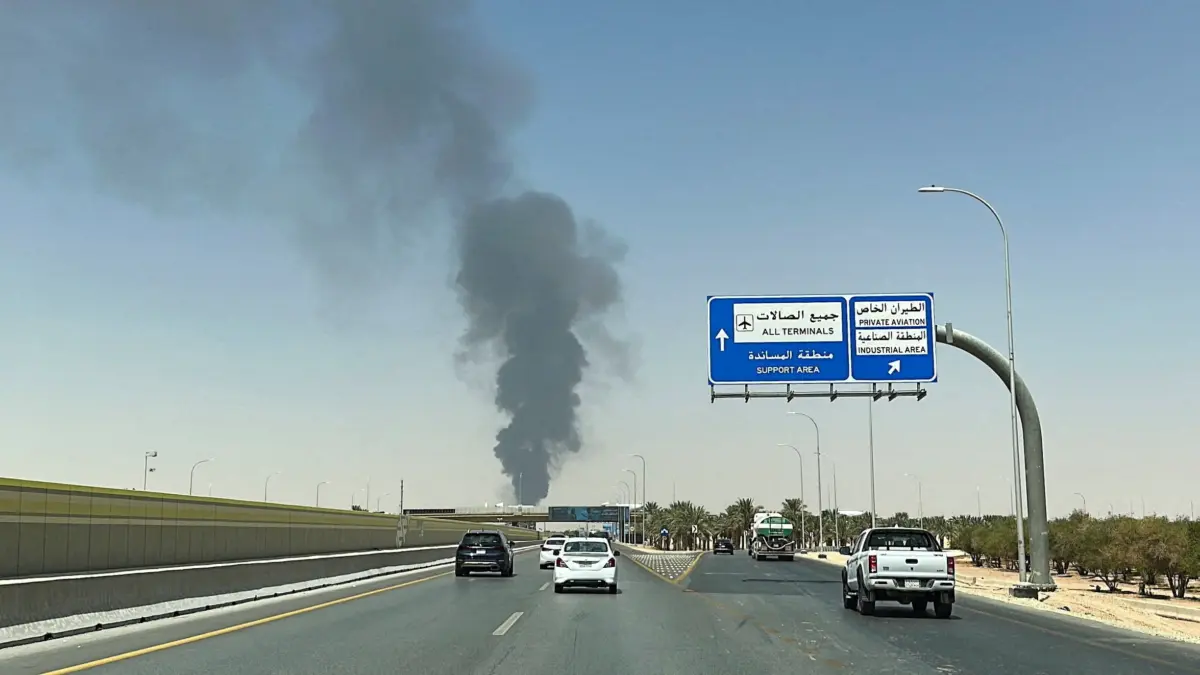
Saudi-led coalition air defense forces intercepted and destroyed an incoming ballistic missile launched by Yemen’s Houthi movement toward the Saudi capital of Riyadh at dawn on Saturday, marking a significant escalation in the ongoing regional conflict. The missile launch triggered emergency air raid alerts in the capital for the first time since a sharp surge in hostilities between the Saudi-backed coalition and the Iran-aligned group began in July, signaling a dramatic return to elevated threat levels across the Arabian Peninsula.
The overnight events leading into Saturday morning saw Saudi defense authorities issue warnings of an impending "hostile aerial threat," triggering a series of emergency notifications sent across the kingdom overnight on Friday. By Saturday morning, residents in Riyadh reported hearing at least one loud explosion reverberating over the capital. People living in neighborhoods near Riyadh’s international airport observed a large plume of dark smoke rising into the sky later in the morning. Despite the visible indications of an aerial engagement above the capital, Saudi authorities confirmed that defense systems successfully destroyed the incoming threat before it could strike its target, reporting no casualties or structural damage.
The ballistic missile directed at Riyadh was part of a larger, coordinated aerial attack aimed at several strategic and civilian locations across Saudi Arabia. Major-General Turki al-Maliki, official spokesman for the Saudi-led coalition fighting the Houthis in Yemen, released a statement on the social media platform X on Saturday detailing the thwarted offensive. According to al-Maliki, the Houthis launched simultaneous attacks targeting civilian infrastructure and populated areas in multiple distinct regions across the kingdom, including Bisha in the southwest, Taif near Mecca, the Farasan Islands in the Red Sea, and the western industrial port city of Yanbu.
Major-General al-Maliki stated that Saudi air defenses engaged and neutralized the incoming aerial threats across all targeted locations, preventing damage to civilian facilities. In his official statement, the coalition spokesman strongly condemned the group’s actions, characterizing them as a deliberate effort to escalate attacks against non-combatants and critical urban infrastructure. Al-Maliki explicitly affirmed the coalition command’s right to take appropriate action to deter Houthi operations and safeguard civilian lives, emphasizing that any retaliatory measures would be carried out in strict accordance with international humanitarian law.
From the Houthi side, military spokesmen presented the wide-ranging aerial operation as a deliberate, multi-pronged strike against sensitive Saudi targets. Houthi military spokesman Yahya Saree issued a statement on Saturday declaring that the group had executed a coordinated military operation utilizing cruise missiles, ballistic missiles, and an array of unmanned aerial vehicles. Saree stated that Houthi forces had successfully targeted "sensitive" sites within the Saudi capital of Riyadh, as well as a facility belonging to the state oil company Saudi Aramco located in the western coastal city of Yanbu.
The broad geographic spread and technical variety of the aerial attack reflect a heightened level of operational ambition from the Houthi movement. Analyzing the strategic implications of the latest barrage, Yasmeen al-Eryani, executive director for knowledge production at the Sana’a Center think tank, noted that the Houthis appear to be dictating the timing and intensity of the broader conflict. In an interview with Al Jazeera, al-Eryani observed that the movement has demonstrated a persistent ability to calibrate its military actions according to its own strategic schedule.
"You could see that the Houthis are determining the timelines and the levels of the escalation," al-Eryani explained, offering an assessment of the geopolitical balance between the warring parties. "So, depending on the current situation, it seems that the Houthis are the ones in control," she added, pointing to the group’s ability to initiate high-profile long-range strikes against key Saudi infrastructure while simultaneously maintaining pressure on multiple ground fronts inside Yemen.
While air defense systems were engaged in Saudi airspace, heavy ground fighting continued to intensify across several crucial frontlines inside Yemen, highlighting the multi-dimensional nature of the recent surge in combat. Armed forces belonging to Yemen’s Saudi-backed, internationally recognized government reported major military engagements in central and southwestern governorates on Saturday as Houthi forces attempted to press forward on key terrain.
In the central province of Marib, government military officials reported that their forces successfully repelled a tactical infiltration attempt by Houthi combatants in the al-Fuliahan sector, located in the southern part of the governorate. According to official military communications, government units engaged the advancing Houthi fighters in intense localized combat on Saturday, frustrating their attempt to breach defensive lines. The engagement resulted in significant losses for the infiltrating force, with government officials confirming that at least 12 Houthi fighters were killed and several others injured before the remaining operational units were forced to retreat.
However, government forces also suffered notable casualties during severe engagements on opposing frontlines over the same two-day period. Military sources confirmed that at least 13 Yemeni government soldiers were killed during intense combat with Houthi forces in the southwestern provinces of Taiz and Lahj. The lethal engagements in Taiz and Lahj point to a broader pattern of active frontline pressure along critical transport corridors connecting Yemen’s southwestern highlands to the southern coast.
The frontline clashes reported in Marib, Taiz, and Lahj are part of a wider resurgence of fighting that has spread across several key provinces. Military reports indicate that active combat, artillery exchanges, and tactical skirmishes have erupted across Marib, Taiz, Lahj, al-Jawf, and al-Bayda. This multi-province military escalation, which began in early July, represents the most intense surge in active hostilities since the relative period of calm that followed the United Nations-brokered truce in April 2022.
The sharp decline in stability following months of relative calm has focused renewed attention on the military challenges inherent to the Yemeni battlefield. Discussing the prospects for military operations against the Houthis, al-Eryani emphasized that conventional tactical options available to anti-Houthi forces remain severely constrained by the physical geography of the conflict zones. Much of the active combat takes place in highly complex, mountainous terrain that presents formidable barrier conditions for attacking forces.
According to al-Eryani, the steep topography of Yemen’s highland regions affords defensive forces a natural advantage, making high-altitude positions exceptionally difficult for opposing military units to access, clear, and permanently hold. This physical environment complicates traditional ground offensives and limits the ability of coalition-backed forces to achieve decisive territorial breakthroughs in northern and central governorates.
Al-Eryani highlighted the direct strategic link between controlling highland mountain positions and securing maritime and coastal areas. Highlighting the tactical geography of western Yemen, she explained that ground control along the strategic coastline cannot be maintained without first establishing control over the adjacent elevated terrain. "Without controlling the peaks that are parallel to the coast, you will not be able to control the coast," al-Eryani noted, illustrating why frontline positions have frequently stalled in rugged geographical zones.
In light of these geographical and tactical realities, al-Eryani suggested that military strategies seeking a total victory over the Houthi movement face severe practical hurdles. Instead, she suggested that strategies aimed at containing the group’s offensive operations and restricting its operational reach may represent a more realistic objective for opposing forces in the immediate term. Containing the group’s strike capacities while maintaining defensive lines on key frontlines may prove to be the primary focus as long as highland strongholds remain difficult to secure.
The simultaneous resurgence of long-range missile strikes targeting major urban centers in Saudi Arabia and high-intensity infantry fighting across central and southwestern Yemen underscores the fragile security environment in the region. With air defense networks in Saudi Arabia actively responding to aerial threats and ground forces engaged along multiple frontlines in Yemen, the conflict has entered its most active phase of military engagement in years, bringing an end to the extended period of operational calm that had prevailed across the region.