
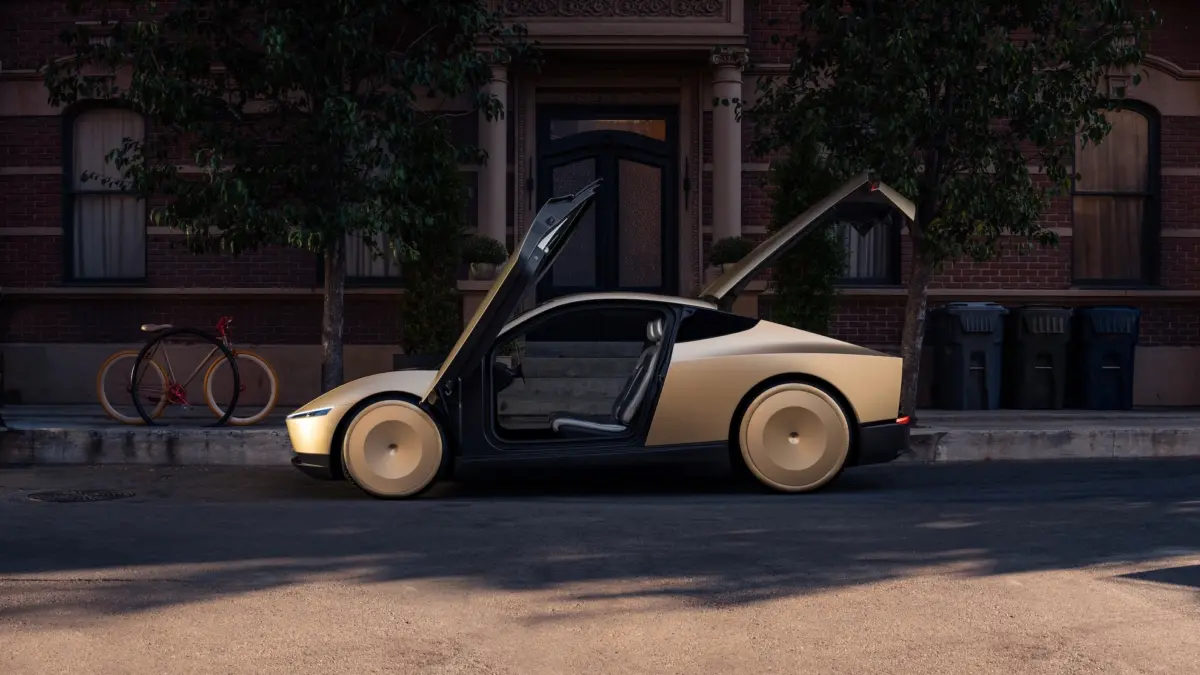
Tesla has announced plans to begin selling its autonomous Cybercab to third-party customers by the end of the year, pushing forward with its ride-hailing ambitions even as federal safety regulators investigate whether the unorthodox vehicle complies with established motor vehicle standards. The striking, gold-hued two-seater vehicle is distinct for its complete absence of a steering wheel, brake pedals, and other traditional manual driving controls.
During the company’s third-quarter earnings call, Lars Moravy, Tesla’s vice president of engineering, outlined the company’s phased manufacturing and delivery strategy. He explained that the Cybercabs currently rolling off production lines are all designated for Tesla’s own nascent robotaxi fleet. As that proprietary fleet expands and matures, however, the company intends to begin supplying fully designed autonomous vehicles directly to external customers, though it plans to start on a small scale. Tesla intends to scale up its delivery operations gradually as it gains operational experience regarding the delivery, ownership structure, and fleet management of fully autonomous vehicles.
The notion of commercializing the autonomous vehicle by selling it to third parties was first floated by Tesla leadership last month around the time of the company’s high-profile Cybercab launch event in Austin, Texas. At that time, the electric vehicle maker even posted an online expression-of-interest form for individuals and entities looking to purchase and operate their own robotaxi fleets. However, industry watchers remained uncertain whether Tesla would ultimately follow through on the concept, or what logistical framework would govern such sales.
For years, Tesla CEO Elon Musk has spoken extensively about his vision for deploying a massive, cost-efficient fleet of robotaxis. Until recently, however, those long-term plans centered primarily on converting millions of privately owned consumer Teslas into autonomous taxis through a remote software update. That ambitious consumer-focused plan has yet to materialize in full, and Musk’s recent commentary during the earnings call highlights a significant shift in his strategic outlook.
At present, Tesla vehicle owners can subscribe to Full Self-Driving (Supervised), an advanced driver-assistance system designed to automate many complex driving maneuvers. Despite its marketing moniker, the system still demands that the human driver remain fully attentive and prepared to take immediate control of the vehicle at any moment. While Tesla continues to deploy frequent over-the-air software updates intended to enhance the system’s operational capabilities, a human operator must remain engaged—a requirement frequently tested by drivers pushing the system’s boundaries in viral social media videos.
During the recent earnings call, Musk stated that an unsupervised iteration of the FSD software—representing true fully autonomous capability—would finally be rolled out to customers sometime in the second quarter of next year. This marks yet another schedule delay for Tesla owners, many of whom purchased or subscribed to the expensive software package years ago under earlier promises of imminent autonomy.
If both corporate timelines hold true, it would create a notable irony: third-party fleet buyers would be able to purchase the dedicated autonomous Cybercab and potentially operate it as a commercial robotaxi service before individual Tesla owners gain access to the exact same autonomous driving capabilities in their own personal passenger cars.
Musk also clarified that the Cybercab is intentionally designed strictly as a dedicated ride-hailing transport vehicle, rather than a traditional passenger car meant for individual private ownership. He emphasized that the Cybercab is primarily envisioned as a transportation-as-a-service product, contrasting it with traditional models like the Model 3, Model Y, and the upcoming Roadster, which are built for direct consumer ownership. Musk noted that the vast majority of Cybercab operations will essentially be Tesla-owned and operated as a service, even as select third-party fleets enter the market.
Despite these grand rollout plans, a major regulatory hurdle threatens to disrupt Tesla’s timeline for the Cybercab fleet. The National Highway Traffic Safety Administration, the primary federal automotive safety regulator in the United States, announced last month that it had officially opened an investigation into the Cybercab. The regulatory move came just hours after the autonomous vehicles first began operating on public roads in Austin.
Federal Motor Vehicle Safety Standards traditionally mandate the inclusion of physical manual controls, including brake pedals, alongside other baseline equipment such as rearview and exterior side mirrors. Historically, automotive manufacturers have relied on a process of self-certification to verify whether their vehicles comply with these federal safety rules, a path that Tesla followed with the Cybercab.
Current federal regulations do not easily accommodate vehicles constructed entirely without manual driver controls. Nevertheless, the broader regulatory environment has shown signs of shifting; the Department of Transportation previously proposed removing traditional brake pedal requirements for vehicles engineered specifically for autonomous operation, a move widely viewed as a regulatory boost for autonomous vehicle developers like Tesla. In the interim, however, NHTSA officials stated that the ongoing investigation will thoroughly examine the engineering processes and technical data upon which Tesla relied when self-certifying the Cybercab, alongside related compliance issues.
The ultimate legal and operational outcome of that federal investigation could profoundly influence whether Tesla—or any prospective third-party fleet operator—will be legally permitted to deploy and operate the steering-wheel-free Cybercab on public roadways across the United States.