
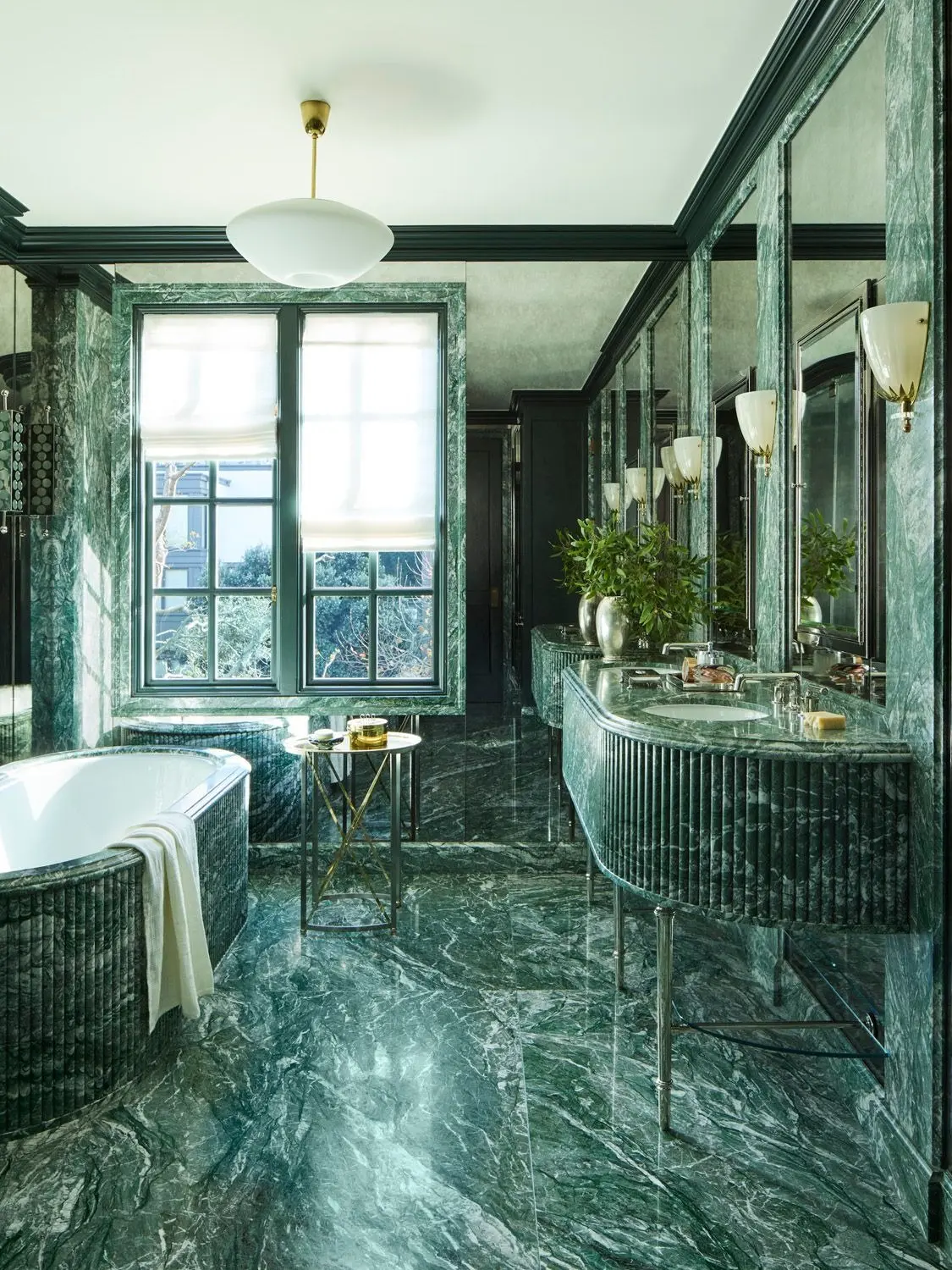
For years, the gold standard of luxury residential design has been defined by the ubiquitous gray-and-white "spa bathroom." These utilitarian sanctuaries—characterized by a minimalist aesthetic, blindingly white surfaces, an abundance of natural light, and acres of pristine Calacatta Viola marble—have long dominated architectural digests and high-end home renovations. Today, however, that clinical dominance is beginning to wane, making way for a much more dramatic, theatrical, and historically rich approach to domestic architecture.

The new movement in high-end bathroom design rejects minimalism in favor of heavily saturated color palettes, dramatically veined natural stone, sculptural Art Deco-style fixtures, and rich woodwork. These spaces evoke the sophisticated, cinematic interiors championed by modern style icons, including interior designer Athena Calderone and supermodel Paloma Elsesser, both of whom have recently showcased breathtaking variations of the look. Rather than treating the bathroom as a sterile space purely for cleansing, contemporary designers are looking backward to a very specific historical reference point: 1930s Milan, an era when bold material combinations and precise geometry turned utilitarian rooms into unforgettable architectural showpieces.
At the heart of this historical revival is the enduring influence of Piero Portaluppi, the legendary 20th-century Rationalist architect whose visionary works include Milan’s iconic Villa Necchi Campiglio and Casa Corbellini-Wassermann. While Portaluppi’s dramatic entry halls, sweeping staircases, and pristine exterior facades have inspired generations of architects and designers for decades, it is specifically his beautifully crafted rooms with plumbing that are currently experiencing a massive renaissance among contemporary tastemakers.

Portaluppi’s mastery of the medium is perhaps best observed at Villa Necchi Campiglio, constructed between 1932 and 1935, where mirrored walls expertly multiply the swirling, organic patterns of Arabescato Orobico marble. Just a short distance away at Casa Corbellini-Wassermann, the architect famously set vibrant green Verde Challant marble against stark, graphic black stonework, creating an environment that feels both disciplined and deeply theatrical.
This juxtaposition of heavy, contrasting materials is what draws modern designers to Portaluppi’s historical blueprints. As Athena Calderone explains, Portaluppi frequently deployed contrasting materials to expertly frame hallways, architectural thresholds, and various spatial elements, allowing these striking visual moments to naturally draw the eye and inject a profound sense of ceremony into otherwise ordinary daily routines. Calderone herself visited the historic Villa Necchi alongside architect Danielle Siggerud while she was in the midst of reimagining her own Tribeca apartment, drawing direct inspiration from the Italian master’s fearless approach to space and material composition.

Similarly, AD100 designer Gregory Rockwell notes that he is endlessly captivated by Portaluppi’s unconventional and daring color palettes. What Rockwell finds most compelling about the architect’s work is the absolute control he maintained over the overarching structural framework, which he would then contrast with sudden, extravagant bursts of marble or unexpected, saturated color choices.
This philosophy was put into practice when Rockwell and his colleague, Hester Hodde, designed the primary bathroom for Paloma Elsesser’s Brooklyn townhouse. The team layered deep burgundy Rosso Francia marble, rich walnut-and-mirror paneling, and contrasting pistachio-green walls to create a space that feels simultaneously historical and avant-garde. While acknowledging that it is a slightly unconventional combination on paper, Rockwell notes that the resulting color harmony possesses an undeniable allure.

For Calderone, the true magic of the 1930s Milan aesthetic lies intimately within the stonework and the meticulous craftsmanship required to assemble it. She notes that there was an incredible degree of ingenuity in the way Portaluppi and his contemporaries clad entire bathrooms in natural stone, frequently utilizing smaller, individually composed pieces rather than massive, uninterrupted expanses.
In her own primary bathroom, Calderone paid homage to this technique by edging sweeping expanses of pale stone with intricate, inlaid tile borders, complemented by Art Deco-inflected fixtures and geometric mirrors. Reflecting on these historic precedents, she observes that this meticulous approach feels almost entirely at odds with how modern designers approach natural stone today, where expansive, perfectly bookmatched slabs have become the prevailing luxury ideal. By contrast, Portaluppi enthusiastically embraced the natural irregularity, imperfections, and striking variations in the veining of the stone.

This profound appreciation for the distinct individuality of natural stone is also prominently on display in Calderone’s own powder room, which features a custom pedestal sink crafted from deeply veined Verde Alpi marble. The space is further elevated by vintage lighting and decorative elements, including sconces designed by Émile-Jacques Ruhlmann and a 1940s Italian mirror.
Another striking sink fashioned from the same deep-green stone can be found in the jewel-box powder room of a Milan pied-à-terre recently designed by Giampiero Tagliaferri for a young art collector. According to Tagliaferri, the custom pedestal sink takes its bold, geometric form directly from Rationalist architectural principles, though the team deliberately kept the surrounding lines clean and the overall layout thoroughly modern to suit contemporary living. Tagliaferri emphasizes that revisiting the design language of 1930s Milan is never about blindly or literally replicating a historical Portaluppi bathroom. Instead, true reinterpretation is about carefully extracting a specific period’s core architectural DNA and translating it for a modern audience.

This sophisticated design thinking is rapidly extending far beyond bespoke, high-end residential interiors. A new wave of commercial bath collections and tile lines are directly borrowing from the Portaluppi bathroom vocabulary, offering homeowners and designers accessible ways to incorporate patterned stone, geometric silhouettes, and saturated color palettes into their spaces without necessarily undertaking a total, structural home renovation.
For instance, Artistic Tile’s Calacatta Gold marble mosaic successfully brings the intricate, detailed beauty of inlaid stone borders to walls and floors alike. Meanwhile, Kelly Wearstler’s oxblood-hued Treillage tile collection for Ann Sacks introduces a rich, dimensional spin to the deep burgundy tones seen in Elsesser’s Brooklyn bathroom. For Clé Tile, Reath Design has developed marbleized patterns that successfully evoke the natural, organic movement of quarried stone on a more accessible scale.

The stylistic influence even extends down to the smallest decorative details and hardware choices. Lighting brands like Charles Edwards are offering alabaster dish lights featuring distinct Art Deco-inspired silhouettes, while mainstream home retailers like Crate & Barrel are introducing Verde Green marble soap pumps and tissue holders that bring the distinctive color palette and dramatic veining of those custom Verde Alpi sinks right down to the everyday countertop scale.
Whether a project involves wrapping an entire primary suite in heavily veined, historic-feeling marble or simply introducing a single, well-chosen architectural detail to a powder room, the underlying impulse among designers remains remarkably consistent. For these professionals, the era of the stark, uninspired white bathroom is fading because domestic spaces should reflect personality, warmth, and visual excitement rather than clinical neutrality. As Rockwell simply puts it, he has never truly understood why bathrooms should be any less interesting than the rest of the house, noting that they might as well be designed to be beautiful and exciting.