
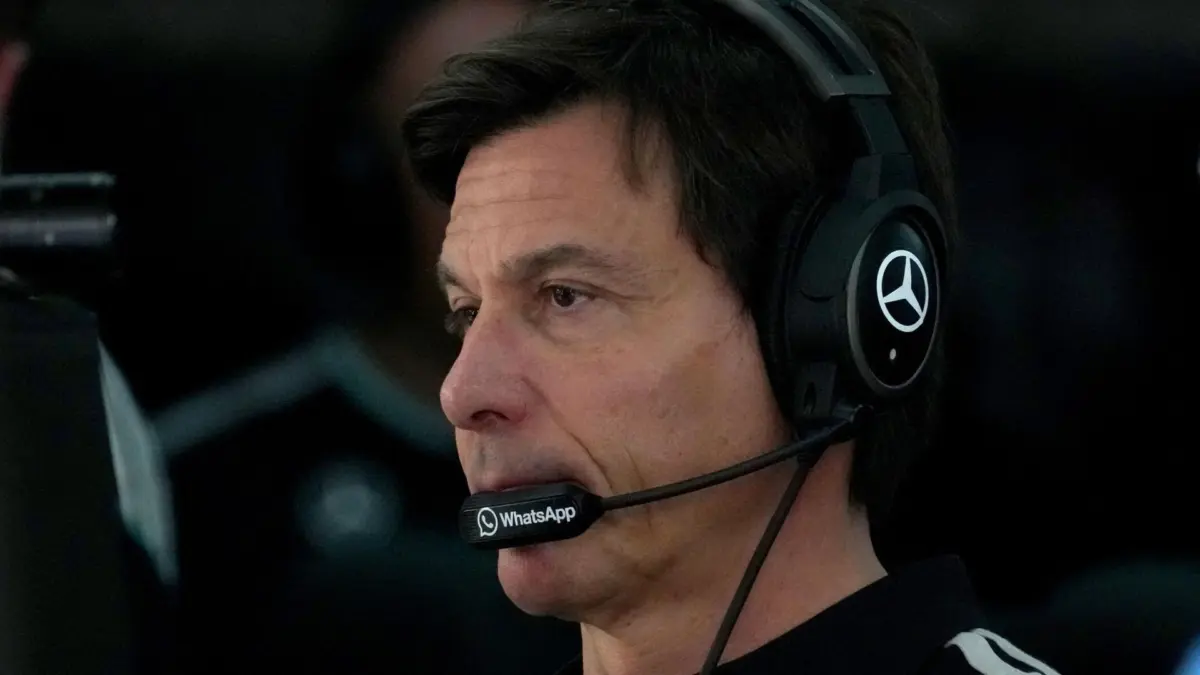
Mercedes team principal Toto Wolff has admitted his genuine surprise and growing bewilderment after the team’s much-anticipated major upgrade package appeared to actively hinder their performance during an underwhelming qualifying session at the Sepang International Circuit.
The Formula 1 paddock arrived in Malaysia for a uniquely scheduled race weekend—hosting the Bahrain Grand Prix due to ongoing security and geopolitical conflicts in the Middle East—with high expectations surrounding the Silver Arrows. Despite enjoying a dominant campaign thus far in the 2026 season, Mercedes had deliberately chosen a measured approach to development, bringing far fewer upgrades to the circuit than their immediate rivals at the front of the grid. This patient strategy meant that immense anticipation had naturally built around the introduction of their first major aerodynamic and mechanical package since May.
Furthermore, the reigning powerhouse squad arrived at the historic Sepang venue riding high on the momentum of three successive race victories. Most industry observers and fans fully expected that formidable winning streak to continue seamlessly with the technological injection of the new parts. Instead, reality proved starkly different under the scorching Malaysian sun.
When the dust settled on a dramatic qualifying hour, Drivers’ Championship leader Kimi Antonelli could only manage a subdued fourth place, while his experienced team-mate George Russell struggled even more, qualifying down in eighth. The session was ultimately commanded by Red Bull’s Max Verstappen, who extracted supreme pace out of his machinery to claim a dominant pole position. Fortunately for the Silver Arrows, both of their drivers will move up one place on the starting grid for Sunday’s main event, a consequence of third-placed Isack Hadjar being forced to serve a grid penalty handed down from a previous infraction.
Speaking to Sky Sports F1 in the media pen following the session, Wolff did not attempt to hide his frustration or confusion regarding the unexpected shift in competitiveness. "Very difficult to understand," Wolff remarked when evaluating the sudden drop-off in lap time. "We have been a little bit caught out on Friday with some car behaviour that we didn’t see all year, but then you can say it’s very hot and the tarmac is different to all the other tracks."
The weekend had not started as a complete disaster. In fact, early indicators during Saturday morning’s final practice session had briefly restored the team’s optimism. "It looked really good this morning in final practice," Wolff continued. "We seemed to have, at least with Kimi, made a step in understanding. And then, qualifying was a little bit back to what we saw before, just no performance."
Delving deeper into the technical ailments plaguing the W-series challenger, the Mercedes boss pointed out specific aerodynamic and handling deficiencies that had uncharacteristically hampered the car throughout the knockout sessions. "It looks like we are very draggy, because it’s the first time that we are losing a lot of time on the straights, especially to Max," Wolff explained. "And then through the low-speed, we are not able to turn the car. There’s just too much understeer. So, overall, things we haven’t seen this year."
Verstappen’s path to his maiden pole position of the 2026 season was secured by an emphatic and demoralizing margin over the chasing pack. Antonelli finished the session half a second adrift of the flying Dutchman, while Russell languished a further couple of tenths behind his younger team-mate.
While the extreme ambient temperatures, high humidity, and abrasive, aging track surface at Sepang create uniquely challenging operational parameters for any Formula 1 chassis, Wolff confessed that the sheer scale of the time deficit on the timing screens was deeply alarming. "Something else is going on, and we have to understand," he added. "This is now working through the data and putting our heads together, because we still believe that the upgrade works. We just need to understand why not here."
Reflecting on the unpredictable nature of the venue, the Austrian executive acknowledged the distinct characteristics of the Malaysian circuit, yet maintained that the performance drop exceeded acceptable margins. "It’s so different here, but nevertheless, you’re expecting three tenths to kick in, and it looks like three-four-five tenths backwards. It’s odd, but I guess we will find a solution."
‘Affecting us more than others’
For George Russell, the Saturday afternoon struggles represented an abrupt and painful reality check. The British driver had arrived in Malaysia brimming with confidence after producing what was widely regarded as the most complete and commanding weekend of his season to claim a brilliant victory last time out in Azerbaijan. Yet, despite his best efforts in the cockpit, he has found himself completely unable to reproduce that race-winning form on Malaysian asphalt.
Russell’s deficit to Antonelli on the final timesheets was made even more disappointing by the strategic reality of the session. The Briton actually enjoyed the luxury of having two timed runs in Q3 compared to his team-mate’s single set of fresh tyres. Antonelli had been forced to burn through an extra set of new rubber during Q2 after a costly track limits infringement placed him under immediate pressure.
Reflecting on his difficult afternoon, Russell told Sky Sports F1: "From the first practice we seemed to be ok, but we’ve just not really made any improvements since. It’s a very demanding circuit on the tyres, the tarmac is all broke up, it’s extremely rough, it’s so hot out there and the tyres are going through hell. And, for whatever reason, it seems to be affecting us far more than others."
On the other side of the garage, Antonelli was left to rue the minor mistake in the second phase of qualifying that compromised his run plan, though he remained philosophical about the ultimate pace potential of the car. The Italian teenager calculated that the driving error had likely cost him no more than a single position on the grid, given that Verstappen’s blistering pole lap was ultimately out of reach, while Ferrari’s Lewis Hamilton had delivered an exceptional lap to snatch second place.
"It’s a shame for the mistake, but all in all, I think with a clean qualifying without the track limit, maybe P2, P3 on the road would have been possible, because obviously with only one set in Q3 it’s never easy, especially with the track cooling down," Antonelli told Sky Sports F1. "Pero Max did an incredible job and was very quick. And also Ferrari, they made a huge step compared to FP3. All in all, we have to be happy because it could have been much worse. We’ll focus on tomorrow."
Formula 1’s historic return to Malaysia—marking the championship’s first Grand Prix at Sepang since 2017—continues on Sunday morning. Comprehensive live coverage of the Bahrain Grand Prix begins with Grand Prix Sunday build-up at 6:30am, followed by the lights-out race start at 8am, broadcast live on Sky Sports F1 and Sky Sports Main Event.