
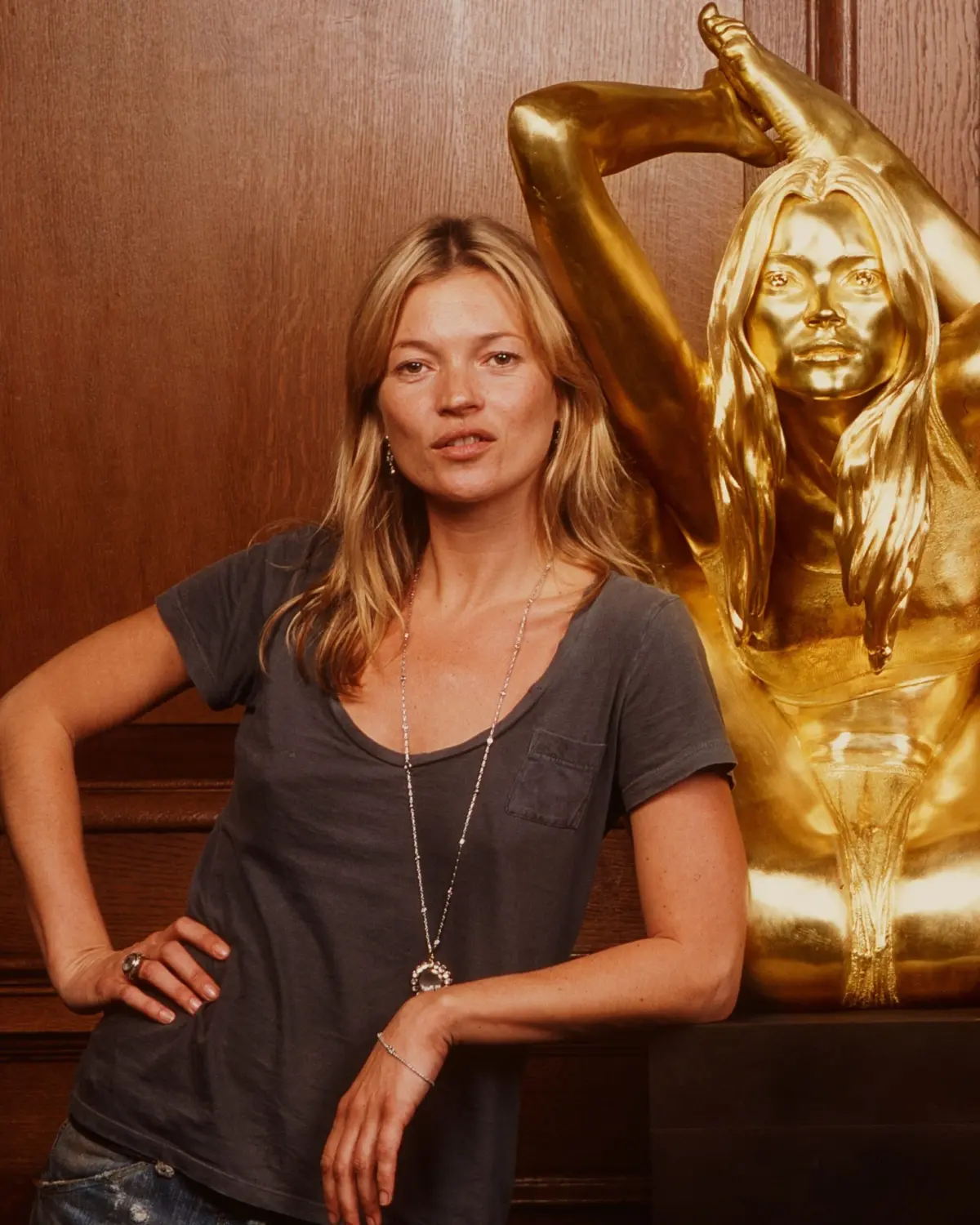
We all remember a time when Kate Moss didn’t speak. Or rather, she presumably spoke—ordered coffee, called her mates, complained about flight attendants—but to the public, Kate Moss was entirely silent. Kate was a billboard, a magazine cover, a paparazzi flash. She was wordlessly everywhere, omnipresent, never complaining, never explaining.

It is difficult now to remember quite how powerful that silence was. Fame today comes with an obligation to narrate itself. Celebrities post their breakfasts, their skincare, their holidays, and their Notes-app apologies. They issue statements before anyone’s bothered to ask the question. We know what people are thinking because they tell us, often several times before lunch. In the mid-2000s, Kate Moss was the last of a generation of celebrities who could be simultaneously ubiquitous and unknowable. The less Kate said, the more there was to say about her. Her image floated above the fray, untethered from the mundane clarifications and overshares that define modern celebrity culture.
Human beings have always had an extraordinary talent for turning images into objects of belief. We carved deities from stone, cast them in bronze, and gilded saints that shimmered in candlelight. We have painted monarchs larger than life and projected movie stars 30 feet high. Every civilization invents an image that carries its aspirations, shifting its methods and materials while the core human instinct remains completely unchanged.

Before artist Marc Quinn began making Siren, the monumental solid-gold sculpture of Moss, he had spent years sculpting bodies historically excluded from the classical tradition. That body of work culminated in Alison Lapper Pregnant (2005), a subversive and powerful break from the traditional "statues of dead blokes who conquered the world," publicly showcasing a disabled woman on the fourth plinth in Trafalgar Square. Having closely considered bodies that society did not traditionally idealize or elevate to the status of high art, Quinn then pivoted to ask himself the exact opposite question: If society could agree on one perfect body, whose would it be?
The answer, in 2006, was embarrassingly obvious: Kate Moss. Looking back from the vantage point of today’s fractured media landscape, it feels almost quaint, the idea that an entire culture could more or less agree on one woman as the embodiment of an era’s aesthetic ideal.

The pose of the sculpture itself refuses to settle comfortably into traditional portraiture. It isn’t the Kate Moss recognized immediately from a grungier Calvin Klein campaign or a hastily snapped tabloid photograph. It hovers somewhere between yoga—a practice of people trying to connect their insides and outsides—pure devotion, and impossible, gravity-defying elegance. It isn’t even trying to capture Kate Moss’s actual physical presence in a literal sense. By the time Quinn sculpted Kate, the image had already detached itself from the human being entirely.
That is perhaps the strangest and most enduring thing about images: we imagine they are fixed and permanent, when really they are deeply collaborative. It is the audience, the public gaze, that gives meaning to an image. Every generation remakes its icons by projecting something entirely new onto them, which is precisely why Siren feels more contemporary, resonant, and urgent now than it did when it was first unveiled in 2008.

Quinn’s fundamental distinction between person and image, once an occupational hazard of extraordinary, rarefied fame, has quietly become an ordinary feature of ordinary life for millions of people. We all have an image now; the difference is merely one of scale. We curate ourselves. We edit ourselves. We perform ourselves across digital platforms. We produce tiny public versions of ourselves that wander around the internet, collecting other people’s projections, algorithms, and commentary. Rather than ending image worship, the internet effectively franchised it, distributing the burden of representation to the masses. This makes Siren feel unexpectedly prophetic in retrospect. It captures the very last moment when a culture could concentrate its collective imagination on one single woman before that collective imagination fractured into billions of smaller, competing mirrors.
Gold was the only material Siren could ever truly have been made from. Gold is precious because humanity collectively agrees that it is. Gods are gods because we agree they are. Images become icons because we agree to see far more than just a person standing in front of us. For a brief, shining moment in time, Kate Moss was one of those rare images. By then, she scarcely needed to speak a word. Siren stands as a testament to what collective belief looks like when it hardens permanently into gold.

Text adapted from KATE BY MARC, published by Idea Books.