
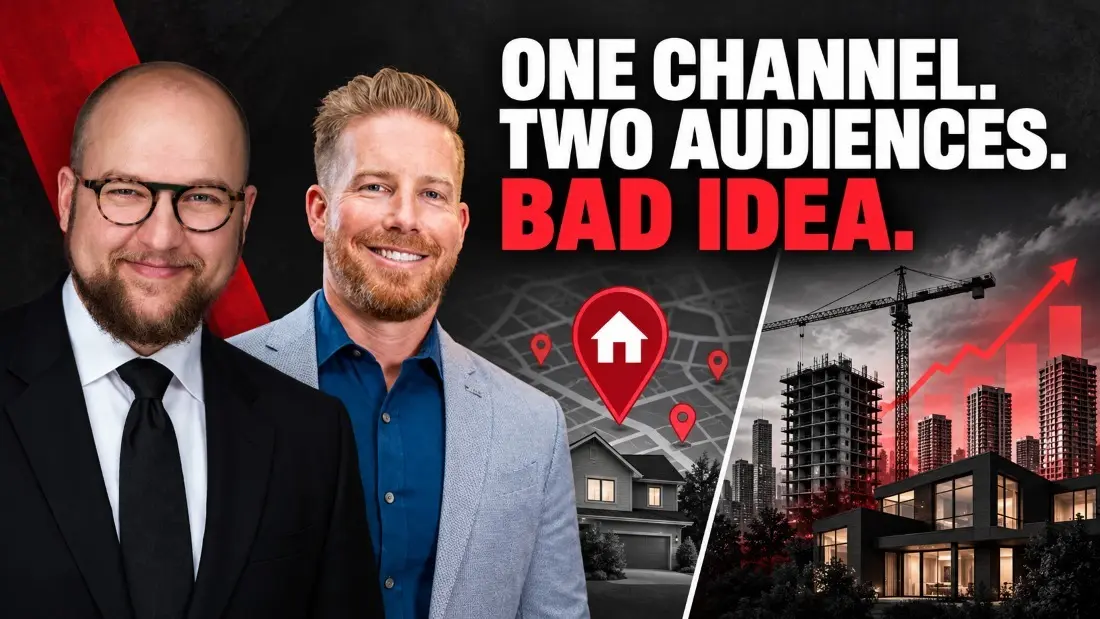
Many real estate professionals treat their business YouTube channels much like a digital filing cabinet or an online resume. A typical browse through a standard agent’s page reveals a disjointed archive: a home buyer’s guide uploaded on Monday, a regional market update on Tuesday, a seller tip on Wednesday, a recruiting pitch for prospective agents on Thursday, followed by a local listing tour and an interview with a mortgage broker over the weekend. While every single one of these videos might offer genuine value on its own, their collective impact often creates a hidden strategic problem. Ultimately, the channel ends up making no clear promise to any single viewer.
This central challenge in modern digital real estate marketing was recently unpacked on the industry program The Leads Are Sht*. During the episode, experienced real estate agent and prominent YouTube strategist Levi Lascsak joined host Taylor Hack to break down the pitfalls of traditional agent video marketing. Lascsak’s core argument was direct and uncompromising: buyer content, seller content, and agent-recruiting content are fundamentally different products tailored for entirely different audiences. When all three categories of media live under a single roof, viewers quickly realize that a significant portion of what the channel publishes is simply not meant for them.
When viewers encounter content that does not address their immediate needs, they learn to skip. And when a channel consistently trains its audience to skip videos, it rapidly loses algorithmic momentum, viewer trust, and overall growth potential.
A Channel is a Promise, Not a Résumé
To understand where many agents go wrong, Lascsak draws a sharp distinction between what he defines as selfish-based marketing and service-based marketing. Self-focused marketing invariably revolves around the agent: it highlights industry awards, historical transaction totals, professional designations, and bold assertions of local expertise. Conversely, service-based marketing begins entirely with the viewer. It asks what the consumer is currently trying to understand, what risks they are trying to avoid, and what major financial decisions they are trying to navigate.
Of course, professional credentials still matter in the real estate sector. They can effectively reduce perceived risk and support a consumer’s final decision-making process. However, designations and awards are rarely the catalyst that inspires a consumer to start searching for answers online in the first place. A relocating buyer, for instance, is typically far more concerned with understanding how two neighboring suburbs differ in terms of lifestyle, commute times, and school districts. A longtime homeowner may be privately worried that a newly announced commercial development will negatively alter the future value or marketability of their property. Meanwhile, an agent considering joining a brokerage team is primarily looking for a proven business system and operational leverage.
These represent three entirely distinct problems. The most useful piece of video content meets one of those specific concerns directly, without diluting the message with unrelated distractions.
Lascsak noted that when prospective clients ultimately contacted his team, they rarely began the conversation by asking about past production volume or corporate accolades. Instead, they already felt a strong sense of familiarity because the team’s video library clearly demonstrated a deep, nuanced understanding of the exact neighborhoods the prospects were researching. The content successfully established relevance and authority long before any formal sales conversation ever took place. That is the ultimate practical value of maintaining a clear channel promise: viewers know precisely what value they will receive, and the right prospects are encouraged to keep watching until they feel fully prepared to take action.
Why Mixed Audiences Weaken a Channel’s Reach
Consider the typical journey of a prospective consumer on a cluttered real estate channel. Imagine a home buyer subscribes after watching a detailed, hyper-local tour of a major metropolitan suburb. The very next upload on that same channel happens to be a tactical tutorial on how homeowners can effectively stage their property for a fast sale. The video after that shifts gears entirely, targeting real estate agents interested in joining a team. Because neither of the subsequent videos is relevant to the original viewer’s intent, the buyer simply skips them.
Now, consider that exact same viewing pattern from the perspective of a potential seller. That homeowner may care deeply about local infrastructure projects, upcoming zoning changes, new highway developments, or competing subdivision growth. They are likely to have very little interest in an out-of-market relocation tour designed exclusively for incoming buyers.
The underlying issue is never that one specific topic is inherently better than another. Rather, the fundamental challenge is that each distinct topic demands attention from an entirely different demographic with completely separate priorities.
Recognizing this friction, Lascsak eventually separated his seller-focused content entirely from his established buyer channel. His dedicated seller channel concentrated tightly on localized developments, infrastructure shifts, community updates, and other macro-level changes that could directly impact a homeowner’s financial decisions or long-term property value.
At first, launching a brand-new channel yielded very little visible traction. For approximately six months, the new initiative failed to deliver the immediate response rates Lascsak anticipated. Yet, he persevered through the quiet initial phase, and the channel eventually began producing exponential results. During his appearance on the show, Lascsak revealed that the dedicated seller channel successfully generated 30 qualified seller leads in a single week, ultimately helping his team secure more listings over the course of the year than they had in the previous five years combined.
The overarching lesson is not that every single real estate agent needs to fracture their digital presence into three separate channels tomorrow. Rather, the takeaway is that content strategy must always follow audience intent. When the intended viewer, their specific problem, and their desired next step are materially different, establishing a separate channel can create a much cleaner, more effective user experience.
Structuring Content for Maximum Impact
For agents focusing on buyer content, Lascsak outlined a repeatable, systematic structure designed to capture attention and deliver deep community insights. Rather than throwing random property tours together, agents can organize their media around specific geographic regions, allowing serious buyers to move naturally from general regional interest down to a highly informed preference without ever needing to leave the channel.
The true power of this approach lies not in any single, isolated video, but in how the media functions collectively as an educational mini-series. By the time a prospect finally reaches out to the agent to initiate contact, the heavy lifting of early education has already been completed. As a result, the initial phone call can begin much further down the decision-making path, transforming cold inquiries into warm, highly educated conversations.
This systematic approach also makes ongoing content planning significantly less intimidating for busy professionals. An agent does not need to invent a brand-new creative concept every single week. A single target community can easily support multiple distinct videos addressing different facets of local life, and that exact same strategic framework can be seamlessly replicated across an entire metropolitan market.
Seller Content as Local Intelligence
Developing content for prospective sellers, however, requires an entirely different creative lens. A homeowner contemplating a move is rarely looking for a generic, nationwide list of home-staging tips. Frequently, their most pressing and valuable question is far more localized: what changes are happening immediately around my property right now, and what do those changes mean for my equity, my timeline, and my next real estate move?
This inquiry opens up a wide array of highly engaging, hyper-local topics. Rather than merely reporting dry local news updates or summarizing municipal council meeting minutes, the strongest video content goes a step further by translating raw data into actionable advice. It helps the owner decide whether they should list their home before new neighborhood inventory arrives, wait until a planned community amenity is fully completed, or simply hold onto the property and do nothing at all.
That crucial analytical step is precisely what separates a professional real estate marketing video from a standard news summary. The agent adds genuine, irreplaceable market value by clearly explaining why a new commercial development or infrastructure project matters directly to a neighborhood homeowner.
Balancing Consistency and Strategic Adaptation
The initially slow growth of Lascsak’s dedicated seller channel highlights another critical distinction in digital marketing: the difference between quitting prematurely and pivoting strategically. Building a successful content system requires adequate time to establish a robust catalogue of media, allow platform algorithms to register viewer signals, and refine overall presentation quality. Abandoning a clear, well-supported strategy after publishing only a handful of videos often prevents the system from ever having a fair chance to work.
At the same time, maintaining consistency must never be confused with stubborn repetition of an ineffective approach. Agents should continuously evaluate whether their target audience is clearly defined, whether their chosen topics match actual consumer search behavior and local interest, and whether their video packaging successfully earns and holds viewer attention. The overarching strategy can remain steady while the tactical execution continuously improves.
In summarizing his operational formula, Lascsak narrowed his priorities down to two core imperatives: publish content consistently and continuously improve presentation skills. He views video production fundamentally as a high-leverage sales presentation delivered in a one-to-many format. Because the camera effectively represents the client, the agent’s primary job is to communicate clearly, authoritatively, and empathetically—rather than getting bogged down trying to become a full-time video editor.
His blunt advice for agents who find themselves perpetually trapped in post-production is simple: delegate or hire an editor. While video editing and technical production tasks can easily be outsourced, an agent’s localized market knowledge, personal perspective, and hard-earned on-camera trust cannot be replaced.
Leveraging the System Behind the Video
Achieving a viral or popular video is never the true finish line of a sustainable digital marketing operation. A thriving real estate business requires a robust internal process for answering incoming inquiries, qualifying prospective clients, and consistently delivering the exceptional service experience that the content originally promised.
Lascsak described a collaborative business model in which he focuses heavily on front-end content creation while internal team members help manage client servicing and transaction execution. In this structure, the more useful videos the team publishes, the more digital versions of the agent are effectively working around the clock—answering common questions, addressing local anxieties, and introducing the brand to prospective clients while the team sleeps.
This is the precise moment when video content evolves from simple promotional noise into true business leverage. A traditional cold call or door-knocking session happens only once, consuming valuable hours of an agent’s day. By contrast, a well-crafted, highly useful local video can continue working on behalf of the business for months or even years. It has the power to educate a single curious homeowner or thousands of relocating buyers simultaneously, all without requiring the agent to endlessly repeat the exact same introductory presentation.
For real estate professionals considering making a serious commitment to YouTube, the path forward does not require establishing three separate channels and a professional production studio on day one. A much simpler starting point involves focusing closely on a single defined audience, identifying their most urgent local questions, and committing to clear, service-driven communication.
The ultimate goal of modern real estate content is never to publish more media simply for the sake of hitting an arbitrary volume quota. Instead, the objective is to become indispensable and deeply useful to a clearly defined group of consumers. When digital marketing respects those fundamental differences in audience intent, the entire process ceases to feel like a traditional broadcast and begins to function as true, scalable service.