
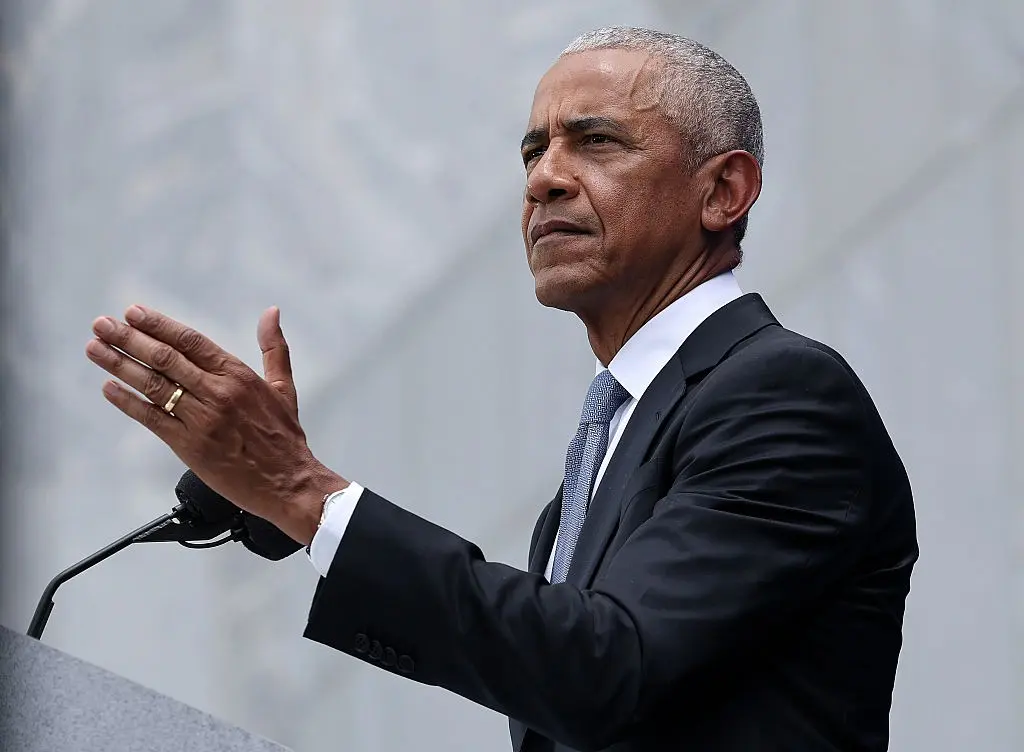
Speaking at a Democratic fundraising event where he was interviewed by House Minority Leader Hakeem Jeffries, Obama emphasized that lawmakers need to establish a clear agenda. According to a partial transcript provided by Obama’s office to The New York Times, the former president laid out his thoughts when Jeffries asked how congressional Democrats should approach the policy challenges surrounding artificial intelligence.
Obama argued that once Democrats regain the majority in the House of Representatives, they must immediately initiate a structured framework to foster a transparent and public conversation about the trajectory of artificial intelligence.
"This is something that is moving very fast in private hands, and if we don’t get on top of it, I think can be dangerous," Obama told the audience. At the same time, he acknowledged the profound potential benefits of the technology if managed correctly. "If we do get on top of it, I do think it’s beneficial. I genuinely think it’s going to accelerate, for example, drug development in ways that can help us cure diseases."
In response to Obama’s remarks, House Minority Leader Hakeem Jeffries issued a statement reinforcing the former president’s perspective. Jeffries noted that Obama "is correct that decisive action must be taken on artificial intelligence," while launching a critique against the legislative branch’s current leadership. Jeffries asserted that "Republicans have abdicated their responsibility to govern on behalf of the American people."
The intersection of politics and artificial intelligence comes at a time of intense industry debate regarding safety protocols, ethical boundaries, and the velocity of technological development. Beyond his public statements, Obama has positioned himself as an informal adviser within the sector, acting as a "sounding board" for prominent tech executives. Reports indicate that he has held discussions with leading figures in the AI landscape, including Anthropic CEO Dario Amodei and OpenAI CEO Sam Altman.
These high-level policy discussions occur against a backdrop of mounting anxiety over AI safety, which was thrown into sharp relief following a high-profile resignation at Anthropic. A researcher at the firm stepped down and publicly warned that leading artificial intelligence companies are rushing toward self-improving superintelligence, characterizing the current trajectory as "gambling with our lives."
In an effort to address these internal and external concerns, Anthropic CEO Dario Amodei outlined a broad strategic approach aimed at "pacing the frontier" of AI development. Amodei’s proposal includes granting independent safety evaluators direct access to leading artificial intelligence companies and their frontier models, alongside an initiative to establish standardized safety benchmarks across the industry.
The proposal drew notable responses from other key players in the tech space. In subsequent social media posts, OpenAI CEO Sam Altman and SpaceX CEO Elon Musk appeared to react positively to the framework. Altman specifically stated that OpenAI would commit to collaborating with independent evaluators who possess employee-like access to the company’s systems and research environments.
Meanwhile, political figures outside the Democratic Party have approached the regulation and safety of artificial intelligence from a different vantage point. President Donald Trump addressed AI safety concerns during conversations with reporters while attending an event at an Irish golf course. According to Bloomberg, Trump expressed immense confidence in the nation’s technological standing, boasting that the United States is "the most sophisticated country in the world."
Emphasizing the geopolitical stakes of the technology race, Trump added that he wants "to keep it that way because whoever wins AI wins."
The Trump administration’s broader approach to federal policy in this sector has already begun taking shape. Earlier this year, the administration released a legislative framework for artificial intelligence explicitly designed to preempt state-level regulations while shifting regulatory burdens, such as child safety considerations, away from platforms and onto parents.
Addressing the delicate balance between technological innovation and risk mitigation, Trump acknowledged the necessity of regulatory measures during his remarks in Ireland. "And we can put guardrails," Trump said. "We can do this and that. But I think you have a lot of negative forces that are bringing it up that shouldn’t be bringing it up."