

The value of the S&P 500 index has experienced a staggering ascent over the past several years, climbing roughly 57 percent in just the last two years and more than doubling over the past five. For everyday savers and retirees holding index funds, this sharp upward trajectory has dramatically altered net worth calculations. Individuals who felt they were only halfway toward their retirement goals during the pandemic era may find they have abruptly surpassed the finish line. Conversely, long-standing retirees are facing a different kind of calculation, occasionally eyeing high-end properties or grappling with the psychological urge to spend as portfolios swell.
This unprecedented growth has triggered widespread financial anxiety and skepticism across the investing community. The central question facing savers is whether this remarkable market expansion reflects fundamental economic reality or if it constitutes a temporary bubble fueled by speculative fervor.
The underlying anxiety was captured in a recent inquiry from a concerned reader who asked whether the market is trapped in an artificial intelligence-driven bubble, how vulnerable that dynamic makes future portfolios, and what it ultimately means for long-term retirement security.

To evaluate the current financial landscape, it is helpful to return to the foundational economics of what a stock actually represents. At its core, owning a stock is simply a more liquid and standardized version of owning a rental house. When an investor purchases a rental property, they are buying a claim on a stream of rental income. After covering operating expenses, the remainder constitutes profit.
If the broader market price for rental properties in a specific region doubles while tenants continue paying the exact same monthly rent, the higher valuation looks impressive on paper, but it yields no immediate change in cash flow unless the property is sold. Even then, selling at an inflated price requires purchasing another similarly inflated property if the investor wishes to remain in the market. A landlord’s actual earnings only increase if the business becomes more profitable through physical expansions, renovations, or streamlined management.
When that property is eventually sold to a new investor, the purchase price should theoretically reflect that future income stream. For example, a property generating $24,000 annually in net rent and selling for $240,000 carries a price-to-earnings ratio of 10. If a seller manages to secure $480,000 for that same property, the price-to-earnings ratio doubles to 20. While that outcome heavily favors the seller, it delivers a significantly reduced yield for the incoming buyer.

Translating this dynamic to the broader stock market reveals a striking parallel. An investor who placed $100,000 into the market in 2019 and continuously reinvested dividends would see a portfolio value approaching $257,000 today—representing a gain of roughly 157 percent. However, over that exact same period, the actual share of company earnings generated by that basket of stocks has risen at a much slower pace, moving from roughly $5,290 to $7,540, or an increase of about 42 percent. Consequently, the overall price-to-earnings ratio of the market has expanded from approximately 20 to roughly 30.
Current stock market investors find themselves in the position of real estate buyers confronting doubled property prices while rental yields remain relatively stagnant. While owning stocks or rental houses remains a viable long-term strategy, basic mathematics dictates that purchasing assets at higher price-to-earnings multiples yields lower future returns as a percentage of the overall portfolio value compared to buying during market downturns.
An exception to this rule occurs when earnings are expected to accelerate rapidly. If a real estate investor overpays for a property based on current rents but knows a massive corporate campus is scheduled to open nearby, anticipated rent surges justify a higher initial purchase price. This principle explains why individual company valuations spike on positive news, such as the pandemic-era surge in Peloton stock when home fitness demand spiked temporarily, only to deflate once consumer habits normalized.

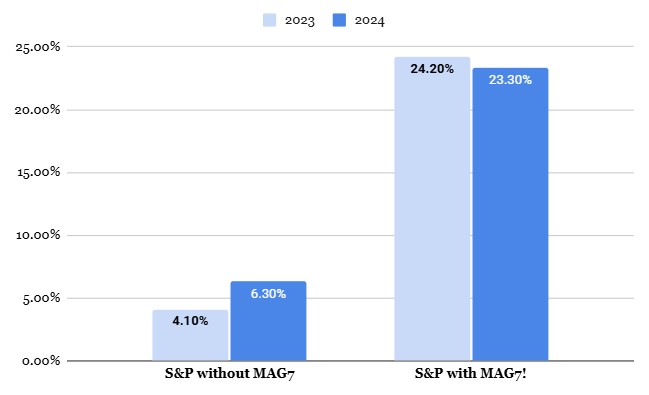
However, when the entire market climbs to historic highs, it raises questions about whether broader economic growth is expected to accelerate at a matching pace. In the case of the current market surge, broad-based economic acceleration is only part of the story. A deep dive into the S&P 500 reveals that approximately three-quarters of the recent market growth has been driven by just seven massive technology corporations: Apple, Nvidia, Microsoft, Amazon, Alphabet, Meta, and Tesla.
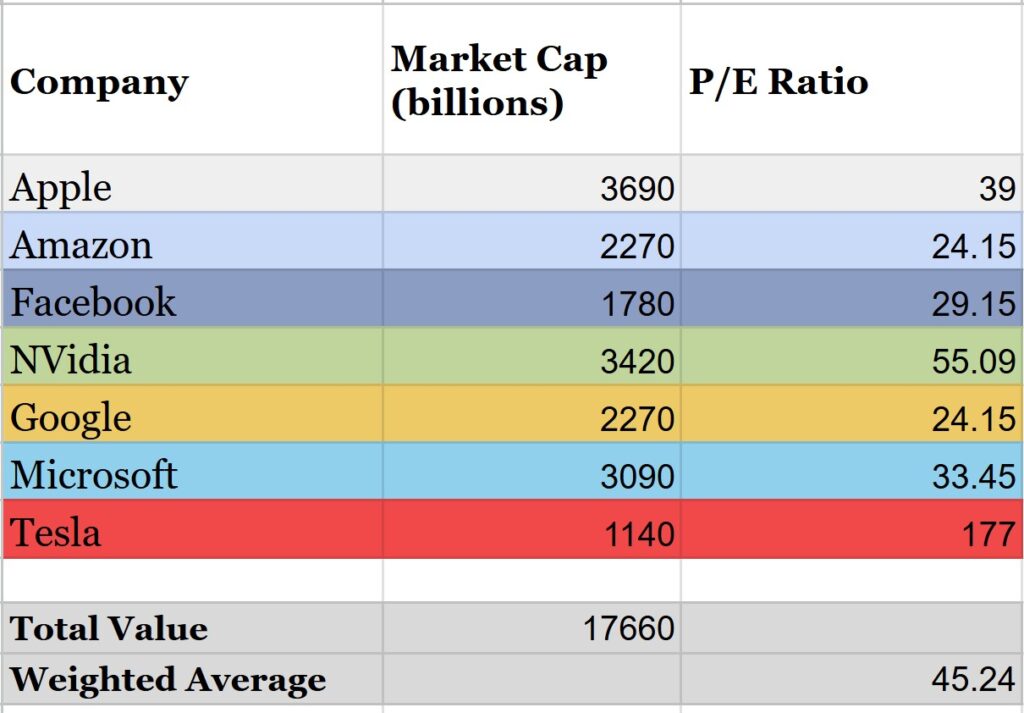
These high-profile entities—frequently referred to as the Magnificent Seven—represent more than 25 percent of the total market value, commanding a combined capitalization of roughly $17.66 trillion. Their weighted average price-to-earnings ratio sits near 45, far exceeding the rest of the market. When these seven dominant firms are excluded from the equation, the remaining 493 companies in the S&P 500 trade at a much more moderate, albeit still elevated, price-to-earnings ratio of around 20. This divergence indicates that while investors anticipate steady overall economic performance, they are pricing in explosive, outsized growth specifically for the tech sector.
This tech-centric enthusiasm is anchored largely by recent breakthroughs in artificial intelligence. Software systems are increasingly demonstrating human-like reasoning across diverse fields, igniting a corporate spending frenzy. Six of the Magnificent Seven giants are channeling hundreds of billions of dollars into constructing massive data centers outfitted with advanced supercomputers. Meanwhile, Nvidia benefits directly from this capital expenditure by supplying the high-demand hardware required to fuel the infrastructure.
Beyond the foundational infrastructure, corporations across nearly every industry are betting that artificial intelligence will usher in an unprecedented era of productivity. Modern systems can process massive volumes of legal documents, analyze complex source code, identify medical anomalies in diagnostic imagery, accelerate pharmaceutical research, and power autonomous robotics. The underlying premise is that businesses are on the cusp of securing an infinite workforce of highly capable digital labor, overcoming humanity’s historical constraints of finite time and intelligence.
While the long-term potential of these technologies is widely acknowledged, significant uncertainties remain regarding execution timelines, cost overruns, competitive pressures, and potential regulatory or societal disruptions. Whether corporate earnings will ultimately materialize to justify current valuations remains an open question.
Historical economic data provides a useful lens for evaluating these trends. Over the long term, inflation-adjusted US economic growth has hovered at a remarkably steady average of approximately 3 percent per decade. Interestingly, recent decades have actually experienced slightly slower-than-average economic growth, underscoring the disconnect between macroeconomic expansion and current equity valuations.
Despite these valuation concerns, long-term equity ownership is projected to remain profitable, albeit at moderated yields compared to periods when stocks were acquired at lower multiples. Market manias, corrections, and panics remain inevitable features of financial history, but attempts to time these fluctuations by liquidating portfolios in anticipation of a market crash consistently underperform steady participation. Even if stocks eventually return to more typical historical valuations, continued economic expansion and corporate earnings growth can support healthy long-term portfolio progression.
Alternative asset classes offer different risk and reward profiles for investors looking beyond US equities. Institutional forecasts, such as those published annually by Vanguard, project that international equities and fixed-income assets may outperform US stocks over the coming decade. International developed markets, tracked by funds such as VXUS, currently trade at substantially lower price-to-earnings ratios near 16, representing a significant valuation discount compared to US markets. However, predictions favoring international equities have frequently lagged behind reality in recent years due to the heavy concentration of artificial intelligence innovation within US borders.
Other investors utilize diversified multi-asset strategies, such as automated portfolio management accounts, which balance holdings across international equities, emerging markets, and bonds to capture smoother volatility curves and potential tax efficiencies, albeit with historical performance trailing US-only portfolios during periods of heavy domestic tech dominance.

Meanwhile, conservative institutional postures reflect similar caution regarding prevailing market valuations. Berkshire Hathaway, led by Warren Buffett, has maintained substantial reserves of uninvested cash while opting against aggressive share repurchases, signaling a scarcity of attractively priced acquisition targets amid elevated market multiples.
For homeowners evaluating debt, the rising interest rate environment has shifted the calculus surrounding mortgage payoffs. While historical models typically favor maintaining low-interest mortgages while directing surplus cash into index funds, higher borrowing costs make guaranteed principal reduction—equivalent to securing a guaranteed return matching the mortgage rate—an increasingly attractive option for risk-averse individuals prioritizing debt-free ownership.
Ultimately, the consensus among long-term financial observers remains focused on consistency rather than speculation. Maintaining disciplined investment habits, ignoring daily market commentary, and keeping a long-term perspective continue to form the cornerstone of prudent financial management, allowing savers to navigate market volatility without unnecessary disruption.