
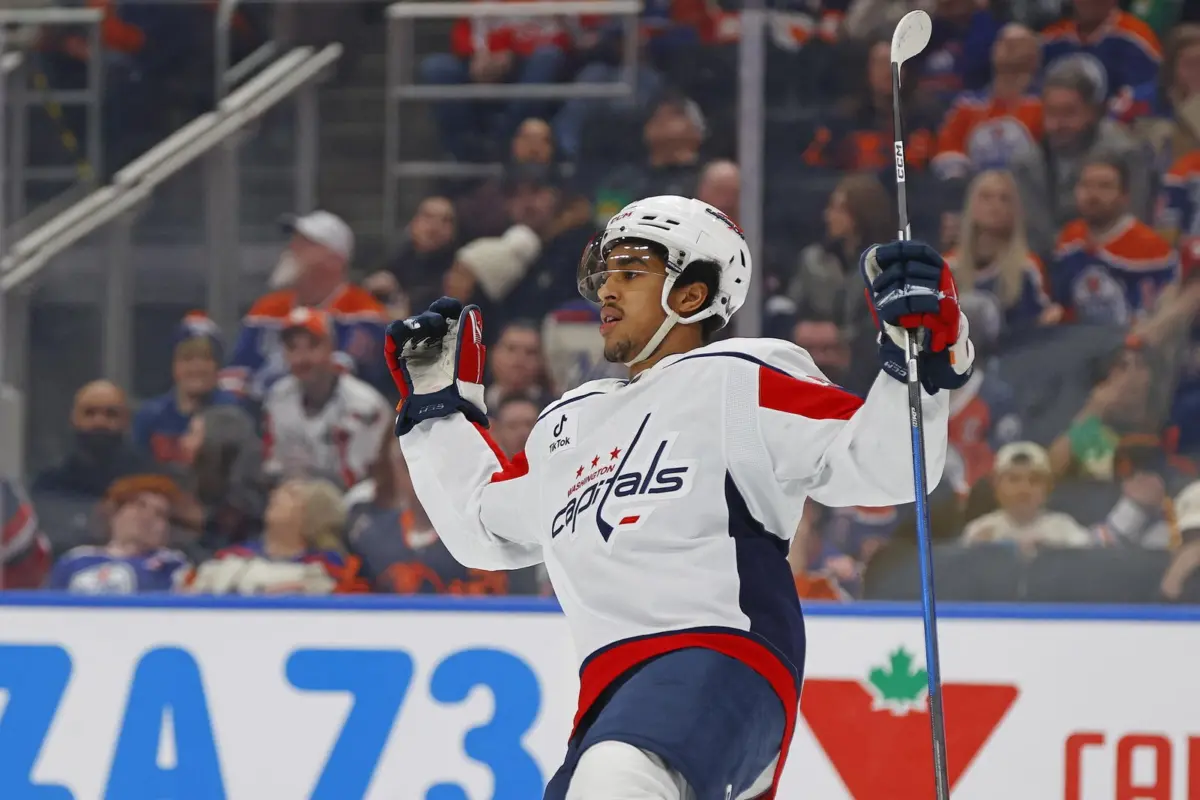
In the tense hours leading up to the expiration of the collective bargaining agreement between the NHL and the NHLPA, general manager Chris Patrick and the Washington Capitals executed a pair of high-stakes maneuvers. Under the wire, the franchise locked up two vastly different, yet relatively unproven, young players to matching eight-year contract extensions. While committing significant term and money to skaters with limited extensive NHL resumes might traditionally raise eyebrows, a closer look at the financial landscape of modern hockey reveals that these moves are far from reckless gambles. Instead, they represent calculated, forward-thinking business decisions designed to capitalize on the rapidly evolving economics of the league.
The first of these long-term commitments went to Ryan Leonard, the dynamic 21-year-old winger drafted eighth overall by Washington in the 2023 NHL Draft. Leonard is coming off an impressive rookie campaign in the world’s premier hockey league, where he netted 20 goals and tallied 45 points. Long projected to evolve into a cornerstone of the Capitals’ offensive attack, his first full season in the majors did virtually nothing to dispel those lofty expectations. With elite goal-scorers around the league increasingly demanding astronomical figures—where wingers capable of reaching the 30-goal mark command cap hits well in excess of $14 million—the Capitals moved proactively. They secured Leonard on an eight-year extension carrying a $10.5-million average annual value (AAV), set to kick off in the 2027-28 season.
For Leonard, the agreement represents financial security and a willingness to trade away some potential maximum earnings down the road in exchange for structured certainty. Crucially, the Capitals structured the deal to include more than 82 percent of his total compensation in signing bonuses. This heavy bonus structure provides immediate liquidity and security for the young star while allowing Washington to secure his services through the entirety of his prime athletic years.
The second major eight-year extension was handed to center Justin Sourdif. At 24 years old, Sourdif arrived in the nation’s capital with a very different profile than Leonard. Prior to this past season, he had logged just four career NHL games, spending the vast majority of his professional development as a mainstay in the American Hockey League within the Florida Panthers organization. As a 2020 third-round draft pick who never managed to exceed 38 points in a single AHL campaign, it was understandable why he struggled to crack Florida’s talent-dense lineup on a regular basis. However, upon arriving in Washington, Sourdif was thrust into some of the most grueling defensive minutes assigned to any forward in the league, and he responded by exceeding expectations.
Despite posting a respectable 15 goals and 35 points across 78 games, Sourdif’s true value was forged in the defensive trenches. He was routinely deployed against the opposing team’s absolute best forward lines. Compounding the difficulty of his assignments, he started less than 40 percent of his total shifts inside the attacking zone. Yet, when Sourdif was out on the ice at 5-on-5 play, the Capitals controlled the run of play, outscoring opponents 47-28 and posting a stellar 52.3 percent expected-goals share. Recognizing this elite underlying impact after just one full year in the league, GM Chris Patrick rewarded Sourdif with an eight-year deal carrying an AAV of $6.35 million.
Naturally, external criticism followed the announcements. The Capitals were far from the only front office around the league to back up a metaphorical truckload of cash to players who have yet to cross the threshold of 100 career NHL games. Inherent risks accompany any long-term pact in professional sports. Young athletes can experience regression, fail to live up to developmental trajectories, or eventually request trades after a few seasons of service.
Yet the internal bet in Washington relies on distinct, projectable outcomes for both players. In Leonard’s case, the franchise expects him to continually refine his game as a premier goal-scoring threat. During his two seasons of college hockey in the NCAA, Leonard finished first and third in goals scored, offering a clear preview of his elite finishing ability. The ultimate organizational vision is for Leonard to seamlessly step into the mantle left by franchise legend Alex Ovechkin, eventually taking over as the primary trigger man on the top power-play unit.

Sourdif’s trajectory is viewed through a different analytical lens. The front office is banking heavily on the projectability of his defensive acumen and hockey IQ. While he was severely underpaid relative to his impact last season and figures to be a bargain again this year, there is a possibility he might look slightly overpaid for a year or two before the math completely evens out. That balancing act will be accelerated by the explosive, ongoing growth of the league’s salary cap.
When evaluated collectively, the $16.85 million that Leonard and Sourdif will command annually from 2027 through 2035 already looks increasingly manageable. Regardless of whether their individual skill sets see marginal or exponential growth, the broader financial structure of the NHL is shifting beneath the feet of traditional team-building models. Financial projections indicate that a $150-million salary cap ceiling is likely on the horizon within the next five years, making an eight-year commitment to players in their early-to-mid-twenties at these price points look remarkably astute.
To contextualize the market, external observers raised very few questions when 30-year-old forward Alex Tuch secured an eight-year pact with a $10.5-million cap hit. If Leonard establishes himself as a consistent 30-goal scorer, a matching $10.5-million AAV will ultimately look like a bargain in a ballooning cap environment, especially given that Washington has him under contract for the entirety of his physical prime.
Similarly, questions may linger regarding whether Sourdif can maintain such elite defensive impacts while continuing to chip in 15 or more goals per season. His 14 percent shooting percentage from last season feels slightly elevated for a player of his specific offensive skillset. Even so, elite defensive forward play capable of tilting the ice against top competition will command a $6-million price tag very soon, meaning the Capitals are simply getting ahead of the financial curve.
Valid concerns do exist regarding the broader roster construction in Washington. The club currently features a significant number of higher-paid veterans on the older side of the spectrum—skaters who, with the exception of Ovechkin, were rarely considered the absolute elite players in the sport at their career peaks. The franchise’s immediate competitive window remains open right now, which could lead to some transitional turbulence down the road. However, when examining the broader prospect pipeline and young core taking shape around Leonard, Sourdif, Aliaksei Protas, Ilya Protas, Ivan Miroshnichenko, and Cole Hutson, the foundation for the future appears secure.
Furthermore, the structural design of these contracts leaves the organization with ample flexibility. Neither player possesses restrictive trade protection clauses. Should unforeseen circumstances arise or developmental curves flatten, these long-term agreements remain exceptionally tradeable commodities. Prudent front offices must always plan for adverse contingencies, and the Capitals have successfully built significant wiggle room into their ledger.
Ultimately, these extensions underscore a modern approach to roster management. Any outside apprehension surrounding the deals largely stems from a failure to fully adapt to the shifting financial realities of the contemporary NHL.