
Across the bustling avenues and public squares of Tehran, large promotional banners present passersby with a direct question above images of heavy weaponry: “Do you know how to work with this?” The visual displays feature rocket-propelled grenade launchers, sniper rifles, automatic assault weapons, and specialized military communications gear.
The pervasive street messaging is the public face of a sweeping drive by the Iranian government to train, equip, and recruit volunteer civilians. Operating under the auspices of the Basij, the volunteer paramilitary wing of the Islamic Revolutionary Guard Corps (IRGC), the initiative seeks to integrate large segments of the population into state security structures amid heightened geopolitical conflict and domestic instability.
The mobilization push, officially named Janfada—a Persian term meaning “those who sacrifice their life”—was first unveiled by the Islamic Republic in late March. Launched during the escalation of a military conflict involving the United States and Israel, the initiative represents one of the largest public recruitment drives in the country’s recent history.
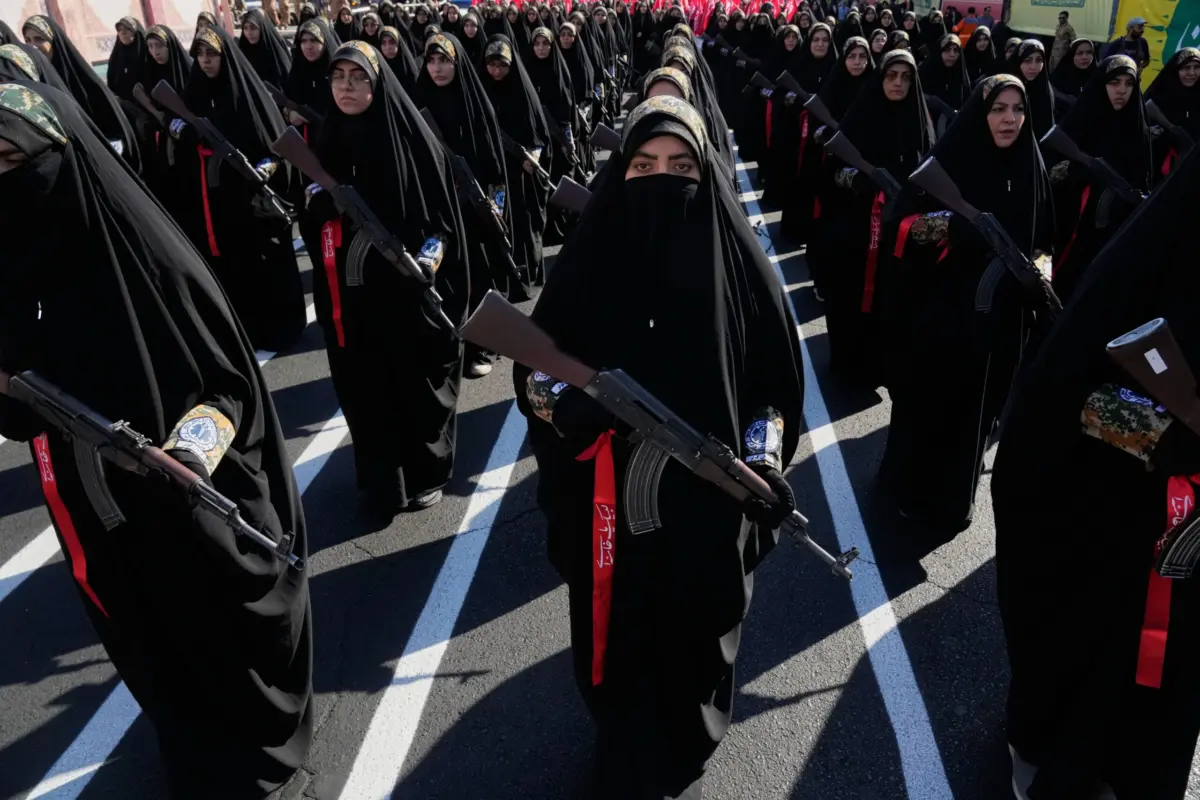
The campaign reached a milestone on Friday in Tehran, where thousands of recruits held their first large-scale public military exercise. Recruits marched through downtown streets in organized formations. The parade included men, women, and children, many of whom wore facemasks and dark sunglasses to conceal their features as they carried military hardware through the capital.
Disputed Figures and Shia Symbolism
In the days leading up to Friday’s parade, state media and official spokespersons framed the event as a march of 313,000 participants. The figure holds deep religious symbolism within Twelver Shia Islam, where 313 represents the prophesied number of core companions who will accompany Mahdi, the messianic hidden imam, upon his return to establish global justice.
However, broadcast footage transmitted by state television across the nation showed crowds that analysts and observers noted did not appear to match the massive numbers claimed by authorities.
Despite the visual discrepancies, military officials insisted the recruitment campaign was gaining rapid momentum. Hassan Hassanzadeh, the commander of the IRGC in Tehran, stated in an interview with the state broadcaster IRIB that more than 600,000 people had answered the mobilization call within the past week alone by signing up on an official campaign web portal.
Hassanzadeh claimed that state authorities aimed to sign up more than one million volunteers in short order, adding that military commanders had already organized initial registrants into 1,000 newly established units designated as "battalions."
The Janfada campaign has faced scrutiny regarding its enrollment figures since its early stages. Just one month after its launch in late March, government officials asserted that more than 31 million people—representing over a third of Iran’s total population of approximately 85 million, and more than half of all citizens over the age of 12—had registered for the program.

That claim was challenged when foreign-based cybersecurity researchers and activists accessed the registration portal’s underlying source code. Their analysis revealed that fewer than four million unique registrations were recorded on the database. Furthermore, tech analysts pointed out that the portal required only a mobile phone number to register, omitting any requirement for a national identification number or official identity verification.
Following the public exposure of the website’s data, an online registration ticker displayed on official media slowed significantly. Nevertheless, during Friday’s events, Hassanzadeh announced an updated figure, claiming that total registrations had surpassed 33 million people. Iranian authorities have not released external documentation, independent verification, or raw database records to substantiate these statistics.
The scope of the mobilization extends beyond combat readiness. According to campaign organizers, only 26 percent of those registered requested placement in direct military or security roles. The remaining majority of volunteers selected non-combat categories, including emergency rescue operations, social services, media production, and financial support initiatives.
Addressing the assembled volunteers during Friday’s parade, President Masoud Pezeshkian connected the patriotic drive to the country’s domestic economic struggles. Pezeshkian appealed directly to the recruits to assist his administration by reducing their household consumption of gasoline, electricity, natural gas, and water, citing severe energy imbalances and economic strain caused by the conflict.
The Iranian government recently implemented fuel price increases and restricted petrol quotas for private vehicles as it struggles with budget shortfalls and fuel production deficits linked to ongoing war conditions. These economic pressures follow a difficult summer marked by rolling power outages across residential and industrial sectors. With the winter season approaching, energy officials have warned of potential natural gas shortages across the country.
Focus on Children and Women
A prominent aspect of Friday’s parade in Tehran was the visibility of youth and female recruits. Teenagers were seen marching in military formation and wielding assault rifles alongside adult units. In recent months, armed teenagers have also been observed accompanying security forces at vehicular checkpoints and roadblocks established throughout Tehran and other major urban centers.
Sasan Zare, the official spokesman for the Janfada campaign, confirmed the focus on youth recruitment during an interview with the state-linked Iranian Labour News Agency (ILNA). Zare explained that while official registration is open to boys aged 15 and older, authorities are actively developing formal programs to incorporate children under the age of 15 into the organizational framework.
“Our effort concerning children and teenagers, first and foremost, is to introduce them to the culture of sacrifice and resistance,” Zare stated to ILNA. “The stronger their value system is formed from childhood, and the more they become familiar with concepts like patriotism and self-sacrifice, the more significant the impact can be on their future.”
Women also formed a visible contingent in Friday’s parade. Clad in traditional black chadors, female volunteers marched carrying automatic weapons. Some female participants were depicted operating motorcycles during the display—a detail that drew attention given that women in Iran are legally prohibited from riding motorcycles in public civilian life.
Strategic Objectives and Internal Security
The military display in Tehran featured various pieces of Iranian military hardware currently deployed in the conflict involving the United States and Israel. The event unfolded against the backdrop of tensions over maritime navigation in the Strait of Hormuz, where the US military continues to enforce a naval blockade against southern Iranian ports alongside tightened economic sanctions.

Mohsen Rezaei, the head of Iran’s Supreme Council for National Security, stated in an interview with Al Jazeera that Tehran had transmitted seven specific conditions for diplomatic negotiations to Washington through Qatari intermediaries. However, Rezaei emphasized that Iranian military commanders remain prepared to resume full-scale warfare if diplomatic efforts stall.
The government’s decision to arm and mobilize hundreds of thousands of civilians has raised questions among regional analysts, given the low probability of a foreign ground invasion. Observers suggest the campaign’s focus may be tied to internal security concerns following major domestic unrest earlier in the year.
In January, nationwide protests resulted in thousands of casualties. Iranian officials characterized the unrest as an attempted "coup" engineered by foreign intelligence agencies in the US and Israel working through armed domestic surrogates. Conversely, a United Nations fact-finding mission released a report alleging that Iranian state authorities committed crimes against humanity during the suppression of those demonstrations. Additionally, human rights organizations, including Amnesty International, published documentation implicating high-ranking officials in severe crackdowns during widespread protests in recent years.
In response to potential future instability, Iranian security forces have issued stern warnings against public gatherings, declaring that any action perceived as threatening national security or "social cohesion" will be met with firm state intervention.
Ali Alfoneh, a senior fellow at the Arab Gulf States Institute in Washington, views the Janfada initiative as a strategic attempt by the Iranian leadership to rebrand the Basij paramilitary force and repair its domestic standing.
Alfoneh noted that during the 1980–1988 Iran-Iraq War, hundreds of thousands of Iranian citizens voluntarily joined the Basij to defend the country out of nationalist and religious conviction. However, in the decades following that war, the organization’s role shifted primarily inward.
“Since the end of the war in 1988, however, the Basij has evolved into an instrument of domestic coercion and the suppression of dissent, severely damaging the organization’s public image,” Alfoneh explained.
According to Alfoneh, the Janfada campaign represents an effort by state leadership to restore the militia’s patriotic appeal in preparation for potential security challenges—whether involving foreign-backed regional insurgencies or domestic uprisings stemming from continued economic hardship.