
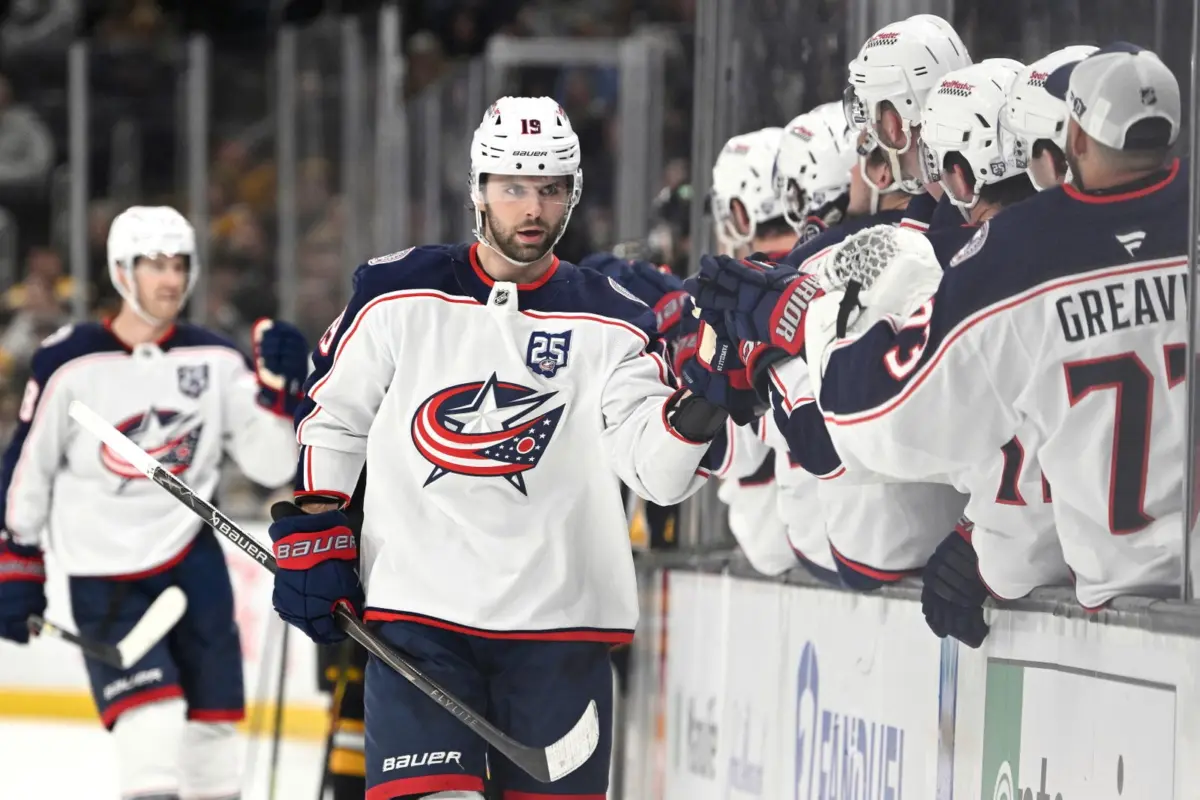
The Columbus Blue Jackets have endured a difficult summer, and the cloud hanging over the franchise threatens to grow even darker if star winger Kirill Marchenko fails to commit his long-term future to the organization. Should the dynamic forward ultimately decide to exit Ohio, the fallout could deliver a devastating blow to a franchise already fighting to regain its footing in a fiercely competitive Eastern Conference.
As the Blue Jackets look toward laying a stable foundation for the future, the status of Marchenko has quickly transformed from a standard contract negotiation into a defining storyline for the front office. Currently playing out the final stages of his current deal, which runs through the conclusion of the 2026-27 season, the 26-year-old winger has offered remarkably non-committal answers when questioned about whether he envisions remaining in Columbus long-term.
Speaking to the media, Marchenko sidestepped questions regarding his future contract status with characteristic neutrality. "I play hockey. I can talk only about hockey," Marchenko told reporters. "It’s not my side, the business side. It’s on [Columbus general manager Don Waddell] and [Marchenko’s agent Dan Milstein], and they figure out everything. My goal is to be ready on the ice."
While those remarks keep the immediate focus squarely on his on-ice preparation, they do little to ease the underlying anxiety shared by fans and management alike. Over the past three seasons, Marchenko has established himself as the undisputed offensive engine of the Blue Jackets. Since the 2023-24 campaign, he has generated 81 goals and 171 points across 233 games, emerging as a rare and reliable source of high-end offensive production in a lineup that has often struggled to find consistent goal-scoring depth.
From a financial standpoint, Marchenko’s current three-year contract—which carries an annual average value of $3.85 million—has proven to be an exceptional bargain for Columbus. However, the realities of the modern NHL dictate that elite young talent eventually commands top-tier compensation. The inability of the Blue Jackets to secure Marchenko on a long-term extension before he reaches the final stretch of his deal has become an increasingly glaring issue for a front office tasked with stabilizing the roster.
Marchenko is currently locked into the final year of the three-year agreement he signed in June 2024. When that contract officially expires at the end of the upcoming season, he will hold restricted free agent (RFA) status. In theory, this designation grants general manager Don Waddell and the Blue Jackets a significant measure of contractual control over the player’s immediate destination.

Yet, the modern landscape of professional hockey demonstrates that RFA status is no longer an absolute guarantee of retention. A wave of recent trade demands across the league has highlighted a stark reality: when a marquee player clearly communicates that they no longer wish to remain in a specific market, front offices are frequently backed into a corner. In such scenarios, general managers are almost invariably forced to part ways with premier assets, often receiving a fraction of their true value in return.
Whether that turbulent path awaits Marchenko and the Blue Jackets remains to be seen. What is certain, however, is that if Marchenko chooses to forgo an extension and successfully maneuvers his way out of Columbus, filling the resulting void will be an extraordinarily difficult task. Finding a replacement who can replicate his goal-scoring output, chemistry, and youth is a luxury the franchise simply cannot take for granted.
Further complicating matters is Marchenko’s arbitration eligibility. Because he holds this right, he could theoretically elect to navigate the arbitration process, sign a short-term, one-year contract, and smoothly transition into unrestricted free agency, ultimately opening the door to sign with any franchise of his choosing without Columbus receiving maximum long-term value.
The ripple effect of losing a player of Marchenko’s caliber could extend far beyond the top line, potentially threatening the long-term retention of other core pieces such as Zach Werenski and Adam Fantilli. When a struggling franchise proves unable to retain its homegrown stars, it risks alienating other elite talents who may view Columbus as an undesirable destination. This creates a deeply frustrating cycle for a fan base that has already weathered years of letdowns, near-misses, and organizational resets. For supporters who have stood by the team through persistent frustration, the departure of cornerstone figures like Marchenko, Werenski, or Fantilli could represent a breaking point in their continued support of the organization.
To be sure, a departure would not automatically signal the end of the world for the Blue Jackets. If Marchenko makes it clear that he will not sign an extension, Waddell retains the option to explore the trade market during the season to recoup a package of prospects and draft picks designed to aid the franchise’s long-term rebuild. Yet, at some point, the faithful in Columbus need tangible proof that the organization can both acquire legitimate high-end talent and convince those players to commit their prime years to the Blue Jackets.
Marchenko unquestionably delivers above-average results on the ice, but his public hesitation to discuss a future extension speaks volumes. Waddell is already operating under immense pressure to steer the franchise back toward respectability and playoff contention. Every day that passes without a signed extension only amplifies the growing concern that Marchenko’s long-term future lies elsewhere.
As the Blue Jackets fight to claw their way back into the tightly contested Eastern Conference playoff picture, losing a player of Marchenko’s magnitude would be a devastating blow. In professional sports, prolonged losing can inadvertently transform a franchise into an uphill battle when it comes to player retention and recruitment. If Waddell is ultimately unable to convince Marchenko to stay—or if doing so requires an exorbitant overpayment that strains the salary cap—the resulting fallout will leave a lasting mark on the franchise, testing the patience of the fanbase and casting a long shadow over the team’s ongoing developmental trajectory.