
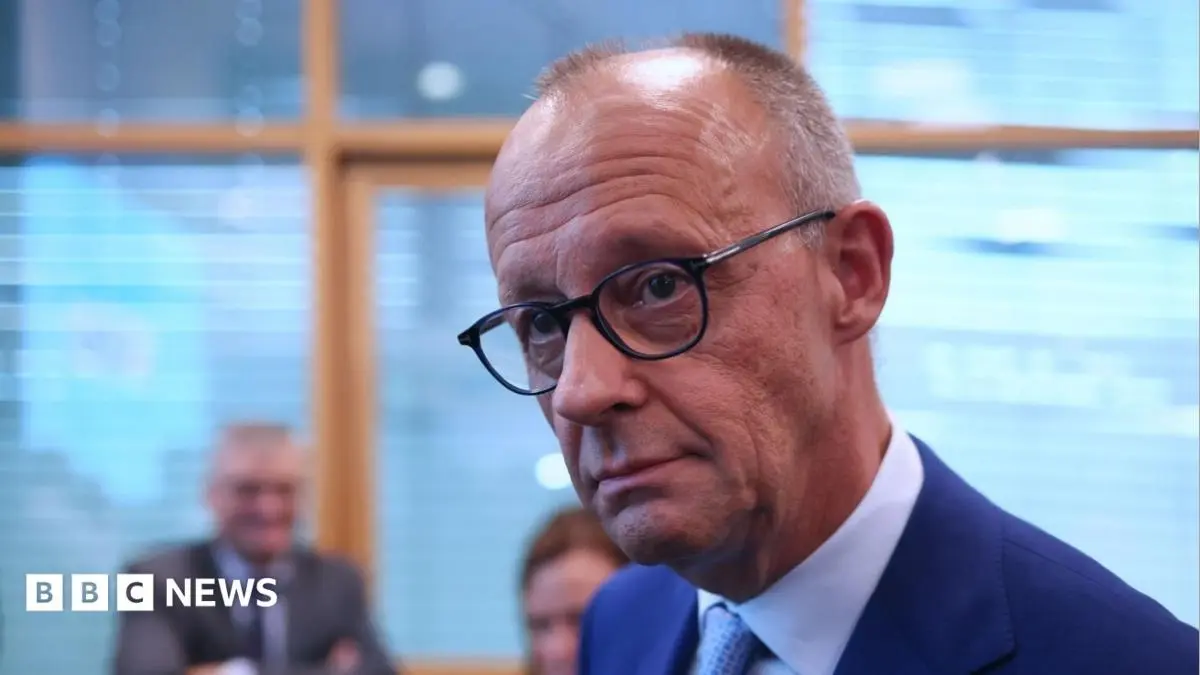
German Chancellor Friedrich Merz has described a pair of crushing local election defeats for his governing Christian Democratic Union (CDU) as a political "disaster," while steadfastly rejecting calls to step down and pledging to push forward with his administration’s legislative agenda. The dual set of electoral losses in the north-eastern state of Mecklenburg-Vorpommern and the federal capital of Berlin has dramatically heightened pressure on the conservative leader, coming just two weeks after another severe electoral setback in the state of Saxony-Anhalt. Despite mounting public discontent and persistent rumors regarding his potential mid-term replacement, Merz insists he possesses the necessary fortitude to navigate the political crisis and maintain control over both his party and the federal government.
The election results in Mecklenburg-Vorpommern represented a historically unprecedented setback for the Christian Democrats. In what has been calculated as the CDU’s worst-ever electoral performance in any German state since the end of the Second World War, the party failed even to clear the mandatory 5 percent threshold required to secure parliamentary representation. The dramatic collapse left the CDU underperforming significantly against prior projections, which had already signaled a record-low turnout and an unprecedented political floor for the party in the north-eastern region.
By contrast, the far-right Alternative for Germany (AfD) surged in Mecklenburg-Vorpommern, placing itself on track to claim the largest single share of the vote. Broadcast exit projections released shortly after polls closed at 18:00 local time (17:00 BST) by public broadcasters ZDF and ARD placed the AfD in first place with an estimated 38 percent of the vote share. The centre-left Social Democratic Party (SPD) followed in second place with a projected 35 percent. Despite its triumph at the ballot box, the AfD remains highly unlikely to take power or form a regional government, as all other political parties represented in the state parliament continue to maintain a strict refusal to enter into coalition negotiations or work alongside the far-right movement.
Simultaneously, in Berlin, the ruling CDU suffered another major political blow, falling behind the socialist Die Linke (The Left). According to the initial projections provided by public broadcasters ZDF and ARD, Die Linke secured nearly 26 percent of the vote share—marking the very first time the party has ever topped an election poll in the federal capital. The incumbent CDU trailed in second place, garnering just 19 percent of the vote share. Meanwhile, the AfD also demonstrated expanding momentum within the capital city, increasing its electoral footprint to a projected 16 percent of the vote.
The double defeat on Sunday followed a mere fortnight after the CDU endured a devastating result in the central-eastern state of Saxony-Anhalt. In that contest, the conservative party saw its vote share halved, while the AfD secured a major victory that underscored the dramatic realignment taking place across significant portions of the German political landscape. Taken together, the three successive election results have delivered a punishing series of blows to Merz’s authority, exposing deep electoral vulnerabilities across both urban centers and former East German strongholds.
As the projected election results appeared on broadcast screens inside the CDU’s central election night gathering in Berlin, the atmosphere was described as subdued and tense, with no cheers or celebration from assembled supporters and officials. Recognizing the profound political trouble confronting his leadership, Merz moved quickly onto the offensive. Addressing reporters and party faithful gathered at the CDU headquarters, the chancellor made it clear that he had no intention of relinquishing his post, directly tackling the growing speculation surrounding his leadership.
Merz, who had long sought the chancellorship throughout his political career before assuming office 16 months ago, signaled an unyielding determination to retain the top job in German politics. Echoing the defensive statements he delivered following the defeat in Saxony-Anhalt two weeks earlier, Merz told reporters on Sunday evening that he intends to forge ahead relentlessly with his coalition government’s ambitious program of structural reforms, focusing primarily on economic revitalization, tax restructuring, and welfare system adjustments.
"The reforms have to come," Merz insisted during his address at the CDU headquarters. "I am taking on this responsibility, because I want to move our country forward." Addressing the rising anxiety within his own political camp and the broader nation, he emphasized that overcoming the present political and economic headwinds would require patience and iron resolve. "What needs to be done now requires backbone, steadfastness and patience," Merz declared. "I will demonstrate this as CDU party chairman and, above all, as chancellor of our country."
Framing his proposed package of economic, tax, and social welfare changes as not merely an administrative policy agenda, but as a critical safeguard against political extremism, Merz argued that fundamental structural changes were vital to combat the appeal of radical movements. "I would even go so far as to say that these reforms are the antidote to the authoritarian poison that, with the fascination of authoritarianism, is penetrating ever deeper into our society," the chancellor added.
The reaction from the political opposition was triumphant, particularly from the leadership of the Alternative for Germany. Following the publication of the exit projections, AfD national co-leader Alice Weidel celebrated her party’s surging performance in Mecklenburg-Vorpommern and its steady gains in Berlin. "We are the strongest force and have reached the mainstream of the population," Weidel declared, arguing that the results demonstrated the party’s broad integration into Germany’s political core.
The political ascent of the AfD comes despite persistent security concerns and intense scrutiny from state authorities. Several regional branches of the populist party have been officially classified as right-wing extremist organizations by Germany’s domestic intelligence services, a designation that the party leadership strongly rejects. Nevertheless, the AfD’s core political platform—built upon strict anti-immigration measures, an explicit "German-first" economic and social outlook, and a Russian-friendly foreign policy stance—has consistently found fertile political ground across the former communist east of the country.
For Chancellor Merz, the dismal election results land at a moment of acute political fragility. Over recent months, Merz has faced mounting political pressure driven by persistently low public approval ratings. The ongoing erosion of public support has fueled widespread speculation within political circles in Berlin regarding his long-term tenure, including persistent rumors that he could potentially be removed or replaced mid-term in a so-called "chancellor swap" arrangement if the party’s downward trajectory continues.
Despite these internal tremors and public doubts, key party figures have rallied publicly to insulate the chancellor from immediate leadership challenges. Earlier in the week preceding Sunday’s voting, the leaders of eight German states issued explicit statements backing Merz, attempting to project unity across the conservative bloc and stabilize his 16-month-old tenure.
Following the announcement of Sunday’s election numbers, senior party leaders continued to defend the chancellor’s mandate to lead. Burkard Dregger, a prominent member of the CDU in Berlin, echoed this sentiment in comments made to the BBC, arguing that replacing the chancellor mid-term would be counterproductive to national governance. Dregger asserted that it was entirely correct for Merz to remain in office despite the state-level losses, emphasizing the urgent need for political continuity at the federal level. "He has a lot of work to do and we don’t have time to waste to form new government in the federal level," Dregger stated.
As counting continued late into Sunday night with final official tallies expected by early Monday morning, the full weight of the regional elections settled upon Germany’s political establishment. The historic failure in Mecklenburg-Vorpommern, where the party fell beneath the 5 percent threshold, combined with the loss of top position in Berlin to Die Linke, underscores a deeply challenging landscape for the chancellor. Friedrich Merz now faces the daunting task of rallying a shaken CDU, attempting to enact controversial national reforms, and arresting the growth of rival political forces across the country.