
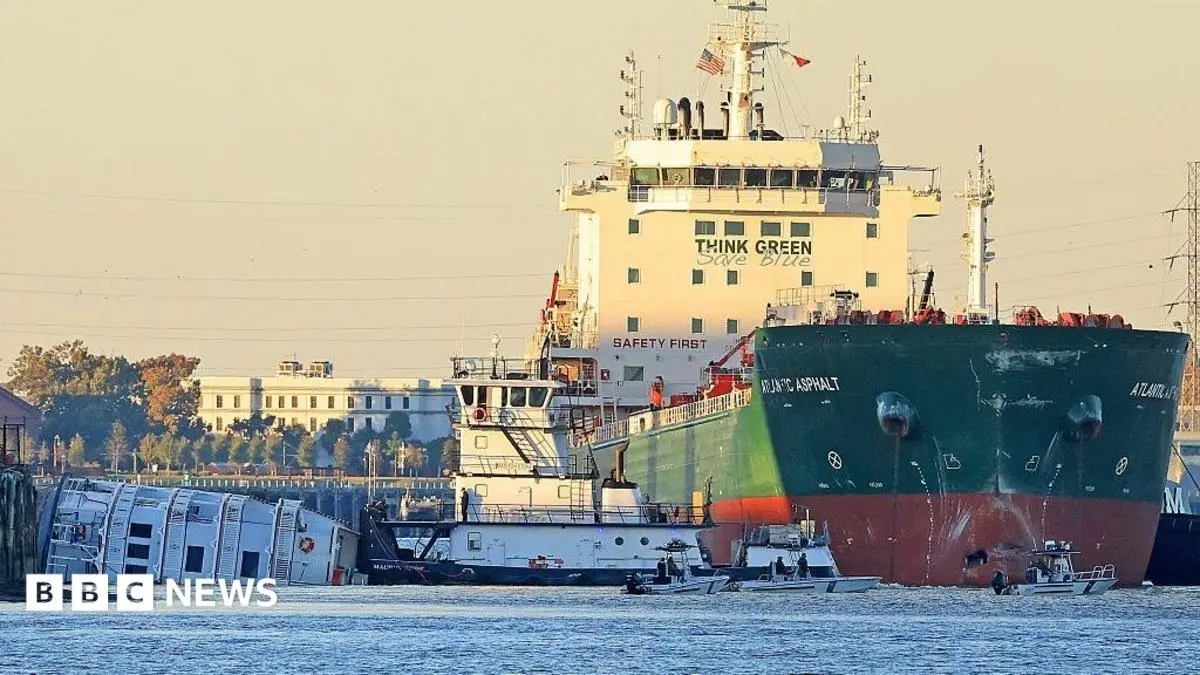
Federal safety officials have launched a detailed investigation into a collision on the Mississippi River after an upbound commercial tanker suffered a mechanical steering failure, veered off course, and struck the paddlewheeler cruise ship American Heritage, forcing an emergency evacuation of more than 100 passengers and crew.
The incident occurred as the American Heritage, operated by American Cruise Lines, was nearing the end of an eight-day inland cruise showcasing historical and cultural destinations across Louisiana and Mississippi. The impact compromised the cruise vessel, causing it to take on water, list heavily to one side, and ultimately tip onto its side in the river, according to local port authorities.
Emergency calls detailing the growing crisis on the river began coming in at approximately 13:30 EST (18:30 GMT) on Friday. As water began entering sections of the American Heritage, nearby witnesses, vessel crews, and emergency responders rushed to assist passengers and crew members before the vessel’s tilt became unmanageable.
Port of New Orleans Chief Melanie Montroll confirmed that surrounding personnel immediately moved into action as distress calls were received. Rescuers worked rapidly to evacuate the passengers and crew aboard the compromised paddlewheeler as it took on water. According to port authority figures, there were approximately 129 passengers on board the American Heritage at the time of the collision, along with the ship’s operational crew.
The emergency response quickly mobilized a broad network of maritime assets. Tugboat operators working in the vicinity, alongside local police units and specialized water rescue teams, hurried to the scene to pull individuals from the listing cruise boat. Recognizing the extreme hazard posed to ongoing rescue efforts by active commercial vessel traffic and river currents, officials took the immediate step of completely shutting down river traffic along the affected section of the Mississippi River.
The National Transportation Safety Board (NTSB) dispatched a dedicated team of investigators to determine how and why the upbound tanker drifted out of its designated navigation channel. Federal investigators quickly secured and began analyzing data extracted from the tanker’s Voyage Data Recorder (VDR), which logs audio, navigational telemetry, and operational data from the ship’s bridge prior to and during maritime incidents.
Initial findings from the VDR audio reveal a scene of intense emergency activity on board the tanker’s bridge in the minutes leading up to the collision. According to NTSB investigators, the recording captured audio consistent with the ship’s automated warning systems, indicating an active onboard warning alarm as the bridge team realized the vessel was off course.
In addition to the automated warning alarms, the recorder captured verbal commands from the ship’s officers instructing crew members to deploy the tanker’s anchors. Dropping anchor is a standard emergency maneuver intended to create mechanical drag and slow a vessel’s movement when power or steering control is lost. Bridge recordings also documented urgent emergency ship handling orders issued as the crew attempted to counteract the vessel’s uncommanded drift toward the bank.
Investigator-in-charge Bart Barnum provided key insights into the vessel’s operational state during a news conference addressing the preliminary evidence. Barnum confirmed that the tanker suffered a direct failure in its steering apparatus that mechanically jammed the rudder in a starboard position.
"We are aware that there was an issue with the steering on board and causing the rudder to remain at a starboard position, causing the heading of the vessel to veer towards the east bank," Barnum explained during the news briefing. The uncommanded starboard angle directed the upbound tanker directly toward the river’s east bank, placing it on an unavoidable path toward the American Heritage.
Although NTSB investigators have identified the stuck starboard rudder as the direct cause of the tanker’s change in heading, Barnum noted that the precise root cause of the steering system failure has yet to be determined. Technical specialists are conducting detailed forensic examinations of the ship’s hydraulic pumps, electrical control systems, mechanical linkages, and backup steering controls to establish why the rudder jammed and why secondary controls failed to disengage it.
The vessel struck by the tanker, the American Heritage, is a traditional-style river paddlewheeler operated by American Cruise Lines. Designed specifically for passenger travel along North America’s inland rivers, the ship offers multi-day cruises featuring destinations along the Mississippi River. At the time of the collision, the vessel was concluding an eight-day itinerary that brought travelers to historic ports of call throughout Louisiana and Mississippi.
When the upbound tanker struck the paddlewheeler near the east bank, the force of the collision breached the cruise ship’s structure. As river water rushed into the lower sections of the American Heritage, the sudden shift in weight distribution caused the boat to list sharply to one side. The list rapidly worsened, causing the paddlewheeler to tip onto its side as passengers and crew scrambled to evacuate the leaning decks.
In the immediate aftermath of the crash, nearby tugboat operators, local police officers, and civilian rescuers launched a rescue effort. Tugboats operating in the area altered their courses to assist the listing paddlewheeler, positioning themselves to help extract passengers and stabilize the emergency area. Good Samaritans aboard nearby craft also assisted in helping people off the damaged boat as it continued to take on water.
The decision by authorities to shut down traffic on the Mississippi River during the rescue operation was critical to ensuring the safety of both victims and rescuers. The lower Mississippi River is one of the world’s most heavily navigated commercial waterways, accommodating deep-draft ocean tankers, large cargo barges, and river passenger vessels. Halting river transit created a safe zone, preventing commercial vessel wakes from complicating rescue efforts or further destabilizing the capsized paddlewheeler.
Port Chief Melanie Montroll emphasized the speed and coordination of the response, noting that from the moment calls began arriving around 13:30 EST (18:30 GMT), first responders focused on getting everyone off the vessel safely. Port officials coordinated with local emergency management agencies to establish shore-side triage areas to evaluate passengers and provide immediate assistance following their rescue.
The 129 passengers aboard the American Heritage, along with the vessel’s crew, faced a frightening end to their eight-day cruise along the Louisiana and Mississippi waterways. However, the immediate arrival of