
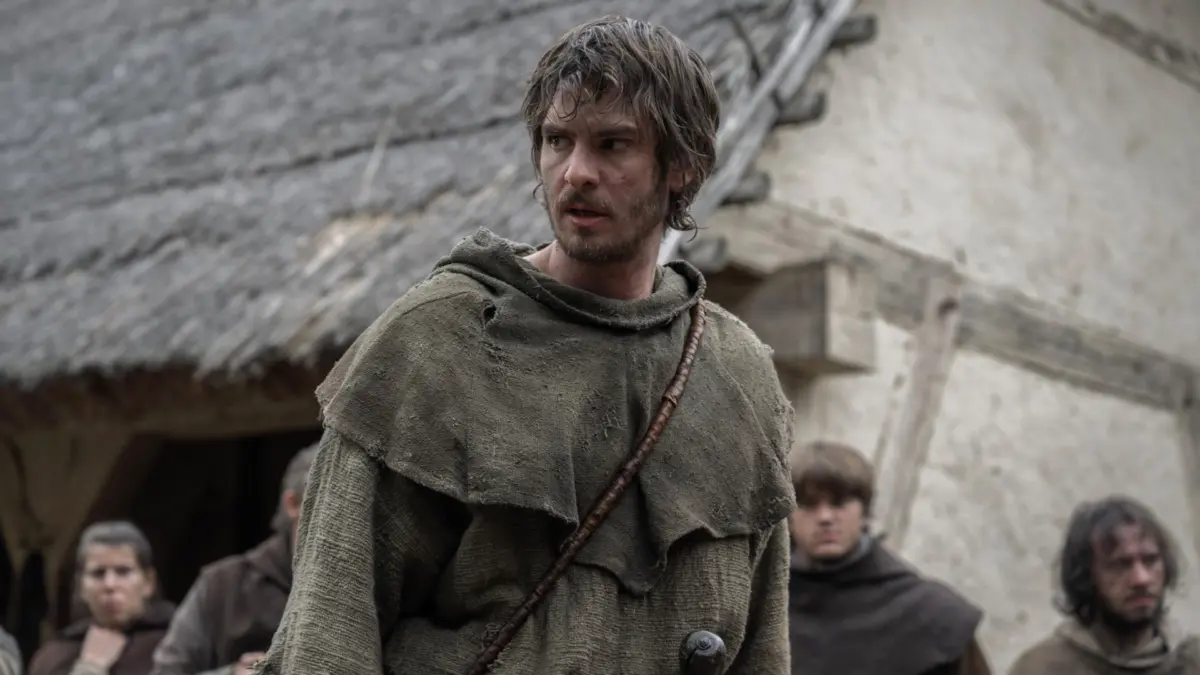
Andrew Garfield may portray a historical rebel fighting against a medieval monarch in his upcoming feature film The Uprising, but the Oscar-nominated actor believes the movie’s true cautionary message should resonate most strongly with modern society’s ultra-wealthy elite.
During a recent, widely discussed question-and-answer session alongside the film’s director, acclaimed filmmaker Paul Greengrass, Garfield elaborated on his hopes for the picture. He expressed a desire for the historical drama to serve as an unmistakable warning shot to the world’s richest individuals. The Uprising, which draws its narrative inspiration from the historic uprisings that ultimately gave birth to the enduring folklore and legend of Robin Hood, stars Garfield as a character named Ploughman. In the film, Ploughman bands together with a determined army of commoners to rise up against the tyrannical rule of King Richard II in an arduous, high-stakes fight for basic human justice.
When moderators and interviewers asked the actor what he ultimately hopes audiences take away from the cinematic experience when the film finally premieres, Garfield did not mince words about his broader social aspirations for the project. "First, I hope they come and see it, for first thing," the celebrated actor remarked when addressing the crowd. "But secondly, I hope it’s galvanizing. I hope there’s some awakening that people feel, that they feel that their own, that we all feel like our own struggles are being reflected in the struggles of these characters from a distant time and place, and that it could be directive. And I hope that if any billionaires watch it, they’re scared shitless."
The thematic resonance of the project quickly became a focal point of the conversation as the event continued. At one point during the discussion, the moderator quoted a poignant, heavy line delivered within the narrative of the film itself: "There will be no peace until we are healed." Responding to the profound weight of the quote, director Paul Greengrass observed that the underlying sentiment remains just as harrowing and accurate of today’s sociopolitical climate as it was half a millennium ago, noting that the phrase is "true of today as it [was] 600 years ago, for sure."
Garfield quickly jumped into the conversation to expand on the director’s observation, offering a sharp critique of modern wealth accumulation and the moral condition of the global elite. "I’m going to include the billionaires in that as well, because they’re the ones that might be the most soul sick," Garfield added. "They’re the ones that might need the healing the most in a way."
Although The Uprising is formally set centuries away from the modern era—specifically taking place against the gritty, turbulent backdrop of 14th-century England—the core themes of the picture regarding the systemic abuse of political power, rampant economic inequality, and the routine dehumanization of the working-class underclass felt deeply personal and urgent to Garfield.
The parallels between medieval socioeconomic collapse and contemporary societal anxieties were further addressed by Garfield during a comprehensive interview with Esquire last month. Reflecting on the harrowing historical realities that inspired the film’s backdrop, the two-time Oscar nominee detailed the exact conditions that plagued the era. "The truth of that period of time was that there were brutal conditions for working-class people, brutal taxation post-plague, incompetence in government, abusive practices, with the underclass being seen as sub-human creatures from the perspective of those in power," Garfield explained to the publication.
When interviewers directly pressed the actor on whether those grim historical conditions could realistically pertain to today’s modern world, Garfield offered a bleak and direct confirmation, stating, "Yeah, here and in the United States, and all around the world."
The actor also addressed the complex ways in which audiences might interpret the film’s political dimensions, acknowledging that art of this nature rarely fits neatly into conventional ideological boxes. "One of the things that’s cool about this film is that it’s a bit of a Rorschach Test," Garfield continued during the Q&A session. "A lot of differently politically aligned people will go, ‘Oh, it’s me!’ We get into really dicey territory — and to not see the Tommy Robinson stuff as anything but despicable is just ignorant — but I’m sure a bunch of people will look at this film and go, ‘England first! What about us?’ It’ll be very interesting in that regard."
Despite the heavy, systemic oppression and dark historical realities depicted throughout the narrative, Garfield emphasized that the ultimate heartbeat of the project remains rooted in a sense of collective hope, resilience, and human agency rather than pure despair. Elaborating on what sustained the cast and crew through the intense physical and emotional demands of production, he noted, "What was inspiring and exciting in the making of [the film] was this possibility of justice, this possibility of healing."
Audiences eager to see how Paul Greengrass and Andrew Garfield bring this turbulent medieval chapter of history—and its sharp contemporary parallels—to the big screen will not have to wait much longer. The Uprising is scheduled to hit theaters nationwide on September 10, courtesy of its theatrical release.