
As a general rule, finding a way to want to like Zillennial hangout comedies often proves easy, even when an initial viewing falls short. Having once navigated the turbulent waters of one’s twenties and likely been remarkably obnoxious about it, many viewers are naturally inclined to give their younger television counterparts the benefit of the doubt, especially when faced with abrasive edges or bratty posturing. Occasionally, that patience even pays off in rewarding ways. For instance, FX’s Adults recently returned for a sublimely hilarious second season following an uneven freshman run, allowing audiences the smug satisfaction of recognizing hidden potential all along.
Per those same criteria, the new Netflix animated comedy series Dang! arrives as a project primed to generate immediate goodwill. Created by Andrew Law—a veteran writer and producer of acclaimed comedies like Hacks and The Good Place—the show follows a trio of siblings living in New York City who are each uniquely unqualified for adulthood. Yet, while the eight-episode half-hour comedy features occasional moments of genuine cuteness and clever writing, and only rare instances of active tedium, viewing the series frequently feels like watching a show one wanted to laugh at far more often than the material actually delivers.
Dang!
Airdate: Tuesday, Aug. 8 (Netflix)
Cast: Andrew Law, Poppy Liu, Stephanie Hsu
Creator: Andrew Law
The Bottom Line: Funnier in theory than in practice.
In addition to its familial focus, Dang! stands out as a relative rarity in the television landscape: an original series created by and centering on Asian American characters. Notably, the show largely bypasses the well-worn clichés of tiger parents and assimilation blues, choosing instead to define its central duo by their utter and unapologetic uselessness.
Andrew, voiced by creator Andrew Law, operates roughly in the tech sphere, having secured a make-work job at a Depop-like startup primarily by virtue of being the founder’s former college roommate. For the most part, his daily concerns revolve around trying to get laid, successfully avoiding any actual labor, and looking after his baby sister. That sister, Eunice—voiced by Poppy Liu—serves as an unpaid intern at a Goop-like wellness enterprise while occasionally earning income as an OnlyFans streamer whose primary gimmick involves stepping on bread with her bare feet. Eunice is intensely narcissistic where Andrew is hopelessly neurotic, yet she remains only too pleased to let her older brother handle all the cooking, cleaning, bill-paying, and even burping her from time to time.
Eunice and Andrew function as inseparable best friends, remaining so perfectly in sync that they can effortlessly carry out entire conversations through grunts and hums alone. A typical exchange might feature one asking about a misplaced battery pack, with the response casually noting that it is currently charging a vibrator in the next room. Their favorite shared activities include experimenting with recreational drugs, marathoning reality television programs, and actively avoiding spending any quality time with their oldest sister, Ruthie.
Voiced by Stephanie Hsu, Ruthie is a high-powered corporate lawyer who barely bothers to disguise her deep disdain for her siblings’ feckless and unproductive lifestyles. However, when Ruthie abruptly upends her own life following an extramarital affair with a colleague, portrayed by SungWon Cho, she relocates from San Francisco to New York City to start fresh and—to her siblings’ horror—attempt a genuine reconnection. Dang! chronicles the mostly silly, occasionally moving dynamics among the trio, neatly summarizing their relationships through birth order: the oldest acts as the bully, the youngest remains the baby, and the middle child functions as the resident nuisance.
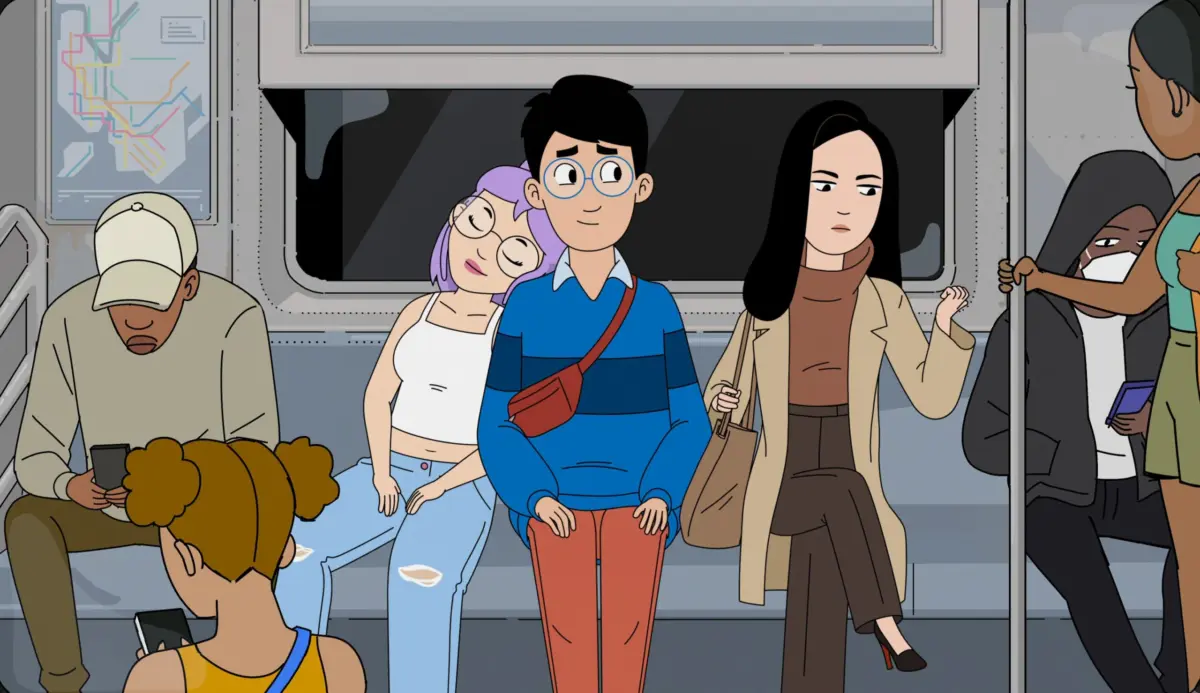
The series certainly possesses several notable assets. Chief among them is the animation provided by Titmouse, which proves consistently pleasant to look at. Featuring soft shapes, clean lines, and charmingly expressive facial animations, the visual style evokes the gentle warmth of Hayao Miyazaki alongside contemporary adult animation like Tuca & Bertie. Furthermore, the show’s tone strikes a delicate balance, remaining slightly sweet while retaining a predominantly irreverent edge. Dang! never pretends that its main characters are anything other than deeply flawed individuals—Ruthie is a cold-blooded capitalist, Andrew represents a toxic mixture of passive-aggressiveness and pushovers, and Eunice is unabashedly bratty. At the same time, the series clearly understands that their love for one another, though imperfect, is entirely sincere. The siblings will readily promise to be there for each other in times of need and mean it, only to immediately sigh with relief and remark how glad they are that an actual crisis was averted when an offer of help turns out to be unnecessary.
When the show’s underlying affection for its characters is channeled through scenarios specific enough to feel fresh, Dang! can blossom into a minor delight. Among the season’s standout comedic moments is a spot-on parody of suspiciously fervent Christian praise songs. One recurring church tune from Andrew’s youth group days features lyrics like "Come inside of me, come and fill me up" paired with requests to "come inside me when I’m open wide." The added comedic layer—wherein Andrew remains entirely unsure whether the song is simply bad or bad "in the way that gay guys like things that are terrible"—provides a pitch-perfect punchline. Sequences like this clearly stem from a creative team that has spent an inordinate amount of time navigating both Protestant youth groups and trendy gay nightclubs.
For the most part, however, Dang! is frequently undermined by a shortage of true innovation and a lack of sharp precision. The series leans heavily on familiar caricatures, such as Andrew and Eunice’s respective bosses who embody hustlebro grindset and wellness-empress archetypes that might have felt entirely novel half a decade ago. Similarly, tossed-off cultural references occasionally miss the mark. A casual line noting a sighting of a public figure acting disruptively at a theatrical production functions adequately enough as a bleak illustration of how disappointing New York City life can occasionally feel. Yet, the specific name-drop often reads as random rather than pointed, leaving viewers to imagine how much more incisive a similar joke might have been handled by writers behind series like Hacks or The Other Two.
A distinctly first-draft feel is hardly an insurmountable hurdle for a brand-new series still actively discovering its unique comedic voice. Encouragingly, some of the strongest material arrives in the season finale, which features a trip back to the siblings’ hometown. This episode successfully blends broad, character-driven humor—such as the increasingly thick Boston accents that Andrew and Eunice effortlessly slip back into—with genuine emotional growth. One can only hope that Dang! will similarly manage to mature, evolving into a more confident, distinct, and fully realized version of itself.