
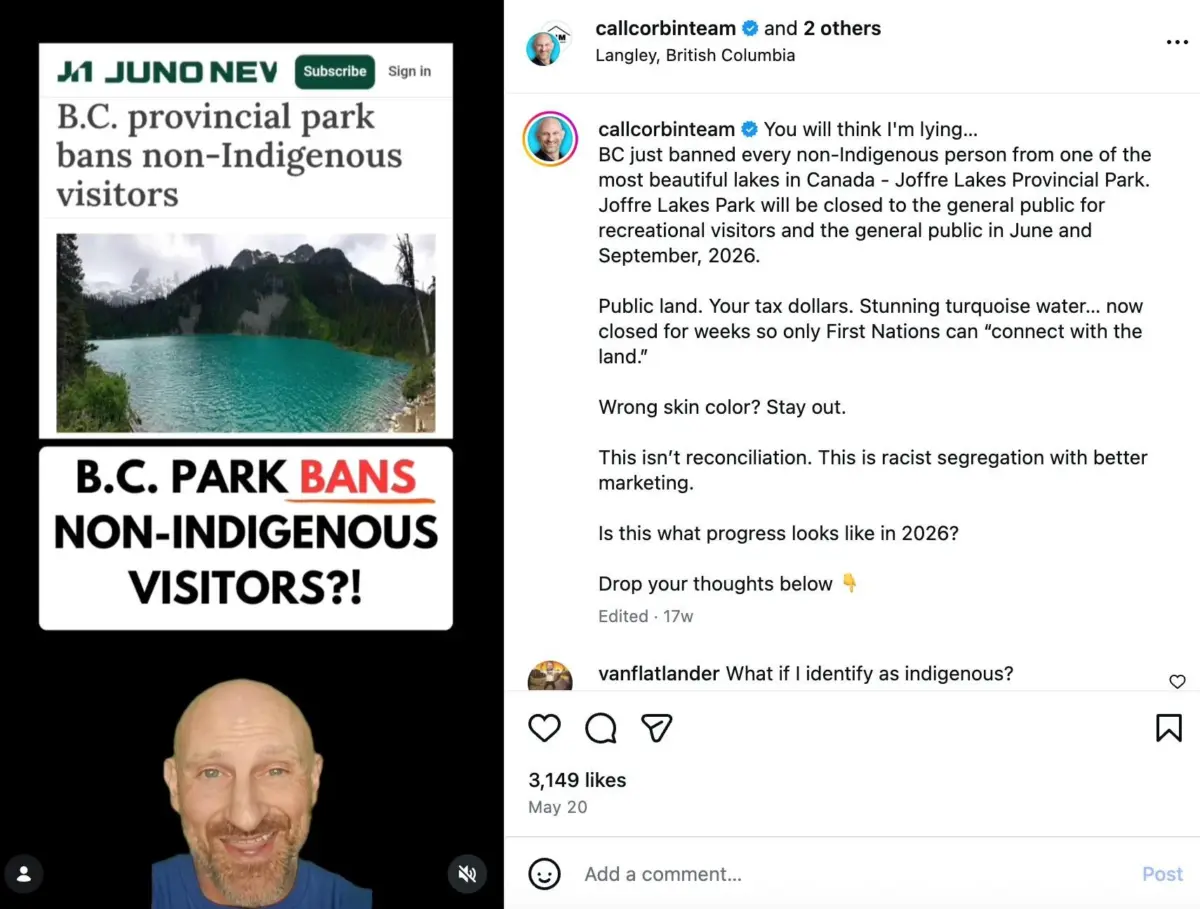
FRASER VALLEY, B.C. — Fraser Valley real estate agent Corbin Chivers is no stranger to sharing his thoughts and opinions online, but a pair of political posts on social media recently drew the sharp attention of the province’s real estate regulator, igniting a broader conversation about professional boundaries, freedom of expression, and the limits of regulatory oversight.
On June 22, the B.C. Financial Services Authority (BCFSA) sent Chivers, the lead of the Corbin & Co. team at Stonehaus Realty, a formal letter of advisement. In the correspondence, the regulator stated that it was issuing "cautionary guidance" following two complaints it had received from members of the public concerning Facebook and Instagram posts authored by Chivers. The posts in question touched on sensitive and politically charged topics, specifically Indigenous rights, Indigenous land claims, and ongoing discussions surrounding reconciliation in British Columbia.
In the original letter—a copy of which was provided to Real Estate Magazine (REM) by Chivers—the BCFSA characterized some of his public comments in stark terms. The regulator described the remarks as "polarizing," "inflammatory," and "discriminatory," while warning the veteran realtor that engaging in such political speech could potentially bring the wider real estate industry into public disrepute.
"By engaging in speculative, inflammatory, polarizing, or misleading commentary, your actions risk undermining public confidence in the real estate profession and bringing the industry into disrepute," the June 22 letter read. "Real estate licensees are expected to exercise good judgment, communicate respectfully, and ensure that their public commentary—whether personal or professional—upholds the integrity of the profession."
At the time, the BCFSA noted in its correspondence that the advisory letter was intended strictly for educational and informational purposes and did not constitute a formal disciplinary record against Chivers’ professional license. Nevertheless, the receipt of the letter set off a chain of events that would ultimately prompt intervention from constitutional advocates and a swift retreat by the provincial regulator.
Free Speech Lawyers Challenge the Letter
Chivers told REM that almost immediately after receiving the advisory letter from the BCFSA, he recognized the profound implications it carried for his professional livelihood and personal liberties. Determined to push back against what he viewed as regulatory overreach, he contacted the Canadian Constitution Foundation (CCF) to evaluate his options and challenge the BCFSA’s message.
"My real estate licence is my livelihood, and I had my regulator telling me what I’m allowed to say off the clock," Chivers reflected. "I don’t need people to agree with me. I just want the right to share my opinion as a private citizen without it affecting my licence or my job. Accepting the letter would have meant agreeing that a regulator gets a say over my personal political views. I couldn’t do that."
The intervention from legal advocates was prompt. On September 9, CCF director Josh Dehaas and counsel Alexander Surgenor formally wrote to the BCFSA on Chivers’ behalf. In their legal correspondence, the lawyers argued that the advisory letter directly infringed upon Chivers’ Charter-protected freedom of expression. They maintained that a provincial regulator has no mandate to police the personal political commentary of licensees when that commentary is entirely unrelated to real estate transactions, consumer protection, or professional misconduct. Consequently, the foundation demanded that the cautionary letter be rescinded and removed entirely from his professional file.
The legal pressure yielded results within a matter of days. On September 16, just a week after the CCF’s letter was sent, the BCFSA officially withdrew the June 22 advisory letter. In its place, the regulator issued a completely revised letter, confirming that the controversial matter was no longer a part of Chivers’ permanent regulatory file.
In the replacement letter, Raheel Humayun, the BCFSA’s director of compliance and enforcement investigations, acknowledged that the original communication had missed the mark. Humayun stated that the initial letter "should not have suggested that BCFSA made any finding of misconduct or that the letter formed part of a disciplinary record."
In a formal statement provided to REM, the BCFSA explained that it had reviewed the original advisory letter after Chivers raised formal questions regarding its contents and implications. Upon review, the regulator determined that some of the language utilized in the initial correspondence "could have been clearer."
"Following our review, BCFSA withdrew the letter and replaced it with a new letter that clarified the intent of the original letter and made the licensee aware of the complaints and expectations set out in BCFSA’s social media guidance," the regulator stated.
Due to the timing of the provincial political landscape, the BCFSA noted that it could not provide further extensive details on the matter, pointing out that the provincial government was operating in caretaker mode during the recently called provincial election cycle.
‘I’d Rather Be Honest Than Be Everyone’s Cup of Tea’
For Chivers, the episode underscores a vital distinction between a regulator’s legitimate mandate to protect consumers and what he views as an inappropriate intrusion into the private lives and political beliefs of working professionals. He maintains that while professional activities—such as how individual clients are treated, the accuracy of advertising standards, and adherence to trade laws—are entirely appropriate subjects for regulatory oversight, that authority should never stretch to encompass an individual’s personal political views.
"Having an opinion shouldn’t put someone’s licence at risk. When a regulator starts grading the content of your politics, that’s no longer consumer protection," he emphasized.
When asked whether he harbored concerns that taking public, unfiltered stances on polarizing issues might alienate potential clients or damage his business prospects, Chivers pointed to his extensive track record in the Fraser Valley market.
"I’ve spent 12 years in this business and sold over 800 homes, and I show up the same way for every client, whether we agree on politics or not," he said. "People are allowed to disagree with me—that’s fine. What isn’t fine is a regulator deciding my opinion is a problem for my profession. And honestly, the support this week has been overwhelming. I’d rather be honest than be everyone’s cup of tea."
BCFSA Points to Social Media Guidelines
The high-profile dispute brings renewed attention to the BCFSA’s official social media guidelines, which were originally released in November 2025 to establish clear expectations for how real estate licensees conduct themselves across digital and social platforms.
The regulatory guidance advises all real estate professionals to exercise sound judgment online, reminding them to operate under the assumption that anything posted in the digital sphere can eventually become public knowledge. Furthermore, the guidelines call upon licensees to communicate respectfully in a manner that actively "promotes and protects the image and integrity of the real estate profession," while taking full personal and professional accountability for the content they publish.
To mitigate potential conflicts between personal expression and professional standing, the BCFSA recommends that licensees maintain strict separations between their personal and professional social media accounts, utilizing more restrictive privacy settings on personal profiles where appropriate.
At the same time, the regulatory guidelines explicitly prohibit licensees from engaging in what is defined as "unprofessional, aggressive, disrespectful, or intimidating behavior" online. This prohibition encompasses abusive or offensive language, defamatory communications, personal insults, and direct threats. Additionally, the guidelines strictly bar any form of discriminatory statements or hate speech directed against any individual person or identifiable group.
In its statement to REM, the BCFSA reiterated that these guidelines are designed to highlight and address the specific professional risks that can arise when a licensee’s online activity becomes publicly intertwined with their professional role in the community.
"BCFSA has a responsibility to provide guidance and, where appropriate, address conduct that may affect public trust and confidence in the profession," the regulator concluded.