
DEIR EL-BALAH, Gaza Strip — In a small shop selling prepaid internet access cards in the central Gaza Strip city of Deir el-Balah, 24-year-old Ahmad Mohsen sits surrounded by the digital lifelines of a displaced population. Three years ago, before Israel’s devastating war on the Gaza Strip began, Mohsen envisioned a starkly different trajectory for his youth. Having earned a university degree in nursing, he was actively preparing to complete the final administrative procedures required to secure his professional license. He harbored clear, ambitious goals: securing a position at a local hospital, pursuing a master’s degree, and taking specialized medical courses to advance his career.
Instead, the outbreak of full-scale war abruptly derailed those ambitions, casting him into a radically altered reality along with the rest of Gaza’s population.
During the initial months of the conflict, Mohsen put his training to use under extreme conditions, working as a volunteer nurse at Al-Aqsa Martyrs Hospital in Deir el-Balah. Day after day, he attended to overwhelming numbers of killed and wounded Palestinians arriving at the overwhelmed medical facility. However, as months passed without any financial compensation, the compounding economic pressures of the war forced him to step back from the hospital wards and seek alternative means of survival.
"I got tired, and I wasn’t being paid for my efforts, so I started looking for another job that would give me at least a small income," Mohsen explained.
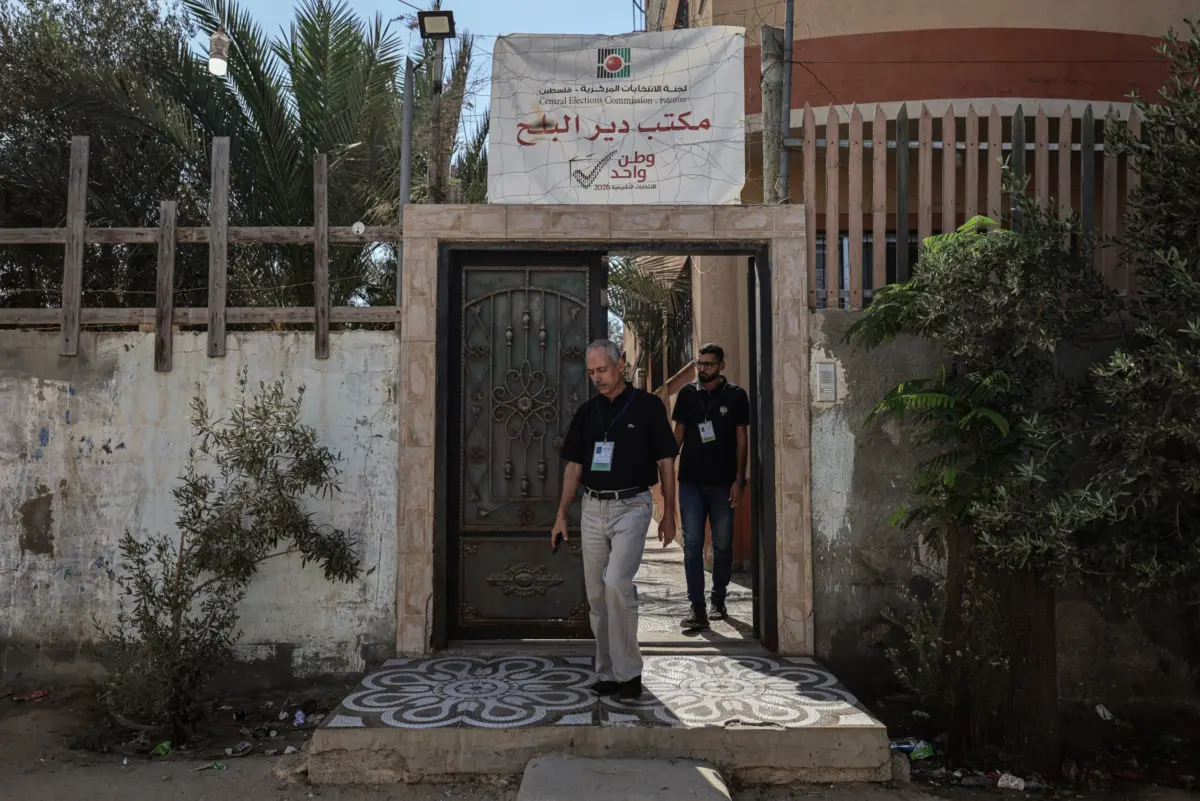
Today, as the Palestinian Central Elections Commission prepares for nationwide legislative elections scheduled for November 28, Mohsen finds himself facing his first opportunity to participate in a national vote. It marks the first Palestinian legislative election since 2006—a 20-year gap during which an entire generation of young Palestinians grew up without ever casting a ballot.
For Mohsen, the upcoming vote is defined entirely by immediate, practical priorities. He wants prospective candidates to step away from high-minded political rhetoric and directly confront the severe crises crushing his generation, including rampant unemployment, widespread insecurity, destroyed housing, a collapsed education system, and a devastated healthcare sector.
"The first thing I want is to be able to find a stable job with a decent salary so I can support myself and my family, and the second thing is to have security," he said.
Mohsen’s demands reflect a collective frustration shared across the Gaza Strip, where economic life has been reduced to ruins. Years of a suffocating Israeli blockade, compounded by a catastrophic war that has killed more than 74,000 Palestinians, have left Gaza’s economy in absolute collapse, driving unemployment to an unprecedented rate of approximately 80 percent.
The physical loss extends to family property and land as well. Mohsen’s family owns agricultural land located east of Gaza’s primary thoroughfare, Salah al-Din Street. However, because the area falls within a zone where Israel heavily restricts access, he and his family remain completely unable to reach or farm their property. Like many in Gaza, he pins his hopes on the terms of the October 2025 ceasefire agreement, praying that Israel will complete its promised withdrawal from restricted areas, allow residents to return to their lands, and enable the massive reconstruction effort required to restore the devastated territory.
Yet, Mohsen remains clear-eyed about the political process, emphasizing that the mere act of holding an election is meaningless unless it yields tangible, material improvements in the daily lives of ordinary citizens.
"A candidate should put themselves in the people’s place and speak with the people’s voice, not someone else’s voice," Mohsen said. "They should speak for us, the young people who have been wronged for 20 years through wars and destruction. There needs to be an end to this."
Democratic Memories
While younger voters like Mohsen are preparing to step into a voting booth for the very first time, older generations retain vivid, complicated memories of the last time Palestinians went to the polls.
Ghassan Marwan, 53, remembers the 2006 legislative elections clearly. At the time, Marwan was an established goldsmith who had built a successful factory from the ground up, providing a stable income and a comfortable life for his family.
When he cast his ballot two decades ago, Marwan believed the election would solidify democratic governance, generate employment opportunities, strengthen national security, and guarantee a prosperous future for his children. He distinctly recalls walking into a polling station set up inside a school in the Nuseirat refugee camp to vote for an electoral list headed by the independent politician Mustafa Barghouti. Looking back, he describes the process as remarkably transparent, professional, and full of civic promise.
"I witnessed a great deal of transparency and integrity. It was like a democratic celebration," Marwan recalled. "But unfortunately, that experience was not repeated over the past 20 years."

In the two decades since that vote, Marwan’s world has been systematically dismantled. The stability he spent decades building evaporated in January 2024, when an Israeli attack destroyed both his family home and his gold factory during the height of the war. More than 30 years of hard labor and entrepreneurial success were erased in an instant, taking with them the security he had worked so hard to preserve for his children.
"After losing your home and your source of income, what else do you want? All you hope for is reconstruction, calm and security in the country," Marwan said.
For Marwan, the most painful aspect of the current catastrophe is witnessing his children forced to endure life in temporary tent encampments rather than the permanent, comfortable home he spent a lifetime establishing. Furthermore, the sheer physical toll of displacement has forced the 53-year-old former business owner back into grueling daily survival routines that he never anticipated facing at his age, such as hunting for clean drinking water and hauling heavy containers over long distances.
"After all these years, I am carrying water from far away," he said. "Am I going to remain in this situation? I am 53 today. In 10 years, I will be in my 60s, and I will not be able to carry this burden."
This relentless struggle for basic daily necessities has severely dulled the public’s engagement with formal politics, Marwan noted.
"Our interest in politics has declined, not because it does not concern us, but because of all the frustration and despair that have accumulated," he explained. "People have become preoccupied with how to get by and secure their daily bread."
Given the pervasive destruction, widespread displacement, and ongoing humanitarian crises defining life in Gaza, the prospect of organizing nationwide democratic elections leaves Marwan deeply torn between a faint lingering hope for change and profound cynicism regarding the practical reality of the vote.
"Sometimes I feel that talking about elections is almost a joke, because there are no clear conditions for holding them," he added.
Recovery is Priority
Despite the formidable obstacles on the ground, the Palestinian Central Elections Commission is moving forward with administrative preparations to conduct the legislative vote across the occupied West Bank, occupied East Jerusalem, and the Gaza Strip.
Within Gaza alone, the commission estimates that approximately 1.24 million Palestinians are eligible to cast their ballots. However, organizing a national election across a territory characterized by widespread physical ruin and mass displacement presents unprecedented logistical and security hurdles.
Jamil al-Khalidi, the Gaza regional director for the Palestinian Central Elections Commission, noted that the extraordinary scale of physical destruction throughout the enclave has severely compromised traditional voting infrastructure. To navigate these challenges, the commission has been forced to devise specialized contingency plans, including preparations to manufacture and print essential election materials locally inside Gaza should Israeli authorities restrict or prevent the entry of voting supplies through border crossings.
From an analytical perspective, the profound shifts in daily life brought on by the war have fundamentally reshaped how Gaza’s population views the purpose of elections. According to Gaza-based political analyst and writer Iyad al-Qarra, the years of conflict have not erased the public’s interest in political affairs, but they have radically transformed what citizens expect political leaders to deliver.
After nearly three years of continuous displacement, widespread physical destruction, and total economic disruption, al-Qarra emphasizes that political demands in Gaza are no longer focused on ideological debates, institutional administration, or sweeping political slogans. Instead, the electorate’s demands are now directly tied to a prospective leadership’s concrete ability to restore basic normalcy to daily life.
The primary mandate for any future legislative body, al-Qarra argues, will be delivering tangible recovery: rebuilding destroyed neighborhoods, restoring obliterated water and sanitation infrastructure, rehabilitating the shattered healthcare and education sectors, and establishing the economic conditions necessary for displaced families to rebuild their lives and livelihoods.
"There is a widespread desire for leadership that puts Gaza’s recovery at the top of its priorities, given the heavy price the Strip has paid," al-Qarra said.