
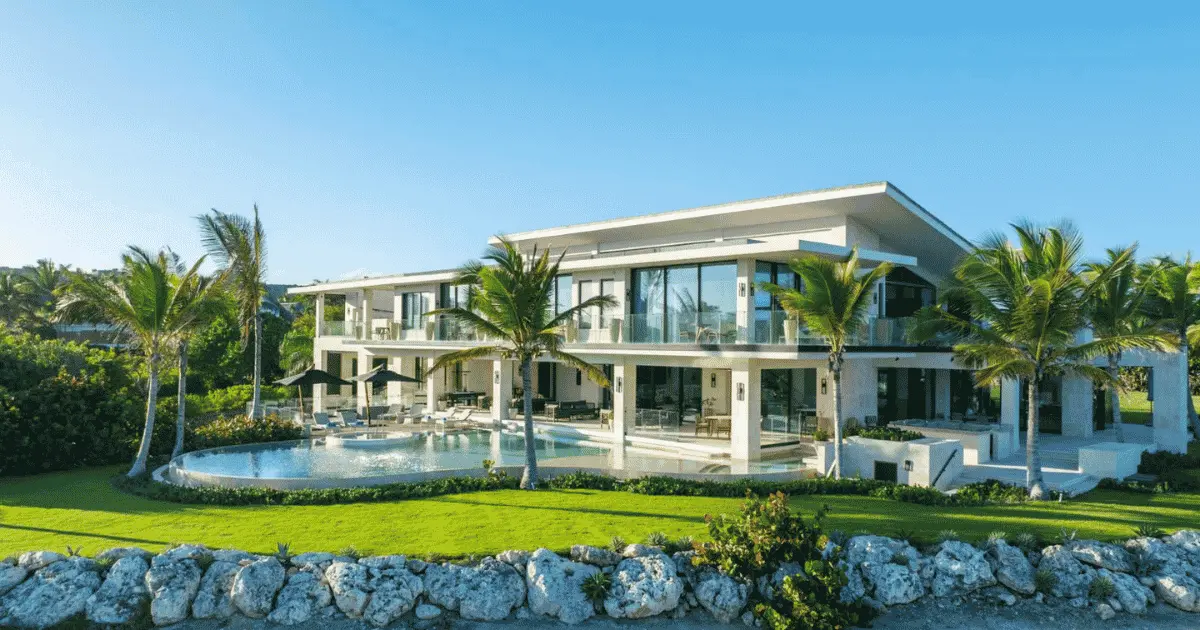
Villa Azurée, a six-bedroom oceanfront estate in Cap Cana, is listed at US$29 million and comes with access to two private cenotes, including one on the property.
As part of REM’s ongoing series, The Industry Abroad, writer Susan Doran explores how real estate operates in international markets, examining everything from licensing and commissions to listing systems and buyer trends. Previous installments have covered Europe, India, Australia, China, Greenland, New Zealand, and Monaco. This time, the focus turns to the Dominican Republic.
The Dominican Republic was hardly on the radar as a resort destination a couple of generations ago. Along its wild, white-sand shores, a cruise ship was nowhere in sight, and the local tourism industry had yet to take its modern form.
The nation’s tourism sector was kick-started in the 1970s on the easternmost tip of the island when early developers, including Club Med, began clearing the tangled jungle to establish the palm-fringed coastal strip of Punta Cana.
That pivotal moment marked the beginning of the Dominican Republic’s steady climb from a little-known Latin American nation into an all-inclusive global resort machine.
Today, robust international air connectivity and strong buying power—bolstered by favorable dollar-to-Dominican-peso exchange rates—continue to drive foreign capital into the country while broadening the scope of available real estate options.
The birthplace of legendary baseball stars now ranks among the Caribbean’s most visited and booming destinations. This growth occurs despite the nation sharing the island of Hispaniola with Haiti, the poorest country in the Western Hemisphere. While Haiti inevitably shapes global perceptions of the Dominican Republic in various nuanced ways, the two are completely separate sovereign nations.
The border between them is famously stark, reportedly visible even from space, with lush, dense rainforest on the Dominican side contrasted sharply against bare, deforested land across the border in Haiti.
From Jungle to Property Hub
The transformation of the Dominican Republic into a popular and comparatively affordable international property hub and golf destination has accelerated significantly over time. Today, development is scattered broadly across the country, fueled further by the pandemic and the rise of remote work. These trends have attracted younger generations alongside traditional vacationers, expatriates, investors, and retirees.
The country is experiencing a major economic surge driven by record-breaking foreign investment and continuous infrastructure growth.
"Historically, real estate has grown together with tourism," says Manuel Higuera, CEO of Engel & Völkers Dominican Republic. The two sectors remain deeply and inextricably linked.
"What makes the Dominican Republic unique is that foreigners have the same ownership rights as Dominicans," Higuera explains. "It’s one of the most open markets in the region."
While affordability remains a primary lure for many buyers, the luxury segment has also taken off dramatically.
Over the past five decades, the country has evolved from housing a few pioneering resorts into developing master-planned, premier gated communities like Casa de Campo—famous for its world-class golf courses and visits from megastars like Beyoncé and Jay-Z—and Cap Cana, notes Higuera.
The broader real estate market is remarkably diverse. It spans the bustling tourism hub of Punta Cana and vibrant urban centers like the teeming, historic capital city of Santo Domingo, as well as less saturated markets along the north coast such as Puerto Plata, Sosúa, and Cabarete. Meanwhile, on the previously unexploited southwest coast, new cruise ports are opening to welcome travelers.
Outside the comforting tourist bubble of the main resort zones, however, navigating daily life changes. A basic understanding of Spanish becomes much more essential, and exercising caution while driving is strongly advised. Motorcycles frequently outnumber cars, and traffic signals are often treated more as loose suggestions than strict rules. Crime is also a common concern cited by prospective visitors and buyers.
How the Business Works
Foreign buyers face very few barriers in the Dominican Republic, as there are no restrictions on foreign ownership and no local residency requirements. To actively attract international investment, any property purchased within a development project approved by CONFOTUR—the nation’s tourism promotion council—is granted various long-term tax exemptions.
"Government policy has been a key growth driver," says Higuera. "Most foreign buyers pay in cash or through developer payment plans. And most resort transactions are in U.S. dollars."
Property ownership is strictly freehold, with titles officially registered with the government. Furthermore, the country has implemented increasingly strict anti-money laundering regulations to govern financial transactions. Real estate agents are generally compensated through commissions paid by the seller, typically ranging between 3 and 5 per cent, according to Higuera, though commissions in particularly high-demand tourist areas can run much higher.
While the industry shares many similarities with North American real estate practices, a major exception is that the Dominican Republic does not yet require mandatory licensing or formal education for agents. Nevertheless, the government is actively moving toward improved regulatory frameworks.
"There are very professional international and local brokerages," says Higuera. "At the same time, the lack of mandatory licensing has allowed some informal operators who do not proper practices, and they sometimes hurt the image of the industry."
Compounding this is the absence of a standardized multiple listing system. Open listings are common, and agents often find the local market to be fragmented.
"Cooperation between agents is important, but the availability and accuracy of information can vary," observes Yolanda Tejeda, an agent with Sotheby’s International Realty Dominican Republic, who partners with Andy Taylor, a Sotheby’s vice-president in Canada.
Tejeda stresses that buyers should always work with an independent Dominican lawyer to verify property titles, legal permits, and zoning documentation. A truly capable agent must coordinate effectively with various legal and technical experts.
"The role is not simply about showing properties," Tejeda emphasizes.
Contrary to popular belief among outsiders, she notes that "the job is not necessarily more relaxed than in North America. In the luxury market especially, clients expect a high level of responsiveness and personal attention."
The reality of the high-end market is that weekends and holidays can frequently be the busiest days of the week, with international clients often utilizing their personal vacations to tour properties and make purchasing decisions.
Not as Cheap as You Think
Another common misconception is that the entire Dominican Republic is dirt-cheap.
While the country can offer "considerably more space and lifestyle amenities for the money than many major North American markets," Tejeda concedes, "it’s misleading to describe the entire country as inexpensive."
Sol Aufiero, CEO of Century 21 Sunsets in the Dominican Republic, concurs that while buyers frequently secure more bang for their buck compared to North American markets, local real estate prices range dramatically.
"In areas like La Romana and Bayahibe, you can find investment opportunities starting at approximately US$60,000 to US$70,000," Aufiero explains. "At the other end of the spectrum, exclusive communities such as Casa de Campo have villas worth several million dollars, with some properties exceeding US$30 million."
Rental options are similarly varied, he notes, ranging widely from US$400 per month to US$20,000 or more depending on location and luxury amenities.
Over time, the profile of the foreign buyer has visibly evolved. Modern purchasers are far more analytical and increasingly focused on long-term value rather than short-term gains.
"They’re no longer buying just for the sunshine, beaches, and palm trees," Aufiero observes.
It remains a market full of dynamic opportunity, drawing clients from "North America, Europe, Latin America, the Dominican diaspora," and various other international regions, he adds.
"We’ve made tremendous progress in development, infrastructure, and international visibility," Aufiero concludes. "Now I believe we face an equally important challenge matching that growth with higher professional standards."