
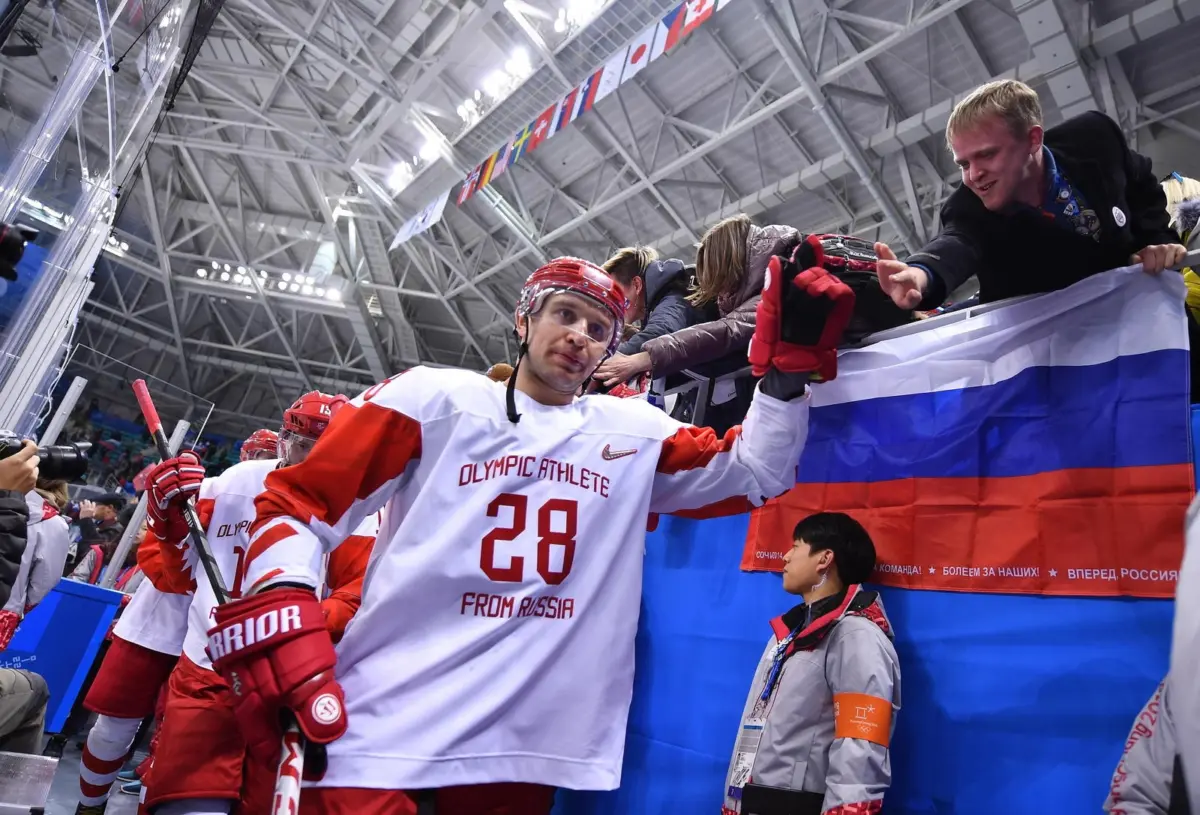
It appears that Russia’s highly anticipated return to international ice hockey will face yet another significant roadblock, courtesy of the Canadian federal government.
As first reported by The Athletic’s Chris Johnston, Canada’s Secretary for Sport, Adam Van Koeverden, has officially confirmed that Russian and Belarusian players will not be permitted to enter or compete at next month’s World Junior Hockey Championship tournament, which is scheduled to be held in Edmonton and Red Deer, Alberta. This prohibition applies strictly regardless of whether the individual athletes or officials already possess valid Canadian visas.
The policy stance was detailed further by government officials, who emphasized the broader geopolitical reasoning behind the travel restrictions. According to the Immigration, Refugees and Citizenship Ministry, targeted measures are being enforced to individually assess and block Russian and Belarusian athletes and officials from entering Canada for competitive sporting events, even for those holding pre-approved travel documentation.
"The measures are not directed at the Russian and Belarusian people," Van Koeverden and federal officials conveyed through policy statements. "Rather, they are intended to prevent the governments of Russia and Belarus from using international sporting events hosted in Canada as platforms for state representation, political legitimacy, and propaganda."
Federal authorities reiterated that the Canadian position remains firm and unwavering. As long as the Russian military engagement and war of aggression against Ukraine persists, the Canadian government maintains that there can be no return to business as usual, signaling that Canada will continue to stand in solidarity with Ukraine across all diplomatic and cultural fronts.
This dramatic escalation stems directly from a legal and administrative clash that began on October 30, when the Court of Arbitration for Sport (CAS) issued a binding order directed at the International Ice Hockey Federation (IIHF). The CAS ruling dictated that the international governing body must immediately reinstate Russia into all official IIHF competitions. Under the initial framework of that mandate, the reinstatement was slated to take effect immediately, starting with the upcoming World Junior Championship at the conclusion of this calendar year.
While the IIHF reluctantly accepted the arbitration ruling to comply with legal constraints, the decision triggered an immediate and widespread backlash from participating member nations across the top tiers of international hockey. National hockey federations representing Sweden, Finland, Czechia, Switzerland, and Latvia swiftly unified in opposition, publicly declaring that their respective national teams would refuse to play against Russia under any circumstances. These federations went so far as to state that they would willingly accept game forfeitures rather than take to the ice against squads from Russia and Belarus in any sanctioned international tournament.
The cascading effects of the immediate reinstatement mandate also caused administrative chaos for other developing hockey nations. Norway, for instance, released a public statement on November 8 after being formally notified by the IIHF that they would be bumped out of the upcoming World Junior Championship tournament. This demotion occurred despite the Norwegian squad having earned a hard-fought promotion after winning the U20 Division 1A tournament the previous year.
The abrupt reversal was viewed as an unfortunate turn of events for Norwegian hockey, which had presumably invested substantial financial resources, planning, and developmental focus into preparing their world junior roster for the elite stage.
"We are aware of the status and the measures the IIHF feels compelled to take, and will await further information from the IIHF in the coming days," the Norwegian Ice Hockey Association stated at the time. "We have previously made it clear where we stand on the issue of Russia’s participation, where we believe they should not be able to participate internationally as long as the war in Ukraine continues."

The Norwegian federation added that the situation clearly demonstrates the severe practical challenges and immediate consequences that arise when international governing bodies attempt to force immediate reinstatements amid ongoing global conflicts.
With the Canadian government now directly intervening by denying entry visas, international hockey finds itself at a critical and precarious crossroads. The repercussions extend far beyond a single tournament, threatening a powerful trickle-down effect that will inevitably impact a multitude of upcoming global events, forcing stakeholders to make high-stakes decisions under intense time pressure.
Immediate logistical questions now loom over the hockey world. How will the World Junior Championship function if the Canadian government flatly refuses entry to Russian athletes? Will the IIHF proceed with schedule alterations and record a string of automatic forfeits for every match involving the Russian team? Alternatively, will the governing body choose to grant Norway re-entry into the tournament and preserve the original, pre-CAS schedule of events?
Pressure is mounting from all directions. According to Match TV, a Russian sports outlet, the Russian Ice Hockey Federation dispatched a formal letter to the IIHF on November 10 demanding that Russia be granted its rightful participation in the tournament, or alternatively, that the entire event be relocated to a host nation willing to accommodate them.
However, finding alternative host nations willing and able to step in at the eleventh hour may prove to be an insurmountable challenge. Other potential host countries could easily follow Canada’s lead, erecting further institutional and political obstacles to Russia’s reintegration. Indications of such resistance are already surfacing in Europe; the city of Turku in Finland has explicitly stated that it will refuse to host its designated portion of the 2028 World Junior Championship if Russia is permitted to compete.
Attempting to pivot toward alternative hosts on such short notice is widely viewed as nearly impossible. Furthermore, the global pool of countries willing to grant visas under these politically charged conditions remains exceptionally small.
Financial implications are compounding the crisis for the IIHF. Major corporate sponsors, including Swedish industrial firm AJ—a loyal, multi-decade commercial partner of the IIHF for nearly 40 years—have openly warned that they will pull their financial backing and terminate partnerships if Russia is allowed back onto the ice. Because commercial sponsorships and broadcast revenues form the financial lifeblood of international sports administration, these ultimatums place the IIHF in an intensely pressurized financial dilemma where corporate backing directly challenges administrative rulings.
As the tournament draws closer, the most probable next step is for the IIHF to proceed with the World Junior Championship as originally structured, keeping Norway safely in the fold. Under this scenario, the IIHF could return to the Court of Arbitration for Sport to argue that its administrative hands are tied by external, uncontrollable factors—specifically, the Canadian government’s sovereign refusal to issue entry visas to Russian athletes, alongside an entirely unreasonable timeline required to alter hosting arrangements.
This path forward, however, only defers the underlying crisis to the next wave of international tournaments across both men’s and women’s divisions. The IIHF will inevitably be forced to craft a comprehensive solution that satisfies neither side entirely. Meanwhile, member nations will likely continue using diplomatic and organizational pressure to constrain the IIHF’s administrative choices, while the Court of Arbitration for Sport defends its legal framework.
International hockey remains caught between legal mandates and geopolitical reality, with critical questions left unresolved as the story continues to unfold.