
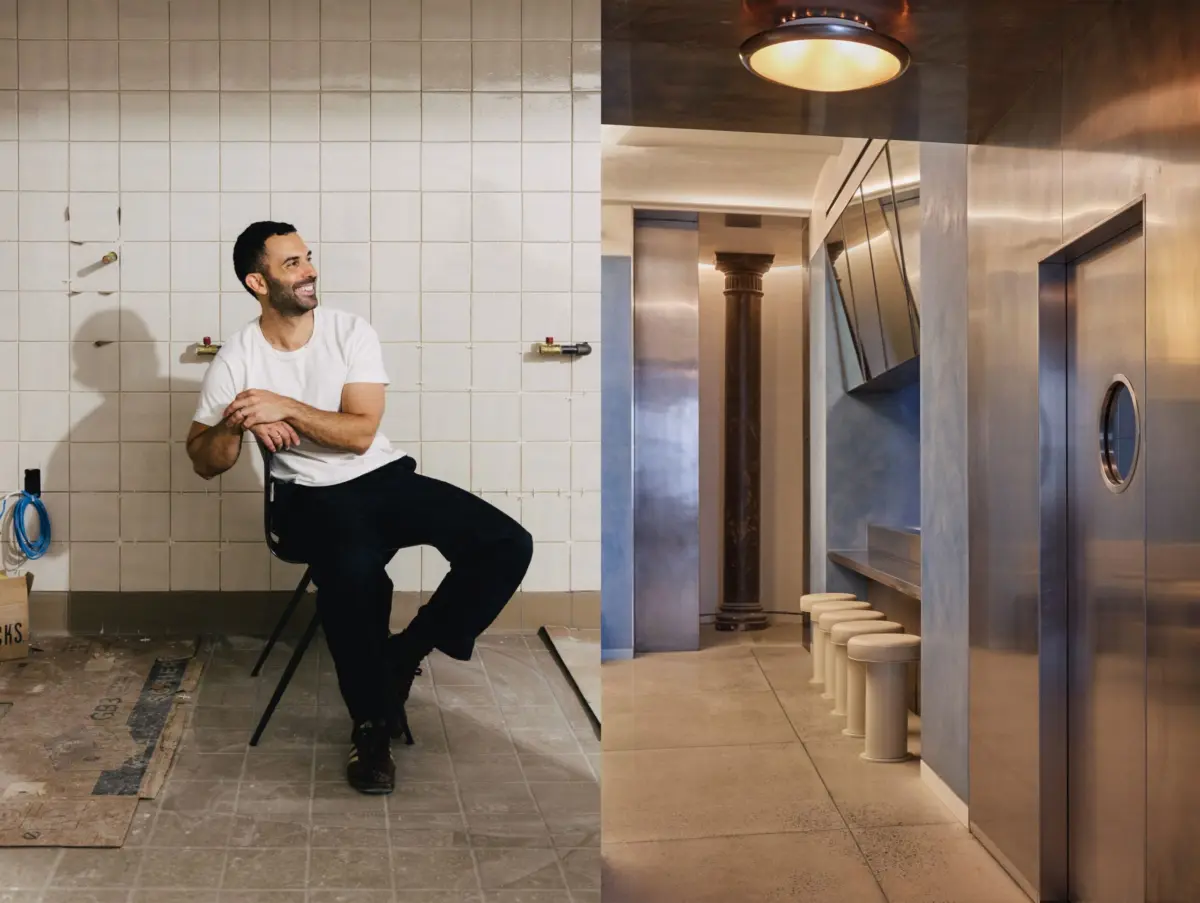
"I’ve always been obsessed with design, since I was a kid," says Andy Baraghani. "I love how restaurant interiors can take you to a different place."
At Ditto, the all-day café he is opening in New York’s Flatiron district, the chef, cookbook author, and YouTube star has given that obsession free rein. With each design decision—from the vintage glass-prism Holophane pendants in the front window to the intense blue (tinted to match Benjamin Moore Buckland Blue) of the rear dining area’s Venetian plaster walls—he asked himself: "Would I actually do this in my home?" If the answer was yes, it passed the test.

For Andy Baraghani, design is something of a family affair. His husband, Keith Pollock, is a former Architectural Design editor and now a West Elm executive. But opening a restaurant was never part of the initial plan. In fact, when Michael Silber, a restaurant investor behind New York hot spots like Borgo, Penny, and Bistrot Ha, approached him with the idea of a laid-back restaurant open for breakfast, lunch, and dinner, Baraghani admits his first reaction was that he simply had no interest in entering the venture.
It certainly was not for a lack of industry experience. Baraghani had started his career working in professional kitchens—from Chez Panisse in Berkeley, where he worked as a teenager, to Estela in New York—before transitioning to media as a food editor at Bon Appétit and ultimately winning a James Beard Award for his acclaimed cookbook, The Cook You Want to Be.
Yet, he quickly bonded with Silber over their shared love of greenmarket cooking and deep dives into interior decoration. When the conversation turned to Ditto, Baraghani realized he wanted the space to thoroughly convey his personal style. It certainly helped that he and Silber found themselves completely on the same page regarding the aesthetic direction. Silber notes that they discussed styles ranging from Bauhaus, de Stijl, and classic modernism to 1970s and 1980s aesthetics drawn from places like Italy and France.

To bring this vision to life, they brought in a team of like-minded collaborators: interior designer Eric Wink and architect Alta Indelman. Wink, a close friend of Baraghani who previously helped design the home Baraghani shares with Pollock, says the partners informed him that New York’s much-missed City Bakery, which was located just two blocks uptown from Ditto’s 16th Street address, served as a primary inspiration. Wink notes that they wanted the space to feel casual and approachable, carrying a bit of a classic New York diner quality while maintaining a sophisticated edge.
The physical space occupies a 1905 former industrial factory whose last incarnation was an agnès b. store. The interior is thoughtfully divided into three distinct zones. In the front section, visitors can browse and shop at a market area stocked with hand-picked specialty groceries. A glossy white counter featuring distinct Bauhaus curves anchors the middle section of the restaurant. This is where customers line up, take a number, and either carry their food out or sit down at laminate-topped tables positioned underneath a trio of oversized custom fabric pendants.
The menu at Ditto, handwritten on a roll of butcher’s paper and updated daily by the kitchen, features creative dishes such as a pomegranate spoon salad and what Baraghani describes as "the Platonic ideal of granola," served with tahini, maple syrup, and yogurt drizzled with fig-leaf oil. Flaky biscuits also stand out as an anticipated signature dish on the evolving menu.

The third zone, the one dramatically painted in vibrant blue, features an open kitchen and cozy café tables pulled up against a banquette that runs the entire length of the room. Baraghani explains that the layout creates an intentional dynamic, noting that there is a good kind of chaos in the middle while the back provides a much calmer moment for diners.
Indelman, a veteran architect with extensive experience collaborating with New York restaurateurs like Andrew Tarlow and Gabe Stulman, was tasked with giving the space a utilitarian, high-tech ambience. To achieve this, she clad the walls and the open kitchen area in patinated stainless steel while carefully preserving original industrial elements, including structural architectural arches and polished concrete floors.
However, it was Baraghani and Silber who personally took the lead on honing the intricate visual details of the interiors. Silber recalls going through roughly 50 possibilities just to find the right seating option for the dining room. The chair they ultimately selected—a 1960s Dutch industrial piece known as the Model S22 from Galvanitas—was sourced directly from Amsterdam Modern in Los Angeles.

Silber also spent hours browsing eBay to bid on midcentury ceramic bud vases to accent the shelves. He points out that each vase cost under $20, but when grouped together on a shelf, they create their own little Giorgio Morandi-inspired tableau.
The no-nonsense decor is rounded out by custom white wall speakers, created specifically for the space by sound artist Tom Bloxam and programmed with carefully curated playlists put together by Michael Scanlon of Chandelier Creative, the agency that oversaw Ditto’s overall branding. But the space also incorporates quirkier, unexpected moments. When it came to choosing the fabric for the custom stools, Baraghani insisted on Maharam’s Stripe It, which he felt brought a distinct Baja California vibe to the room. He notes that the space needed that specific kind of twist.
For the restrooms, Wink specified his favorite stainless-steel toilet: the wall-mounted MiniLoo from Neo-Metro. Wink explains that he added a custom wood top to the fixture to soften its industrial appearance slightly.

Meanwhile, a pair of massive midcentury French ceramic faces hanging on the wall opposite the daily menu are actually on loan directly from Baraghani’s own home. He explains that these personal pieces help anchor the space and add a necessary touch of craft, noting that he simply knew they belonged there from the very beginning.