
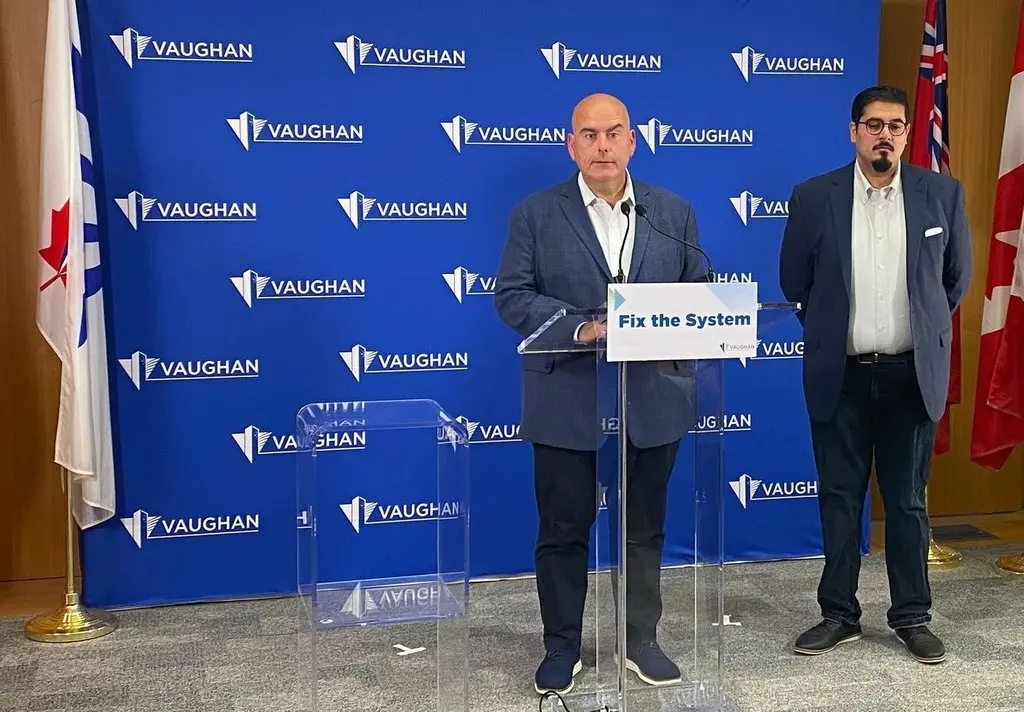
The Ford government is facing strong political resistance from local municipal leaders following its decision to appoint Vaughan Mayor Steven Del Duca as the Chair of York Region, a move that opponents argue creates an unacceptable conflict of interest and threatens to disadvantage neighboring communities.
Under the new arrangement announced by the Progressive Conservative government, Del Duca will serve in dual roles for the next four years, retaining his position as mayor of Vaughan while simultaneously taking on the governance responsibilities of the regional chair. In addition to combining these key leadership posts, the provincial government has equipped Del Duca with enhanced executive authority designed to fast-track decision-making on major provincial priorities, including housing development and key infrastructure projects, while granting him direct control over setting the official budget for the Region of York.
The appointment marks a significant shift in how the regional government operates. As mayor of Vaughan, Del Duca was already one of 22 representatives sitting on the York Region Council. However, the newly granted provincial powers fundamentally change that dynamic, giving him the explicit ability to overrule the full regional council. The governing body includes elected representatives from across the area’s constituent municipalities, including major urban and suburban centers such as Markham, Aurora, Newmarket, and Richmond Hill.
The centralization of authority has sparked sharp criticism from other municipal leaders within the region, most notably Markham Mayor Frank Scarpitti, who voiced deep alarm over the structural and democratic implications of the province’s decision. Scarpitti made it clear that he views the dual arrangement as fundamentally flawed from a governance standpoint, arguing that combining a local mayoralty with regional executive control creates an inherent conflict of interest that cannot be easily reconciled.
Scarpitti stressed that a sitting mayor is elected specifically to champion the interests of their own municipality. Giving that same individual executive power over regional operations creates an imbalance, as the leader possesses the institutional levers necessary to shape regional policies, resource allocations, and infrastructure decisions to favor their own community over others. The model of having a sitting municipal leader serve as regional chair, Scarpitti argued, represents a clear conflict between local advocacy and regional oversight.
In addition to the inherent conflict of interest, Scarpitti raised serious concerns regarding the democratic balance of power across York Region. By placing overriding authority in the hands of a single municipal leader, the province has effectively altered the legislative weight of the region’s nine local mayors. Scarpitti characterized this central authority as a troubling concentration of power, particularly when considering the vast financial resources overseen by the regional administration.

The scale of that authority is underscored by the regional budget itself. York Region manages an annual operational and capital budget of $5.2 billion, funding crucial public services, regional transit, road networks, water systems, and municipal infrastructure. Placing overriding budgetary and administrative authority over such a massive financial portfolio into the hands of one person, Scarpitti warned, undermines the collective decision-making process that has traditionally guided the multi-municipal region.
In response to the growing criticism, Del Duca issued a statement aimed at reassuring local politicians and residents across all parts of York Region. He stated that he intends to act as a broad advocate for the entire region and promised to work closely with leaders from all nine constituent municipalities to advance shared local and regional priorities.
Addressing concerns about systemic bias toward his home city of Vaughan, Del Duca insisted that his leadership would remain inclusive. He stated firmly that no single municipality within York Region would be overlooked or left behind under his tenure. Del Duca highlighted the historic tradition of municipal partnership in the region, noting that a spirit of collaboration has long been essential to its collective growth. He expressed his intention to work in close partnership with all 22 members of the York Region Council to meet the pressing needs of local residents.
Despite those assurances, the appointment has drawn widespread attention due to the remarkable political evolution between Del Duca and Premier Doug Ford. The two leaders have a long history of intense political rivalry, having previously stood on opposite sides of high-stakes provincial debates and electoral contests.
The rift between the two politicians deepened in 2020 when Del Duca won the leadership of the Ontario Liberal Party, positioning himself as Premier Ford’s primary political opponent. Throughout the COVID-19 pandemic, Del Duca launched aggressive public critiques of the Progressive Conservative government’s handling of the crisis. At the height of public frustration over pandemic measures, Del Duca went so far as to publicly call on Ford to resign, lambasting the government’s approach to public health restrictions and emergency management.
The hostility between the two political figures escalated further during the 2022 provincial election campaign. Ford routinely targeted Del Duca’s political record, focusing heavily on his previous tenure as Minister of Transportation under former Liberal Premier Kathleen Wynne. During public campaign appearances, Ford repeatedly characterized Del Duca as a failed cabinet minister, asserting in sharp terms that Del Duca had failed to deliver results on major provincial transit and infrastructure projects during his time in office.
However, the political dynamic between the two former rivals shifted dramatically following the 2022 provincial election. After stepping down from provincial politics, Del Duca successfully ran for municipal office and was elected mayor of Vaughan. Following his entry into local government, Del Duca and Ford established a surprisingly cooperative working relationship, setting aside their past political battles in favor of policy alignment.

Del Duca quickly demonstrated support for key provincial policy initiatives, including endorsing provincial measures aimed at removing automated speed enforcement cameras from city streets. This shift in alignment earned public praise from Premier Ford, who publicly softened his stance toward his former political opponent. Ford began referring to Del Duca as a close ally and a personal friend, eventually praising him publicly as one of the best mayors serving in the province of Ontario.
That sudden turnaround in political relations has not gone unnoticed by municipal critics. Scarpitti responded to the apparent camaraderie between the premier and the Vaughan mayor with sharp skepticism, pointing out the stark contrast between Ford’s past political rhetoric and his current praise for Del Duca. Referencing previous public comments made by Premier Ford regarding international relations, Scarpitti offered a biting commentary on the close political alignment that has developed between the premier and the newly appointed regional chair.
Scarpitti’s distrust of the appointment is also deeply rooted in historical friction dating back to Del Duca’s cabinet post in the Wynne government. Reflecting on past infrastructure negotiations, Scarpitti recalled instances where the city of Markham found itself at odds with the provincial Ministry of Transportation during Del Duca’s tenure as minister.
According to Scarpitti, major transit and municipal development initiatives—such as securing approval and funding for the York University campus expansion and driving forward the critical extension of the subway line into York Region—faced persistent hurdles at the ministerial level. As a result, municipal leaders from Markham felt compelled to bypass Del Duca’s ministry entirely, taking their appeals directly to the Premier’s Office in order to secure favorable decisions for their city.
That history continues to color Markham’s perspective on the regional leadership change. With Markham currently holding the status of the most populous municipality in all of York Region, Scarpitti openly questioned whether the city’s interests would be fairly represented under Del Duca’s leadership at the regional level, stating flatly that Del Duca has historically shown little favor toward Markham.
The provincial decision to grant enhanced executive authority to the York Region Chair reflects a broader push by the Ford government to centralize decision-making authority in municipal upper tiers to ensure provincial housing targets and infrastructure priorities are met rapidly. However, as the new governance model takes effect, the sharp divide between regional municipal leaders underscores deep-seated concerns over local democracy, financial control, and political equity across the nine communities that make up York Region.