
New-home buyers across Ontario are currently navigating a significant financial landscape shaped by substantial Harmonized Sales Tax (HST) relief, with potential savings reaching up to $130,000 on eligible transactions. Designed to stimulate the housing market and ease the burden on purchasers acquiring newly constructed properties, this enhanced relief framework has fundamentally changed the math of buying a brand-new home. However, as market conditions evolve and new marketing practices take root, industry experts are issuing timely warnings about a critical distinction that both buyers and the real estate agents advising them must thoroughly understand to avoid unpleasant financial surprises.
The core of the issue lies in how builders advertise their properties. In recent months, real estate professionals have observed an increasing number of developers marketing new-home prices as "exclusive of HST." Industry veterans are quick to point out that this terminology does not mean "after the HST rebate."
When the enhanced HST relief measures were first rolled out, the presentation of prices across the province was largely uniform. Many builder price lists explicitly featured prices described as "after HST rebate" or otherwise presented figures that immediately reflected the anticipated tax relief. For prospective homeowners wading through complex financial decisions, those straightforward figures made comparing properties and assessing affordability much easier.
An advertised price structured as "exclusive of HST," however, operates under an entirely different mechanism. This figure represents the base cost of the property before any taxes are factored into the equation. Once this baseline is established, the applicable 13 per cent HST must be calculated, and only after that crucial step are the specific rebates or tax relief measures that a particular purchaser qualifies for applied to the total. This distinction is far from semantic; it can materially change the actual amount of money a buyer must bring to the closing table.
While marketing a home using an HST-exclusive price is not inherently incorrect—particularly when it is accompanied by clear and prominent disclosure—it carries a significant potential for misunderstanding. Prospective buyers who assume that a bold headline number already accounts for available government relief can easily miscalculate their true purchasing power. If this gap in understanding goes unrecognized during the early stages of a transaction, the financial shortfall can materialize as a severe and stressful shock when closing day arrives.
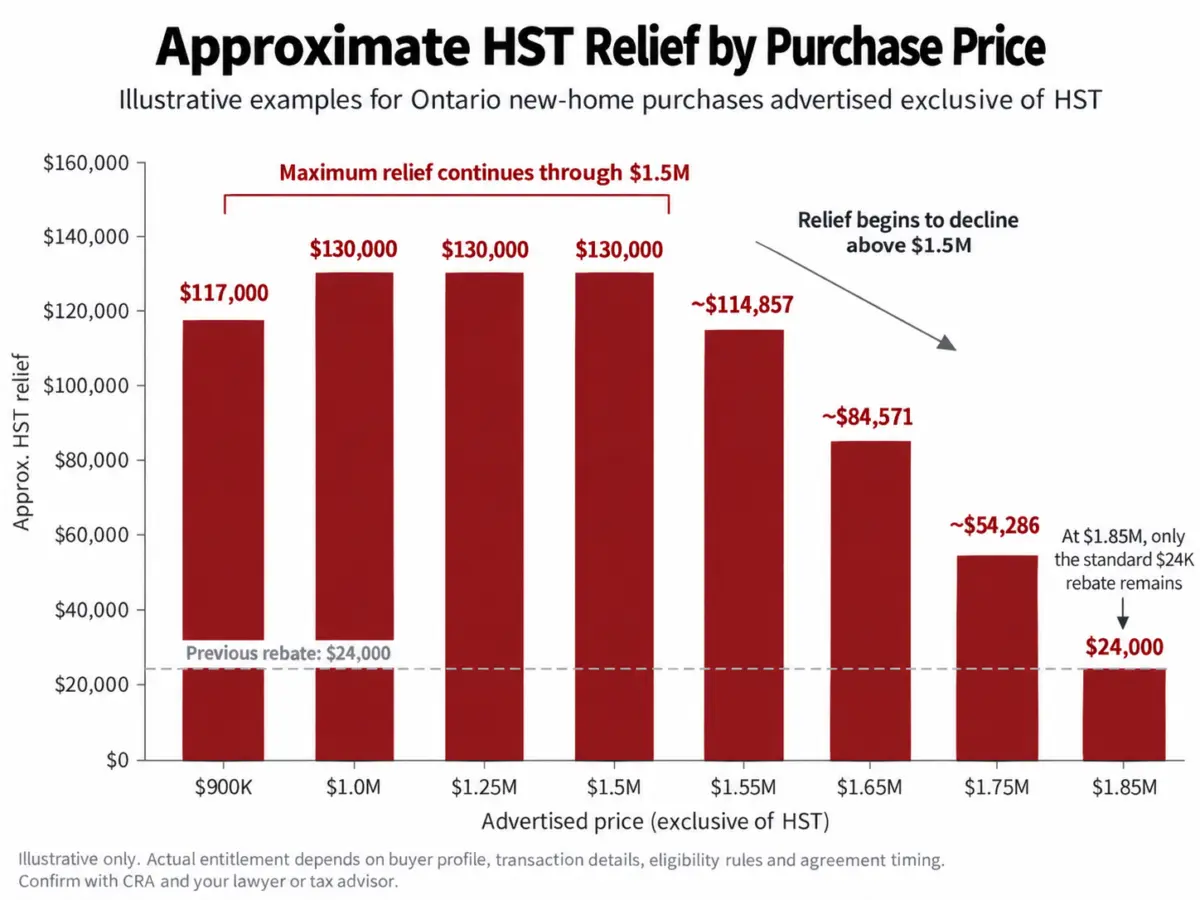
Understanding the underlying numbers reveals just how profound the impact of Ontario’s enhanced HST relief can be, but also highlights why transparency in pricing is so vital. Under the current framework, eligible purchasers can receive tax relief equivalent to the full 13 per cent HST on homes priced up to $1 million. For properties valued between $1 million and $1.5 million, the maximum relief is capped at $130,000. For homes priced above $1.5 million, the enhanced relief begins to taper off gradually until it effectively disappears at the $1.85 million threshold, at which point buyers revert to the existing Ontario rebate framework of up to $24,000, where applicable.
To put this into practical perspective, consider a property with a purchase price of $1.5 million before HST. Under the current enhanced relief regime, an eligible buyer could benefit by approximately $106,000 compared to the older, more restrictive $24,000 rebate framework. Yet, that significant tax break does not mean a $1.5 million home marketed as "exclusive of HST" can be acquired for a total of $1.5 million. In this specific scenario, after factoring in the standard tax calculations and the maximum available relief, the actual purchase price rises to approximately $1.565 million.
The complexity of these calculations deepens when buyers begin customizing their properties with lot premiums and architectural upgrades. These additions are not isolated line items; they directly influence the overarching HST calculation and can inadvertently alter a buyer’s eligibility tier.
Consider a newly constructed home advertised at $1,475,000 exclusive of HST. Assuming the purchaser qualifies for the maximum available relief, the final purchase price after applying the HST relief would land at roughly $1,537,000. If that same buyer decides to incorporate a $75,000 lot premium into the agreement, the baseline price before HST increases to $1,550,000.
That seemingly straightforward upgrade pushes the transaction past the critical $1.5 million threshold. Crossing this financial line triggers the phase-out mechanism of the enhanced HST relief, causing the amount of available tax relief to decline. Consequently, the resulting final purchase price surges to approximately $1,637,000.
In this scenario, a lot premium valued at $75,000 ultimately increases the buyer’s total closing cost by roughly $100,000. The underlying reason for this discrepancy is twofold: the buyer must pay the standard HST on the additional $75,000 value, and crossing the $1.5 million threshold simultaneously reduces the overall amount of HST relief the government provides. A discretionary upgrade or a desirable lot selection can therefore carry a financial footprint considerably larger than its face value once its ripple effects on taxation and rebates are fully accounted for.
Looking at the broader spectrum of the market, the financial impact varies widely depending on the baseline price. For a home with an advertised exclusive-of-HST price of $900,000, the approximate HST relief reaches $117,000, leaving no remaining tax portion to be paid and resulting in an actual purchase price of $900,000—delivering a $93,000 benefit over the previous $24,000 primary residence rebate regime. At the $1 million mark, maximum relief hits $130,000, entirely wiping out the tax burden and yielding a $106,000 advantage over older rules.
However, as prices scale upward into the $1.25 million and $1.5 million ranges, remaining tax portions of $32,500 and $65,000 respectively begin to factor into the final equations, even after applying the maximum $130,000 relief cap. For properties priced at $1,550,000, the estimated relief dips to roughly $114,857, leaving an HST portion of approximately $86,643 to be paid and driving the actual purchase price to about $1,636,643. By the time an advertised price reaches the upper threshold of $1,850,000, the enhanced relief has phased out entirely, leaving only the standard $24,000 rebate and resulting in a total purchase price of $2,066,500—yielding no additional financial benefit over the legacy system.
Industry experts emphasize that these figures remain illustrative. An individual purchaser’s actual entitlement depends heavily on the specific transaction structure, the exact date of the agreement, strict occupancy requirements, and various other statutory eligibility criteria. Prospective homeowners are consistently advised to verify their precise entitlements directly with the Canada Revenue Agency alongside qualified legal and tax professionals.
For home buyers and the real estate agents representing them, navigating the modern pre-construction market requires a shift in analytical rigor. Before comparing a newly built property against competing developments or established resale homes, stakeholders must look beyond promotional marketing materials. The availability of government tax relief remains an undeniably valuable asset for those entering the housing market, but headline figures can easily mask the true financial commitments required. In the end, the fundamental question facing every purchaser remains straightforward and uncompromising: what will this property actually cost at closing?