
Ontario’s new-home buyers are currently navigating a significant financial landscape shaped by enhanced Harmonized Sales Tax (HST) relief of up to $130,000 on eligible transactions. However, as real estate professionals and purchasers adapt to these substantial savings, industry experts are warning of a critical distinction in how builders market their properties. A growing number of developers are beginning to advertise new-home prices as “exclusive of HST,” a pricing strategy that can easily be misconstrued and lead to unexpected financial liabilities if not carefully scrutinized early in the buying process.
When the enhanced HST relief measures were first introduced to stimulate the housing market and ease affordability pressures, the transition was relatively straightforward for consumers to digest. At that time, many builder price lists explicitly presented figures described as “after HST rebate,” providing a transparent baseline that already reflected the anticipated tax relief. For everyday buyers entering the complex pre-construction market, seeing a single, comprehensive number made budgeting and comparing developments far more manageable.
Today, the prevalence of prices advertised as “exclusive of HST” changes the mathematical equation entirely. This designation simply means the stated figure is the base price before the provincial and federal sales tax is added. To arrive at the correct cost, the applicable 13 percent HST must first be calculated on the base price, and only after that calculation are the rebates or enhanced relief programs that a particular purchaser qualifies for applied. Real estate authorities emphasize that while marketing a home using an HST-exclusive price is not inherently incorrect, provided it is accompanied by clear and prominent disclosure, it introduces a dangerous margin for error.
The primary danger lies in consumer assumption. Many buyers casually browsing new developments may mistakenly assume that an advertised price already accounts for available government rebates, leading them to underestimate their total financial commitment. If this misunderstanding goes undetected through the initial negotiation and contract signing phases, the resulting discrepancy can manifest as a very unpleasant and costly surprise on closing day, when mortgage approvals are finalized and funds must be transferred.
Understanding the True Mechanics of the Numbers
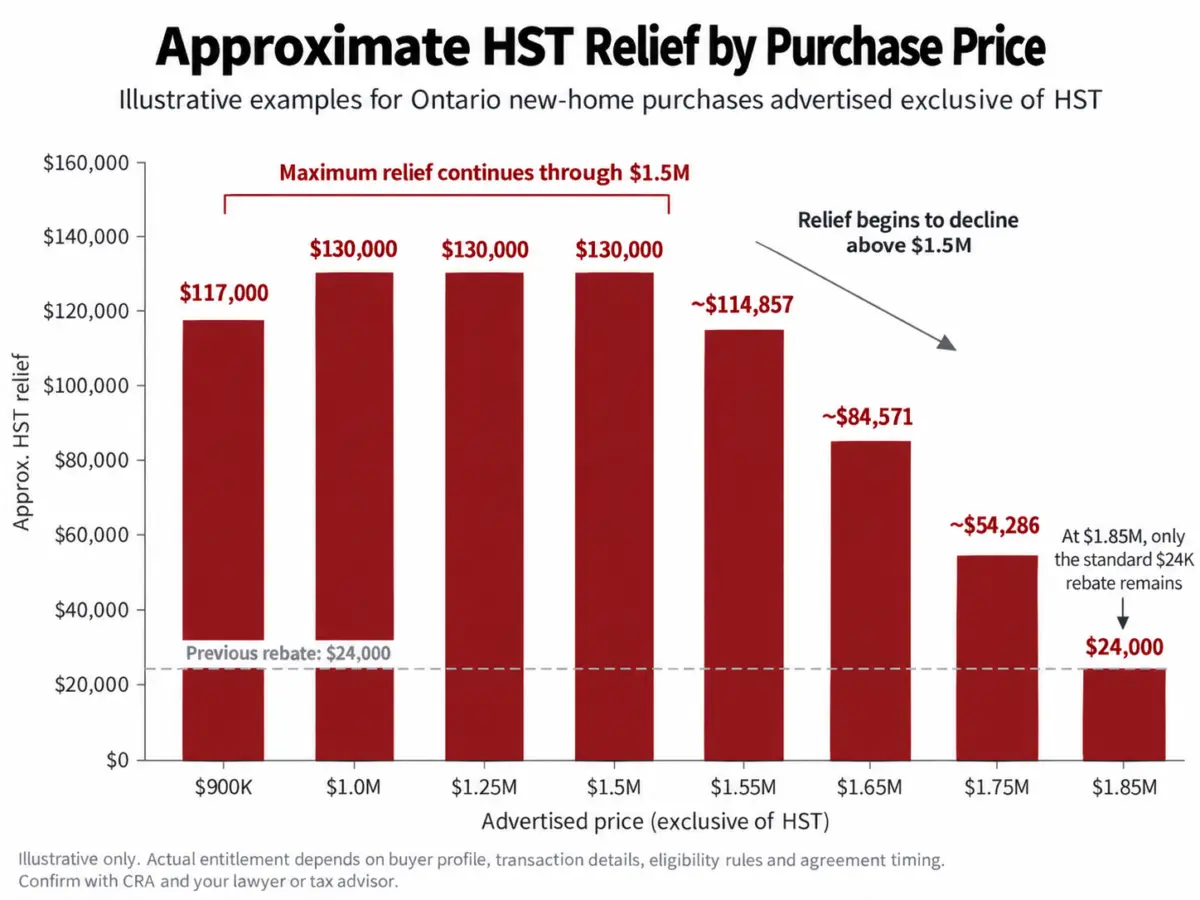
To grasp how these pricing structures impact the bottom line, buyers must understand the sliding scale of Ontario’s current enhanced HST relief framework. Under the updated guidelines, eligible purchasers can receive relief equivalent to the full 13 percent HST on properties priced up to $1 million. For homes valued between $1 million and $1.5 million, the maximum relief is capped at $130,000. As the purchase price climbs beyond $1.5 million, the enhanced relief begins to taper off gradually until it effectively disappears at $1.85 million, at which point buyers revert to the existing legacy Ontario rebate of up to $24,000, assuming they meet primary residency and other standard eligibility criteria.
The practical implications of this sliding scale are substantial. Consider a scenario involving a home with a base purchase price of $1.5 million before HST. Under the current regime, an eligible buyer could benefit by approximately $106,000 in total tax relief compared to the previous $24,000 rebate structure. However, that financial advantage does not mean a $1.5 million “exclusive of HST” home can be acquired for $1.5 million. When the tax is calculated and the maximum $130,000 relief is applied, the actual purchase price rises to about $1.565 million.
This distinction becomes even more critical when buyers begin customizing their properties with structural changes, finishes, and specific property selections. Lot premiums and custom design upgrades are routinely added to pre-construction contracts, and these extras directly alter the fundamental HST calculation in ways that can catch purchasers completely off guard.
The Compound Cost of Lot Premiums and Upgrades
The interaction between upgrade costs and tax thresholds can create a compounding financial effect that far exceeds the face value of the chosen feature. Industry analysts point to specific housing transactions to illustrate how quickly these costs can escalate.
Imagine a home initially advertised at $1,475,000 exclusive of HST. Assuming the buyer qualifies for the maximum available relief, the purchase price after accounting for the HST and the corresponding relief lands at approximately $1,537,000. If that same buyer subsequently chooses a lot premium costing $75,000, the base price before HST shifts from $1,475,000 to $1,550,000.
That modest adjustment in the base price pushes the total transaction value across the critical $1.5 million threshold where the enhanced HST relief begins to decline. As a direct result of crossing that regulatory line, the final purchase price surges to about $1,637,000. In this instance, a $75,000 lot premium ultimately increases the buyer’s total out-of-pocket expenditure by roughly $100,000.
The reason for this exponential jump is two-fold. First, the buyer must pay standard HST on the additional $75,000 value of the lot premium itself. Second, by elevating the total pre-tax price past the $1.5 million mark, the transaction triggers a reduction in the overall amount of enhanced HST relief the government will disburse. Consequently, upgrades and lot premiums can carry a hidden multiplier effect once their impact on both raw taxation and rebate eligibility is fully calculated.
A broader look at the financial spectrum underscores these variances. For a home with an advertised exclusive-of-HST price of $900,000, the approximate HST relief reaches $117,000, leaving no remaining tax to be paid and resulting in an actual purchase price of $900,000—providing a $93,000 benefit over the old $24,000 rebate regime. At the $1,000,000 mark, the relief hits the maximum full-tax offset of $130,000, keeping the final acquisition cost flat at $1,000,000 and saving the buyer $106,000 compared to past standards.
However, as prices rise into the upper tiers, the remaining tax liability grows. At an advertised price of $1,250,000, the $130,000 relief leaves an unrebated HST portion of $32,500, bringing the actual purchase price to $1,282,500. Moving up to $1,500,000 results in $65,000 of remaining tax to be paid after the $130,000 relief, creating a final purchase price of $1,565,000.
Once valuations surpass the $1.5 million threshold, the numbers shift more drastically. An advertised price of $1,550,000 yields approximately $114,857 in relief, leaving about $86,643 in unrebated tax and driving the actual purchase price to roughly $1,636,643. At $1,650,000, relief drops to an estimated $84,571, leaving $129,929 in tax to be paid and pushing the final cost to approximately $1,779,929. Continuing upward, a $1,750,000 home attracts about $54,286 in relief, leaving $173,214 in tax and resulting in a purchase price of roughly $1,923,214. Finally, at the upper boundary of $1,850,000, the enhanced relief phases out entirely, offering only the standard $24,000 rebate and bringing the final cost to $2,066,500—matching the legacy framework with zero net benefit from the new enhanced tier.
These figures, while illustrative, highlight the imperative for rigorous financial planning. Actual entitlements depend heavily on the specific purchaser, the structuring of the transaction, the date of the agreement, ongoing occupancy requirements, and a variety of other legal and regulatory eligibility criteria. Real estate advisors consistently recommend that buyers confirm their exact tax entitlements directly with the Canada Revenue Agency, alongside their legal counsel or qualified tax professionals, before executing binding agreements of purchase and sale.
Ensuring Clarity for Buyers and Agents
As the pre-construction market continues to evolve under these tax provisions, both purchasers and the real estate agents representing them face heightened responsibilities. Before a buyer compares a new development against another pre-construction project or evaluates it alongside an established resale property, establishing a clear line of sight into the total cost structure is paramount.
While government-backed rebate programs offer substantial financial advantages that make homeownership more accessible across Ontario, headline marketing figures can easily obscure the true monetary commitments required. For all parties involved in a transaction, the fundamental question remains straightforward and uncompromising: what will this home actually cost when the closing day arrives?