
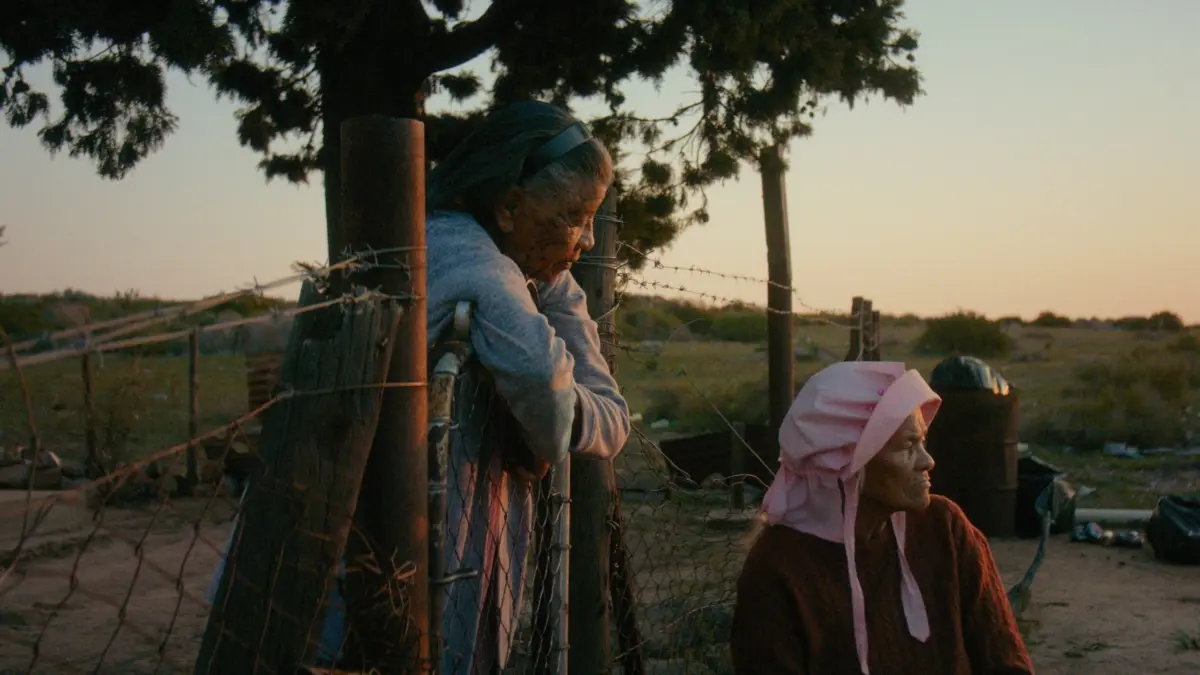
The sun sets over the rugged, sun-baked landscape of South Africa’s remote Kamiesberge, casting long shadows across a landscape that has witnessed generations of toil, endurance, and quiet resilience. Here, amidst the sparse vegetation and rocky terrain, lives Ouma Hettie, an octogenarian goat herder whose daily life is deeply intertwined with the rhythms of the earth. But Ouma Hettie’s quiet routine is suddenly upended when she falls victim to a calculated scam. The fraudsters dangle the promise of long-overdue financial reparation for her father’s unpaid military service during World War II, pulling her family into a turbulent situation that involves far more intervention and drama than she would ever care for.
This compelling narrative serves as the foundation of Variations on a Theme (originally titled Variasies op ’n Tem), a striking new feature film written and directed by the creative duo Devon Delmar and Jason Jacobs. Having previously collaborated on the acclaimed film Carissa, Delmar and Jacobs have crafted a cinematic achievement that has already captured significant international acclaim. Most notably, Variations on a Theme triumphed on the global stage earlier this year by winning the prestigious Tiger Award at the International Film Festival Rotterdam. Following that major victory, the film continued its celebrated festival run with a recent screening at the landmark 70th edition of the BFI London Film Festival.
For audiences and critics alike, the film’s hypnotic pull lies largely in its distinct formal approach. As noted in the official programming from the BFI London Film Festival website, a poetic and distinctive visual style infuses playfulness into this insightful study of a woman’s resilience and a community that exists close to the land.
During the film’s screening at the BFI London Film Festival, Devon Delmar—who pulls double duty as the film’s editor—traveled to London to discuss the unique creative process behind the project. In an interview with The Hollywood Reporter, Delmar opened up about the inherent musicalness of Variations on a Theme, sharing fascinating behind-the-scenes insights, including the revelation that their meticulous structural planning was famously mapped out on Microsoft Excel, making it quite possibly the only movie in cinema history to be written using the spreadsheet program.
Watching the film, audiences are immediately struck by its rhythmic dance-like vibe. There is a palpable sense of an underlying choreography that viewers can deeply feel as they experience the story, even if they might struggle to articulate or explain precisely where that sensation comes from. According to Delmar, this hypnotic quality was entirely intentional from the very beginning of the creative journey.
The genesis of the project is deeply rooted in the personal background of co-director Jason Jacobs. As Delmar explains to The Hollywood Reporter, Jacobs is a deeply perceptive and observant individual who actually hails from the very village showcased in the film. Born and raised in the rural community, Jacobs attended local schools before eventually moving away to live in Cape Town. However, after spending time in the city, he chose to return to his roots to live with his grandmother. The filmmaking duo had previously collaborated on a short film shot in the exact same village, which allowed Delmar to integrate into the community as well.
This deep familiarity with the location provided the filmmakers with a profound understanding of the local pace of life. Delmar notes that anyone who takes the time to observe can pick up on the routine and rhythm of the space. If an observer sits quietly in a corner for long enough, the recurring patterns of daily life begin to emerge naturally. One starts to notice the familiar sights, such as a local resident walking past with his flock of goats just as the sun begins to dip below the horizon. These routines are deeply ingrained into the physical space, and observing the musicality of the environment within that steady rhythm proved to be profoundly inspiring for the directors.
That core observation directly inspired the film’s title, Variations on a Theme. The repetitive nature of everyday village life began to harmonize—to use a musical term once again—with a sobering realization about the broader socio-economic realities of the region. The filmmakers recognized that the exploitation taking place in the village in 2026 was merely history repeating itself in a continuous loop. What modern villagers experience when they are scammed out of their hard-earned money mirrors precisely what happened back in the 1940s to the protagonist’s father, who suffered exploitation at the hands of the government of the day. Furthermore, that cycle connects directly to the historical hardships inflicted upon colonized populations stretching back across multiple generations.
For the filmmakers, this theme of repetition became a vital guiding principle for their creative philosophy. It felt entirely natural to incorporate that exact concept directly into the structural framework of the film, using formal repetition to visually and thematically highlight the cycle of systemic violence alongside the humble daily routines of an elderly woman striving to maintain her dignity.
Translating this complex thematic framework into a rigorous visual structure required unconventional methods. Perhaps most surprisingly, the primary tool Delmar and Jacobs utilized to map out the shots and guarantee the precise visual representation of repetition and cycles was none other than Microsoft Excel. While it sounds like an unconventional choice for artistic creation, Delmar proudly embraces the distinction. He jokes that it is potentially the only film ever to be written on Microsoft Excel, explaining that because the narrative spans five distinct story days, they organized their production plan into five vertical columns alongside thirty specific shots that repeated with absolute, clockwork precision.
The unconventional creative influences behind the project do not stop there. Delmar points to classical music as another major touchstone, specifically drawing inspiration from the renowned Estonian composer Arvo Pärt. Widely celebrated as a towering figure in Tallinn’s musical landscape, Pärt is famous for composing his masterpieces through highly formulaic methods. He frequently constructs his pieces around strict formulas or mathematical equations, starting with a remarkably small kernel or seed of an idea. Once Pärt unleashes that tiny seed, it evolves into some of the most emotionally resonant, beautiful, and deeply spiritual music imaginable.
That compositional philosophy served as a direct blueprint for the narrative architecture of Variations on a Theme. The filmmakers were intensely curious about how they could successfully contain an entire feature film within one single, core conceptual idea, and then effectively press play to let it organically unfold. Comparing the cinematic experiment to a delicate piece of origami that suddenly springs to life as an intricate pop-up book once opened, Delmar and Jacobs have successfully delivered a distinctive, rhythmically driven cinematic experience that continues to captivate audiences across the globe.