
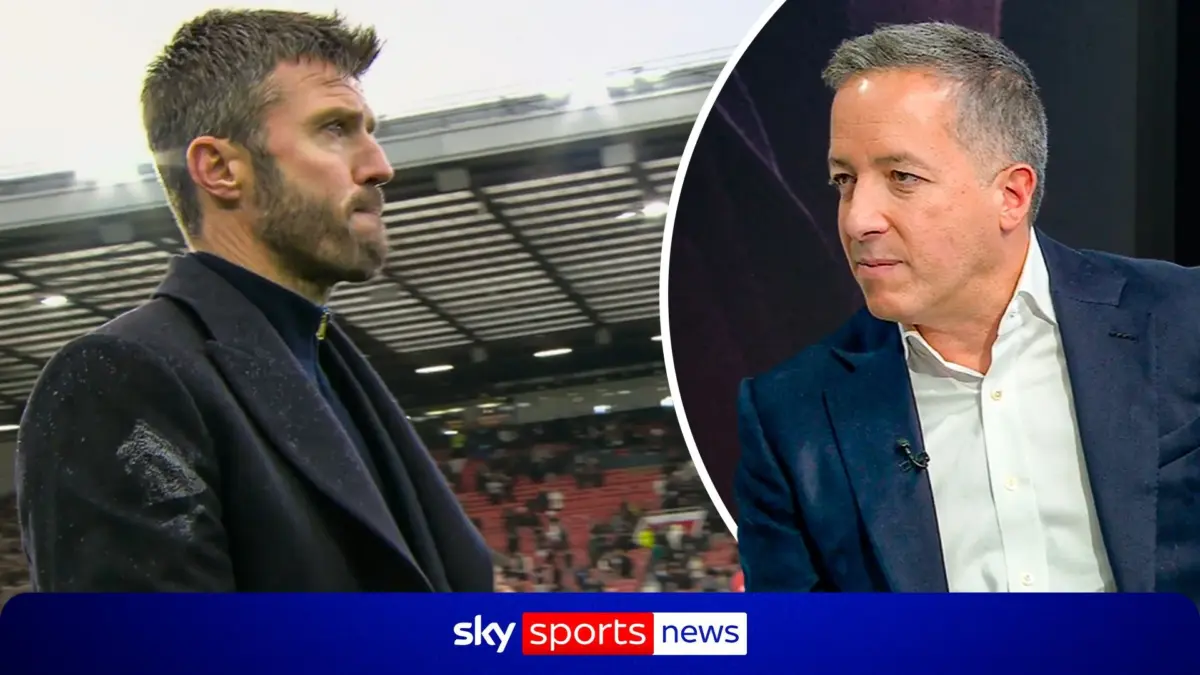
The crisis enveloping Old Trafford continues to deepen as Manchester United find themselves languishing in the Premier League relegation zone, leaving the future of manager Michael Carrick hanging heavily in the balance. Amid mounting pressure from supporters and growing scrutiny over operations behind the scenes, Sky Sports News chief correspondent Kaveh Solhekol addressed the club’s turbulent situation during a comprehensive live Q&A session, tackling the burning questions on every fan’s mind.
From the realistic prospects of a complete takeover by the Glazer family or Middle Eastern investors to the scathing evaluations of the club’s recent recruitment strategies and leadership accountability, the discussion laid bare the complex structural challenges plaguing one of world football’s most scrutinized institutions.
Will Man Utd ever be sold?
Addressing the persistent desire among supporters for a total change in ownership, Solhekol explained that any prospective sale rests entirely with the Glazer family rather than the club’s board of directors. For the American owners to even consider relinquishing their stake, potential buyers would need to table bids amounting to billions of pounds or dollars.
While the Glazers have historically profited handsomely from their ownership despite facing relentless supporter backlash and fan protests, Solhekol noted that a breaking point could theoretically be reached if an astronomical offer materialized. However, the mechanics of such a transaction would follow established corporate protocol. If a sale were genuinely on the horizon, the family would likely instruct a major merchant or investment bank—similar to their previous engagement with the New York-based Raine Group several years ago—to manage the process.
Currently, no such instructions have been given, and there is no official indication that the club is actively up for sale. Furthermore, any prospective investor looking to acquire a major footprint would have to navigate complex contractual structures. For instance, purchasing the Glazer family’s shares could trigger "drag-along rights," forcing Sir Jim Ratcliffe and INEOS to sell their existing 30 percent stake as well. While outside billionaires may quietly monitor the situation behind the scenes, the immediate reality is that Manchester United remain firmly under their current ownership structure.
Is a Middle Eastern takeover a possibility?
The conversation surrounding potential external investment naturally shifted toward the Middle East, recalling previous serious interest from Qatari bidders led by Sheikh Jassim. Solhekol recalled that the Qatari consortium’s ambitious proposals included wiping out Manchester United’s historic debt burden accrued under the Glazers alongside grand developmental plans for the club.
Ultimately, those negotiations collapsed because the prospective buyers felt the Glazer family’s asking price was excessively inflated. With figures floating around five to six billion pounds, the Qataris drew comparisons to their peers—pointing out that Paris Saint-Germain was acquired for approximately £100 million and Manchester City was bought by members of the Abu Dhabi royal family for roughly £150 to £160 million—making a multi-billion-pound outlay for a club struggling on and off the pitch commercially and competitively unjustifiable.
Looking at the current geopolitical and economic climate, Solhekol believes a renewed bid from that region is unlikely in the short term. Ongoing instability in the Middle East, fluctuating oil prices, and logistical disruptions such as constraints in the Strait of Hormuz mean that key regional investors currently have far more pressing economic and strategic priorities to manage than launching a multi-billion-pound Premier League football club acquisition.
Are Man Utd still a draw as a big club?
Confronted with the stark reality of the club’s current standing, Solhekol validated the concerns of supporters questioning whether Manchester United’s historic global pull has fundamentally diminished. A decade or fifteen years ago, United stood uncontested as the wealthiest and most prestigious club in world football, comfortably eclipsing Spanish giants Real Madrid and Barcelona.
That landscape has drastically shifted. Today, Manchester United rank roughly eighth or ninth in global wealth, having been surpassed internationally by Real Madrid, Barcelona, and Bayern Munich, while domestically trailing behind modern powerhouses such as Manchester City, Arsenal, and Liverpool.
Despite their sporting decline, United retain a disproportionate level of media coverage relative to their current league position. Industry insiders readily admit that discussing Manchester United remains a primary driver for audience engagement and commercial media revenue in England, cementing their status alongside Liverpool and Arsenal as the traditional "big three" of English football discourse.
Why did they keep Carrick on?
The decision to entrust Michael Carrick with the permanent managerial post following a successful interim spell continues to draw sharp criticism from the fanbase. Solhekol acknowledged that while Carrick’s interim period—which successfully secured a third-place finish and Champions League qualification—made him appear the lowest-risk appointment at the time, hindsight suggests it may have been a costly misstep.
At the time of Carrick’s appointment, a wealth of top-tier managerial talent was available on the market, offering the club an opportunity to secure elite tactical minds. Available candidates included proven managers such as Andoni Iraola, Xabi Alonso, Thomas Frank, Oliver Glasner, Marco Silva, Antonio Conte, and Roberto De Zerbi before his move to Tottenham Hotspur. Instead, United chose continuity with Carrick, a decision that is now being heavily second-guessed as results plummet.
Should Man Utd stick with Carrick?
Offering a personal perspective, Solhekol expressed sympathy for Carrick’s current predicament, arguing strongly that he deserves time and institutional backing. He emphasized that treating a figure who won 11 major trophies and five Premier League titles as a player in such a ruthless fashion leaves a bitter taste, suggesting that the former midfielder has effectively been left isolated and exposed by the club’s broader structural failures.
Isn’t Poch just another stop-gap?
As speculation mounts regarding potential successors, Mauricio Pochettino’s name has frequently surfaced in connection with the Old Trafford hotseat. Addressing concerns that Pochettino’s journeyman career—spanning multiple clubs in a relatively short timeframe—might brand him as merely a temporary fix, Solhekol largely agreed with the sentiment.
While Pochettino does not project the aura of a generational architect like Sir Alex Ferguson, Solhekol noted that the former Paris Saint-Germain and Tottenham manager maintains a longstanding affinity for Manchester United and holds deep respect for Ferguson’s legacy. Although Pochettino may harbour ambitions of managing the club eventually, Solhekol questioned whether any sensible manager would willingly inherit the notoriously volatile Old Trafford position under the current turbulent circumstances.
Why not go for Ancelotti?
When considering elite, proven winners, some supporters have questioned why the club has not pursued current Brazil national team boss Carlo Ancelotti. Solhekol dismissed the notion as entirely unrealistic, pointing out his firsthand observations of Ancelotti deeply immersed in his international managerial duties with the Brazilian Football Confederation. Having witnessed the Italian manager’s focus during the World Cup cycle, Solhekol asserted there is simply no sporting motivation for Ancelotti to abandon his current high-profile role to rescue a Premier League side currently battling in the relegation zone.
Are Berrada and Wilcox’s futures in doubt?
Behind-the-scenes accountability remains a central theme as chief executive Omar Berrada and director of football Jason Wilcox prepare to present the findings of an internal review to Sir Jim Ratcliffe during a high-stakes meeting in Monaco. Solhekol highlighted the delicate and potentially awkward nature of these discussions.
Ratcliffe, a billionaire industrialist who built a vast commercial empire, is unlikely to sit passively while executives present a report recommending the dismissal of Michael Carrick. Instead, questions will inevitably turn back toward the leadership team itself: whether Berrada and Wilcox are integral components of the solution or part of the ongoing problem.
With the club sinking into the relegation zone and enduring a repetitive cycle of sacking managers and paying massive financial compensation packages for the third consecutive season, the scrutiny extends far beyond the dugout. Ratcliffe and INEOS executives, alongside the Glazer family, are closely monitoring every performance metric and public reaction, ensuring that the upcoming executive presentations will face rigorous examination from top-level ownership.
Should Utd change recruitment strategy?
A recurring critique of Manchester United’s operations centres on their erratic player recruitment model. Solhekol pointed out a glaring strategic flaw unique to United’s recent history: spending massive sums in consecutive summer windows selectively targeting isolated positions—focusing heavily on forwards one year, midfielders the next, and defenders thereafter—rather than methodically constructing the core spine of a successful team.
Football experts universally agree that sustainable success requires establishing a robust foundation featuring an elite goalkeeper, central defender, central midfielder, and prolific forward, mirroring the character and personality of past championship-winning sides. Instead, United’s recruitment has been severely undermined by poor execution, excessive wage commitments, and vast
sums of squandered capital.
The arrival of Sir Jim Ratcliffe and INEOS has forced a harsh financial reckoning. Motivated by strict corporate disciplines that treat club expenditure with the same prudence as private capital, the new leadership has clamped down on reckless spending, signaling a necessary shift toward a much more disciplined and sustainable approach to squad building moving forward.