
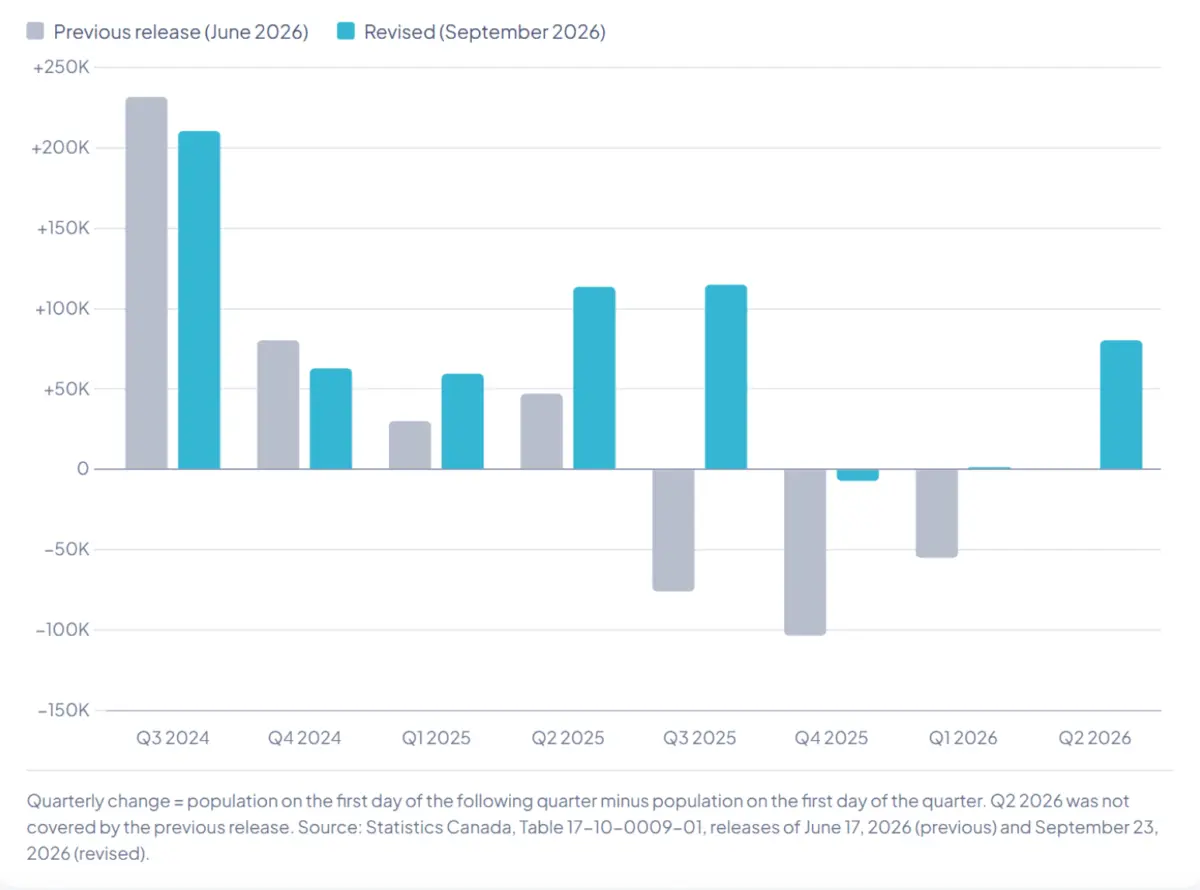
Major revisions to Canada’s official population estimates have dramatically reshaped the economic narrative surrounding the nation’s housing market, erasing two of the three previously reported quarters of population decline and challenging long-held assumptions about what is driving down asking rents.
The sweeping adjustments, which stretch backward nearly five years to the final quarter of 2021, indicate that new housing supply has played a far more decisive role in softening Canada’s rental market than analysts previously understood. According to a comprehensive joint analysis from Rentals.ca and Urbanation, the influx of new construction has exerted a powerful downward pressure on costs across the board, even in the face of continued demographic expansion.
The cooling trend in the rental market remains pronounced. In August, the average asking rent across Canada settled at $2,035, marking a notable 4.8 per cent decline on a year-over-year basis, according to the latest rental market data compiled by Rentals.ca. From the historic peak recorded in May 2024, average asking rents have retreated by 7.6 per cent. For months, economists and policymakers debated the primary catalysts behind this relief, with many pointing to preliminary data suggesting that a sudden contraction in the country’s population growth was starving the market of rental demand.
Population Decline Largely Disappears in Revised Data
The statistical foundation for that demand-contraction theory has now largely dissolved. Previous population estimates published by Statistics Canada showed the country undergoing three consecutive quarters of population decline, a trend that appeared to align neatly with the cooling of rental metrics. However, the newly revised figures reveal a starkly different reality, showing only one modest quarterly contraction: a decrease of 7,225 people during the fourth quarter of 2025.
The magnitude of the statistical corrections becomes even clearer when examining specific periods. The most dramatic adjustment occurred in the third quarter of 2025. Initially, federal data indicated a steep population decline of 76,068 people during that three-month window. Following the comprehensive revisions, that figure was flipped into a substantial population increase of 114,941 people.
When aggregated, the cumulative revisions added an eye-opening 301,008 people to Canada’s estimated total population as it stood in the second quarter of 2026. Furthermore, the year-over-year population growth rate calculated from the first quarter of 2025 to the first quarter of 2026 was adjusted upward from an initial decline of 0.5 per cent to a positive growth rate of 0.5 per cent.
Temporary Residents Drive the Statistical Shift
The primary engine behind these sweeping revisions lies within the category of non-permanent residents. More than 90 per cent of the cumulative population adjustment stems from recalculated estimates of net non-permanent residents, a cohort that was revised upward by a staggering 275,942 people as of the second quarter of 2026.
According to the analysis from Rentals.ca and Urbanation, Statistics Canada attributed the bulk of this massive upward adjustment to the incorporation of newly available administrative data from Immigration, Refugees and Citizenship Canada (IRCC). Specifically, the data captured a large population of temporary residents whose formal permits had expired, but who legally remained inside Canada while awaiting official decisions on pending extension applications or permanent residency pathways.
In earlier iterations of the demographic tracking, statistical models routinely counted these individuals as having departed Canada the moment their original permits reached their expiry dates. By correcting this methodology to account for individuals remaining in the country during administrative processing backlogs, the federal agency uncovered hundreds of thousands of residents who had been statistically invisible in previous quarterly reports.
New Rentals Can Affect Older Stock Through Market Filtering
With population growth remaining robust rather than retreating, analysts had to re-evaluate why asking rents were falling so significantly. The Rentals.ca and Urbanation analysis points directly to the accelerating pace of new rental construction, demonstrating that new housing supply can improve affordability well beyond the boundaries of newly built units, which traditionally enter the market at the highest price tiers.
“A question often asked by policymakers is whether new-build market housing, often priced at the upper end of the market, supports improved housing affordability,” the report notes.
The market response provides a compelling answer. The fact that average asking rents fell by 7.6 per cent from their May 2024 peak—despite ongoing population growth and a significant wave of newly completed rental buildings coming online—suggests that ramping up new supply, even when concentrated at the upper end of the pricing spectrum, successfully drives availability and lowers costs for more affordable rental units as well.
Data from the Canada Mortgage and Housing Corporation (CMHC), highlighted in the analysis, shows that vacancy rates have climbed most sharply in the highest-priced rent quartile where new supply is heavily concentrated. However, vacancy rates have simultaneously reached multi-year highs across all four price quartiles.
Industry experts argue this phenomenon validates the economic concept of “filtering.” As wealthier households and higher-income renters move into newer, more expensive housing developments, they vacate their previous accommodations, freeing up older, more moderately priced units elsewhere in the broader market and easing competitive pressure for lower-income tenants.
While city-level population estimates have not yet undergone the same comprehensive federal revisions, the analysis revealed a clear geographical trend: urban centres where local housing supply significantly outpaced population growth throughout 2024 and 2025 experienced the most pronounced decreases in asking rents.
What Comes Next for Canada’s Housing Pipeline
Despite the immediate relief seen in rental pricing, housing experts warn that the underlying economic conditions governing future construction are growing increasingly precarious. Urbanation president Shaun Hildebrand noted that many of the residential projects reaching completion today were initiated years ago under entirely different macroeconomic and financing conditions.
“These revisions settle any debate. Building more housing improves affordability,” Hildebrand said.
At the same time, he cautioned that the combination of falling rental revenues and persistently high construction costs is making real estate developers increasingly hesitant to greenlight new projects. If market fundamentals shift to a point where new construction is no longer financially viable at prevailing rents, the development pipeline will inevitably experience a severe slowdown. Should that happen just as immigration and general population growth pick up speed again, experts warn the country could easily find itself grappling with another severe housing shortage by the end of the decade.
To maintain momentum in the residential supply pipeline, the analysis suggests that federal, provincial, and municipal governments will need to actively address the economics of new construction. Industry stakeholders point to several critical policy levers that could help sustain development activity, including streamlining municipal permitting timelines, implementing comprehensive zoning reforms, expanding tax rebates for purpose-built rentals, and improving access to viable construction financing.