
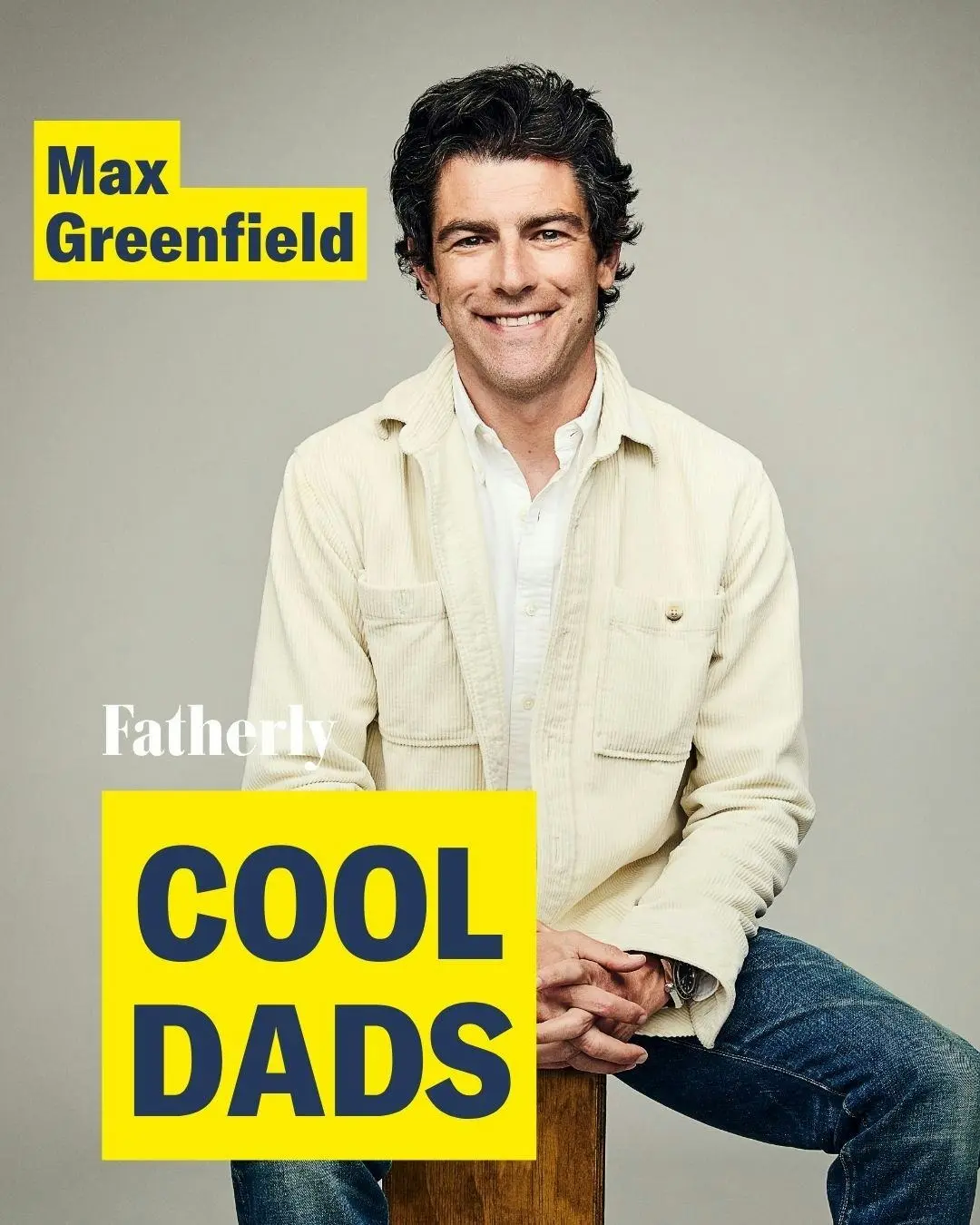
The first thing you may observe about the father figure in Netflix’s upcoming teen drama Don’t Say Good Luck is that his hair looks immaculately styled. That detail, however, is merely the starting point for the deep reservoir of aspirational parenting cues delivered by the character, played with emotional resonance by Max Greenfield. In this compelling family drama—a project that walks a tightrope between sharp humor and undeniable tear-jerking moments—Greenfield’s character navigates the chaotic intersection of a demanding career, elementary-aged twins, a complex teenager experiencing the full spectrum of adolescent emotions, and his wife’s sudden cancer diagnosis. While the character is occasionally thrown off-kilter by the relentless curveballs life hurls his way throughout the film, he never once bumbles through his responsibilities. In scene after scene, he actively seeks out ways to remain an emotionally available, steadfast parent and partner, redefining modern cinematic portrayals of fatherhood under pressure.
Reflecting on the role, Greenfield admits that tapping into the psychology of the character came with a surprising degree of ease. There is a profound overlap between his own internal landscape and the emotional architecture of the film, creating an intimate connection to the material that immediately drew him to the script.
This resonance likely stems from his real life as a father. Greenfield’s daughter is currently a high schooler—close in age to the film’s lead actress, Sunny Sandler—and shares mutual friends with her, placing the actor in a social and domestic orbit that mirrors the film’s milieu. Navigating the theatrical and emotional demands of high school life, at least from an observational standpoint, gave Greenfield an authentic vantage point that effortlessly bled into his performance.
We recently sat down to put Max Greenfield through the quintessential Cool Dad questionnaire before pivoting to a wider-ranging conversation about the new movie, the art of cultivating patience, the ongoing battle against parental anxiety, and the fiercely debated culinary landscape of Los Angeles bagels.
The emotional weight of Don’t Say Good Luck is palpable, hitting viewers long before the credits roll. For Greenfield, the intensity of the project is something he is regularly reminded of during ongoing press rounds.
"They keep playing clips in these interviews that I’m doing for press, and they’ll play it before the interview, and I’m constantly like, ‘I need a minute,’" Greenfield shares, underscoring how deeply the emotional beats of the story continue to affect him.
When asked about the striking parallel between his real-life parenting style and the compassionate father he portrays on screen, Greenfield acknowledges that the lines were frequently blurred. The primary motivation for accepting the role was rooted in a desire to provide a supportive, grounding environment for young co-star Sunny Sandler, whose father, Adam Sandler, commands famously positive and collaborative film sets. Having never worked on a Sandler production before, Greenfield wanted to ensure that Sunny experienced a familiar sense of mentorship and care.
"I mean, there’s so much of me that’s in that movie. I felt so close to what we were doing. It was really the reason I wanted to do it," Greenfield explains. "My daughter, I think, is a year younger than Sunny, and I was really aware that this was going to be a movie that Sunny was starring in. And from everything that I had heard, I had never done a Sandler movie before, but his sets are famously the best. And so I really wanted to just make sure that she had a comparable experience on this with somebody else. I felt like I knew how to do that."
That institutional knowledge of contemporary teenage culture made the transition onto the set seamless. Knowing where Sandler went to school, recognizing mutual acquaintances, and understanding the subtle language of modern teenagers meant that Greenfield did not have to stretch to find his footing. His primary objective was to maintain an atmosphere of lightness and unwavering support.
"I didn’t know if I was going to be very good in the movie as an actor, but I was like, ‘I think I know how to be the dad,’" he admits candidly.
The authenticity of the household dynamics was further amplified by the young actors cast as his on-screen twin sons. Rather than delivering rigid, rehearsed performances, the boys brought an organic, chaotic energy to the production, largely by simply being themselves—running wild and keeping the set energized. Drawing on his recent experience coaching his own son’s basketball team, Greenfield found himself well-prepared for the task of wrangling, organizing, and keeping a group of high-energy young boys engaged. That background prep work transformed logistical challenges into some of the most fun and natural moments captured on film.
"Everything was just like, ‘Oh, this is what my real life is,’" Greenfield says. "Being there with Sunny, I understood that relationship. Being there with the boys, I was like, ‘I get this relationship.’"
Among the film’s most resonant sequences is a dramatically heavy scene later in the narrative—one that mirrors universal experiences of grief and familial illness. For many viewers, the emotional truth of the scene hits uncomfortably close to home, capturing the specific, isolating helplessness of navigating a parent’s cancer diagnosis during formative adolescent years. In the pivotal moment, Greenfield’s character sits in a parked car with his daughter, who asks, "Are you okay?" He responds in kind, asking, "Are you okay?" Both characters ultimately answer with a simple, devastating "No."
Crafting that scene required a delicate, collaborative effort between the cast and the creative team, led by director and co-writer Julia Hart, alongside co-writers Laura Hankin and Jordan Horowitz. Greenfield praises the filmmakers for their openness and willingness to incorporate his input as the emotional arc of the characters developed organically during production.
"We had a lot of conversations about that scene, and they were so generous in my input," Greenfield notes. "It really felt like that scene was going to be the scene for this relationship. And as we started to see how the movie was playing out and what was happening before then, we had sent a bunch of drafts of that scene back and forth to one another, and we all collectively landed in that spot because it really needed to set up everything that comes after that, but it needed to honor everything that was built up before it, and it needed to feel real."
Rather than opting for a Hollywood resolution or an artificial emotional fix, the creative team prioritized raw vulnerability. The goal was to ensure both characters fully inhabited their pain without offering viewers a comforting shortcut. When cameras rolled on the sequence, Greenfield recalls the atmosphere on set as profoundly intense and heavy.
Given that his character operates a bagel shop within the film’s universe, the conversation inevitably turns to culinary preferences and the fiercely competitive Los Angeles bagel scene. Greenfield approaches the topic with the seasoned perspective of a local navigating health consciousness and regional pride, offering up two distinct choices depending on the day.
His first recommendation is a classic execution: an everything bagel layered with cream cheese, sliced onion, tomato, and lox—a combination he describes as an infallible, top-tier choice. For a lighter, vegetable-forward approach, he turns to a careful spread of light cream cheese or high-quality hummus paired with fresh, crisp vegetables, dressed simply with the right seasoning and a touch of salt and pepper.
This culinary exploration recently led him to one of Los Angeles’s most talked-about and heavily hyped establishments, Courage Bagels. Initially deterred by the notorious mile-long queue, Greenfield eventually surrendered to curiosity alongside his daughter. Waiting out the line proved revelatory when they sampled a vegetable-centric creation from the menu, leaving the actor genuinely astonished by the quality.
Beyond the emotional weight of illness and family dynamics, Don’t Say Good Luck tackles a universal parenting dilemma: the complicated ethics of disclosure. The film explores the delicate boundary of what information should be shared with children, when parents should shield them from harsh truths, and the inevitable fallout that occurs when protective deception backfires.
Reflecting on how he approaches this challenge in his own household, Greenfield emphasizes the importance of creating a safe psychological environment where his children feel empowered to initiate difficult conversations at their own pace. Rather than forcing heavy truths upon them prematurely, his strategy relies on patience, gradual exposure, and ongoing dialogue.
"There are certain things that I want them to discover on their own, and hopefully my job is to have created a space where they feel comfortable to then bring those things up to me," Greenfield explains. "And then depending on how the question’s asked or how much they want to know, you ease them into certain topics of discussion and what you choose to discover based on what they’re asking. And you let that conversation be ongoing."
That patient approach has yielded positive results, fostering a domestic environment where his children display remarkable resilience and comfort when processing complex information that might otherwise induce fear or confusion.
Transitioning from the foundational years of infancy and elementary school to the teenage milestones of a 16- and 11-year-old has fundamentally shifted Greenfield’s perspective on parenting. The margin for error has narrowed considerably, forcing him to confront the uncomfortable reality of his own mistakes while learning to distinguish between healthy guidance and fear-based control.
"I’m making a lot more mistakes," he admits. "That thing we talked about, responsibility versus what to let go, that line is thinner and thinner every day. And there’s so many times where, what are the things that I feel like I need to control to make me feel safer in this situation that is so scary? And being a fear-based parent is not a good zone to operate from."
That reckoning with parental fear is thrown into sharp relief as his teenage daughter reaches milestone moments, such as obtaining a driver’s license. The surreal realization that a teenager can legally pilot a two-ton vehicle to routine commitments like volleyball practice tests the limits of parental anxiety. Yet, when stripped of abstract worry, the logic remains straightforward: she trained, worked toward the goal, passed the legal requirements, and earned the right to drive.
While the early years of childhood foster a comforting illusion that parenting will continuously improve and simplify, the teenage years introduce a thrilling and terrifying paradigm shift. For Greenfield, however, the visceral experience of sitting in the passenger seat while his daughter navigates real-world traffic provided an unexpected philosophical clarity regarding anxiety itself.
"When we were learning to drive, I would sit in the car with her, we would drive, and I would go, ‘Oh, you know what? All the anxiety and fear I have about the future and life and work and all the nonsense, that’s not real,’" Greenfield reflects. "When I’m sitting in a car with my daughter and she’s driving, this is real fear. This is what real fear feels like. It’s like, this is the shark in the water kind of fear. And it’s heavy and it’s tangible. And you almost hold it and you go, ‘This is what real fear feels like, and this is appropriate for the situation.’ So outside of that, when I do feel any sort of anxiety about the future or whatever it is, I go, ‘Oh, this is not real.’ And now I know the difference. So at least I have that."