
Lindsey Elliott is exceptionally passionate about bolts. At last year’s 13th annual Bolting Symposium, she recalls that the absolute highlight of the event was participating in a high-stakes game of "Bolting Bingo" alongside a room full of self-proclaimed "torque dorks." For most people, industrial fasteners are an invisible part of everyday life, hidden away inside massive industrial facilities or buried beneath miles of earth. But for Elliott, bolts represent the key to unlocking a massive efficiency and safety revolution across multiple heavy industries.
A former engineer and planner at ExxonMobil, Elliott spent years analyzing and troubleshooting the complex infrastructure required to move oil, natural gas, and petrochemicals. Over the course of her career, she kept returning to a single, persistent bottleneck: the bolts that connect sections of industrial piping, technically referred to by engineers as bolted flange joints. These critical components are everywhere, yet maintaining them remains a grueling, physically demanding task. Loosening and tightening these heavy-duty fasteners requires significant manual labor, and the repetitive strain and heavy lifting associated with the job are a leading source of pipefitter injuries.
Compounding the physical toll on workers is a deeply entrenched labor shortage that continues to plague the trade industries. Skilled pipefitters are increasingly difficult to recruit and retain, leaving existing workforces stretched thin. The demands of the job are relentless, often requiring grueling hours under harsh industrial conditions.
"Those people get really tired when they’re asked to work 12 hours a day for three months in a row," Elliott told TechCrunch. "I’ve talked to pipefitters across the U.S. and across Canada, and just repeatedly have been told North American pipefitting productivity is notoriously low."
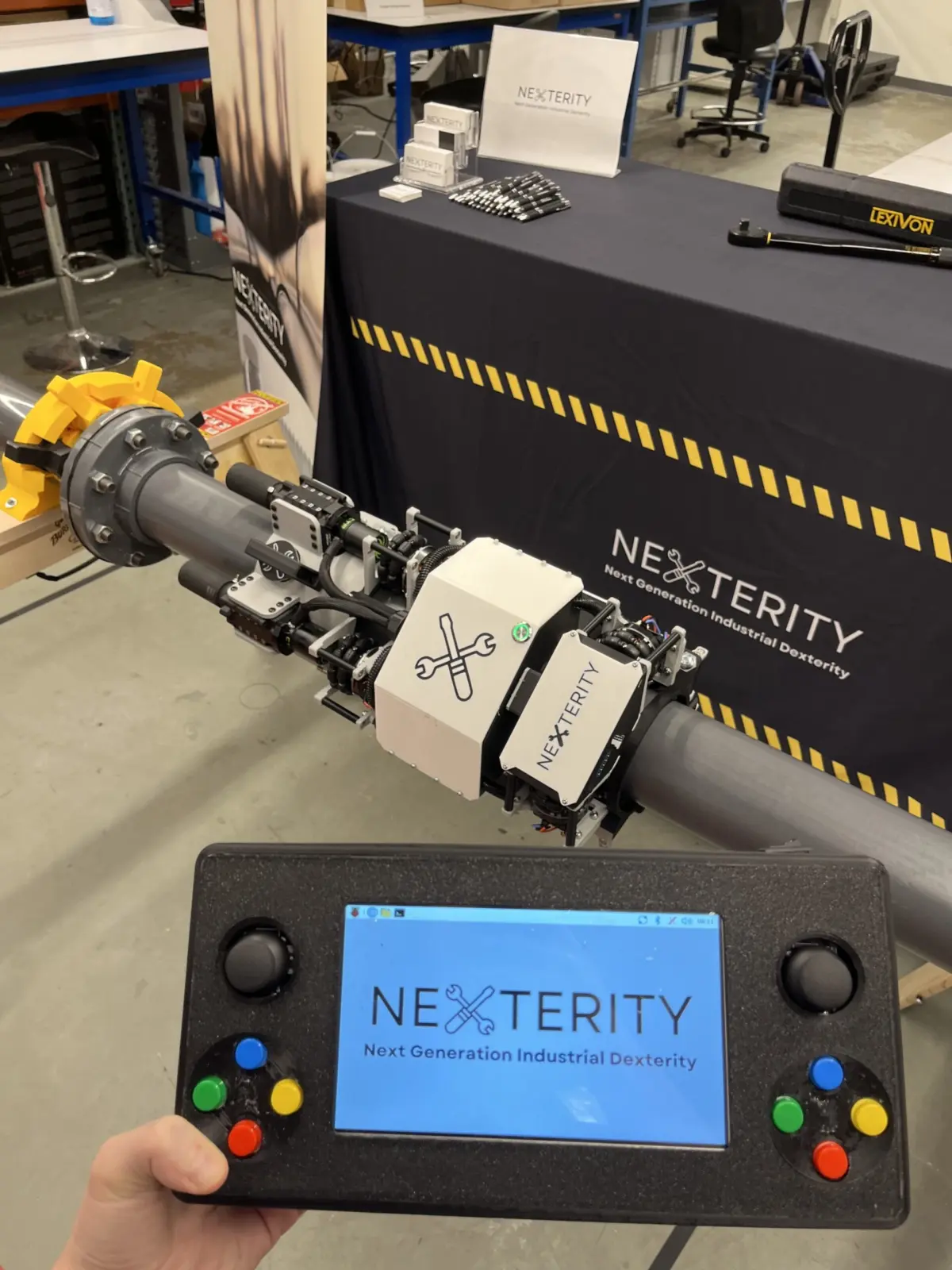
Recognizing this unsustainable dynamic, Elliott set out to find a better way. The solution she ultimately developed is housed within her startup, Nexterity, which has been selected as one of the Startup Battlefield 200 participants to showcase its technology at TechCrunch Disrupt. Nexterity’s flagship innovation is a remote-controlled robot specifically engineered to take over the grueling task of loosening and tightening pipe flange bolts. It is precisely the kind of pragmatic, blue-collar automation concept that has the potential to fundamentally transform a traditional trade, simultaneously protecting workers from repetitive strain injuries while drastically improving overall operational productivity.
In short, Elliott’s vision for the future of industrial maintenance can be summed up with a simple internal motto: more dork, less torque.
The system itself is engineered for efficiency and ease of deployment in tight industrial spaces. The robot is constructed in two main pieces that fit seamlessly around a pipe. Once attached and secured, the battery-powered device is capable of sliding across the length of the pipe, autonomously navigating its position to quickly loosen and tighten four bolts simultaneously.
Elliott explains that Nexterity has successfully developed several different configurations of the robotic unit to accommodate a wide variety of standard pipe sizes. Despite their mechanical capability, the devices are engineered to be remarkably compact. Every unit is small enough to fit inside a standard Pelican case, allowing a single worker to easily transport, handle, and deploy the equipment. This high degree of portability is crucial to Nexterity’s overarching business strategy, which relies on treating the robots much like rental construction equipment that can be quickly shipped and set up at new industrial sites on demand.
The path to this specific mechanical design was paved by years of targeted research and direct engagement with industry experts. Elliott arrived at the concept not only through her firsthand engineering experience at ExxonMobil and her participation in events like the Bolting Symposium, but also through extensive consultations with members of the Pressure Vessels and Piping Division of the American Society of Mechanical Engineers.
"What I learned from the people, the torque dorks per se," she said, "is that 80% of our pipes are between two to eight inches in diameter, or what they call NPS2 to NPS8. And so when you have that much repeatability, you have a fantastic candidate for automation."
By focusing squarely on this high-frequency sweet spot within industrial infrastructure, Nexterity has managed to design a product that solves a universal problem without getting bogged down in unnecessary mechanical complexity. It is a straightforward, elegant idea, but one that carries immense economic upside for industries that have relied on manual wrench-turning for decades.
The potential addressable market extends far beyond the oil and gas sector where Elliott first identified the pain point. Because standardized piping systems are the foundational circulatory system of modern industrial civilization, the applications for remote-controlled bolting technology are remarkably broad.
"I think it would shock a lot of people just how big this market is," she said. "I mean, day to day, most of us don’t think about piping infrastructure, but even water, wastewater, water treatment, food and beverage, mining, nuclear, any kind of green and sustainable manufacturing facility — they all use the same kind of piping."