
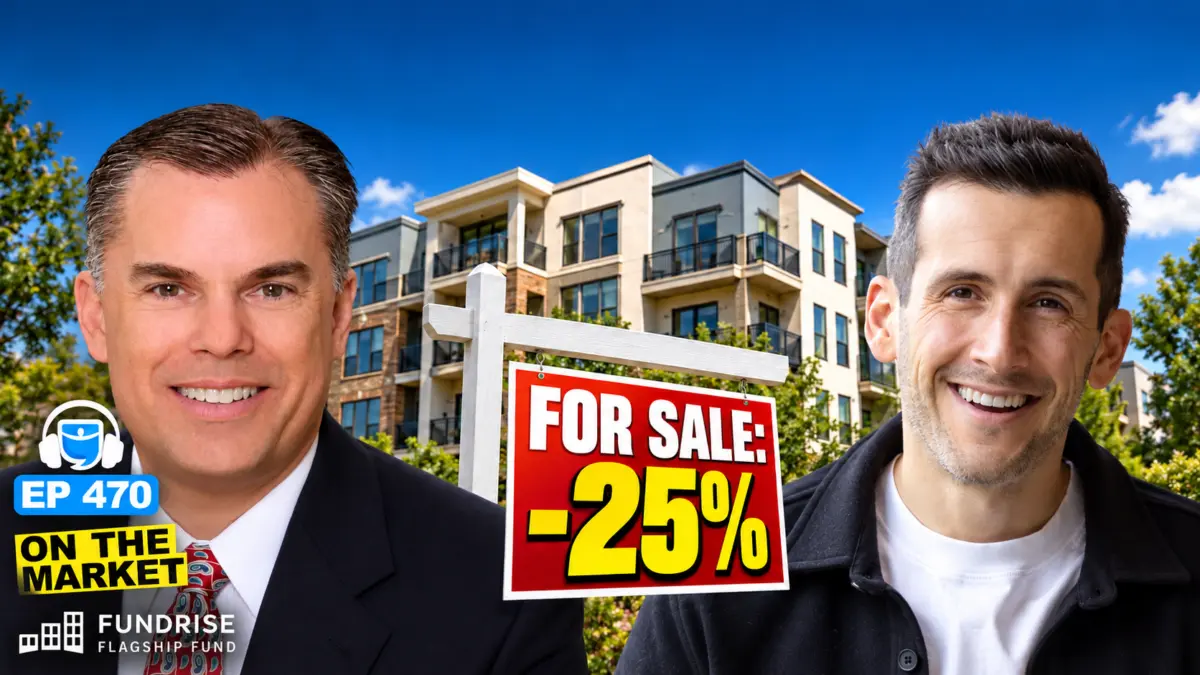
Real estate and economic analysts are increasingly pointing to commercial real estate as a standout asset class for the next five to ten years, driven by significant price corrections across major sectors. While residential real estate, equities, and commodities continue to trade at elevated prices, commercial real estate has seen valuation drops of at least 20%, with office sectors experiencing declines of up to 50%. Industry experts suggest that these downward adjustments could deepen further, potentially creating a once-in-a-generation buying opportunity for disciplined investors over the next few years.
To examine current market dynamics and explore strategies for navigating the downturn, market analysts have turned to experienced multifamily investor Brian Burke. Discussing the current landscape, observers note that the commercial and multifamily sectors have been navigating severe distress, comparing the potential depth of the upcoming correction to the major real estate adjustments seen during the 2007 and 2008 financial crisis. Just as many investors later regretted missing residential buying opportunities in 2010 and 2011, future market participants may view the current commercial real estate correction in a similar light.
The multifamily market, in particular, has faced mounting pressure over the past few years. Described by market participants as a prolonged and challenging period, the current distress did not materialize overnight. Instead, the situation developed gradually, resembling a slow-burning environment where rising economic pressures eventually caught up with property owners and operators. Many market participants initially anticipated that the Federal Reserve would step in with aggressive interest rate cuts to stabilize the market. However, experts emphasize that such expectations reflect a fundamental misunderstanding of broader financial mechanics.
The Federal Reserve directly influences overnight borrowing rates, which in turn impact short-term floating-rate debt tied to indices like the secured overnight financing rate. However, long-term debt rates for multifamily properties are primarily driven by the 10-year Treasury bond, a rate that is not directly controlled by central bank policy. As long-term debt costs climbed, property owners who had hoped to refinance maturing short-term loans into stable, long-term products found themselves facing prohibitively high borrowing expenses. This inability to refinance effectively triggered a secondary wave of market pressure.
This environment has inevitably led to cap rate decompression. Real estate professionals point out that properties cannot logically continue to sell at four or five percent capitalization rates when treasury yields sit significantly higher. The underlying numbers simply fail to generate positive leverage, which occurs when a property’s operational yield exceeds its borrowing costs. When cap rates fall below interest rates, investors experience negative leverage, destroying value and deterring rational buyers. Despite these economic realities, some sellers and brokers have continued to push legacy pricing expectations, attempting to market properties at yields that lag behind current debt costs.
The roots of the current correction extend beyond interest rates, originating from a convergence of multiple economic and demographic factors. During the pandemic and the subsequent economic rebound, several market indicators—including cap rates, interest rates, rent growth, and occupancy levels—all peaked simultaneously before colliding. This overexuberance led buyers to acquire properties at aggressive prices while fundamental market conditions began to erode.
Demographic shifts have also played a substantial role in reshaping apartment demand. The primary demographic for multi-family rentals consists of individuals aged 18 to 30. With birth rates falling consistently over the past 18 years, the population pool entering prime renting age is tapering off. Furthermore, population growth reached historical lows following the pandemic, compounded by subsequent shifts in international immigration trends. At the same time developers engaged in heavy construction pipelines, flooding select markets—particularly high-growth areas like Austin, Texas, and Denver—with new apartment supply. This imbalance between supply and demand created significant dislocations that monetary policy alone could not resolve.
Market observers emphasize that navigating this correction requires patience, as the process is expected to play out over several years. Historical precedent indicates that major commercial real estate downturns are followed by extended periods of flat valuations before a sustained recovery takes hold. For instance, following double-digit price declines in previous decades, the market experienced multi-year bull runs lasting longer than a decade. Consequently, investors do not necessarily need to time the absolute bottom of the market; waiting for clear evidence of a market stabilization still allows participants to capture long-term upside while significantly reducing risk.
Monitoring key operational metrics can help investors identify when the market is moving past its trough. Essential indicators include declining rates of rental concessions, positive lease trade-outs where incoming tenants pay higher rents than departing occupants, decreasing vacancy rates, and a return to organic rent growth. While long-term retail or institutional investors with decades-long horizons may be less sensitive to precise market timing, those deploying raised capital must remain disciplined and focused on economic fundamentals.
For investors preparing to enter the market as opportunities emerge, sourcing distressed assets requires proactive relationship-building rather than relying solely on public listings. Aligning with established property management companies often provides early visibility into distressed properties, as lenders and asset managers frequently engage local operators to manage assets entering receivership. Additionally, maintaining strong relationships with commercial real estate brokers remains vital, as they possess deep insight into the financial constraints and operational timelines of various property owners.
Successfully executing transactions in a distressed environment also demands immediate access to capital and transactional certainty. Lenders and institutions seeking to offload troubled assets prioritize buyers who can demonstrate a reliable path to closing. Investors must cultivate robust capital networks and soft commitments well in advance of making offers, ensuring they can move decisively when viable acquisition targets appear.
Regarding financing structures, experts caution against generalizing specific debt products as inherently good or bad. While long-term fixed-rate financing serves as an ideal permanent solution for stabilized assets, interim bridge debt may still serve as a practical tool for acquiring deeply discounted, distressed properties that require substantial operational turnaround before qualifying for permanent agency loans. Debt brokers specializing in specific asset classes and portfolio sizes remain valuable resources for identifying the most suitable lending partners based on individual property performance, loan-to-value ratios, and market conditions.
Ultimately, navigating the current commercial real estate landscape requires careful preparation, disciplined underwriting, and a clear operational plan. By focusing on asset fundamentals, building reliable networks, and maintaining financial flexibility, investors can position themselves to capitalize on the opportunities generated by ongoing market adjustments.