
DURHAM, N.H. — Any time a program loses even half as much elite talent in a single off-season as the Michigan State Spartans just did, fans and analysts alike naturally brace themselves for a step backward. In the cyclical world of college athletics, an exodus of that magnitude typically signals the beginning of a grueling rebuilding year, a period of transition where wins are hard-come-by and youth is painfully exposed against veteran competition.
Yet, in the modern landscape of college hockey, and within a program as robust and structurally sound as the one head coach Adam Nightingale has built in East Lansing, that traditional narrative simply does not have to apply anymore.
The scope of Michigan State’s roster turnover this past summer is nothing short of staggering. The Spartans bid farewell to a formidable trio of forwards in Porter Martone, Charlie Stramel, and Daniel Russell. To put their departure into perspective, those three players single-handedly accounted for 55 of the team’s 136 total goals a season ago. On the blue line, MSU lost its top two defensemen in Matt Basgall and Maxim Strbak, who led the squad in both points generated and total time on ice.
Perhaps most dauntingly, the netminder position suffered a massive void with the departure of Mike Richter Award winner Trey Augustine. During his stellar tenure in East Lansing, Augustine anchored the crease with a sparkling .929 save percentage, accumulated 22.9 goals saved above expected, and started all but three games for the Spartans.
Losing a Hobey Baker top-10 finalist, a premier goaltending award winner, and prospects heavily projected to make immediate splashes at the professional level would spell doom for many programs. Yet, through the first four games of the new campaign, the heavily revamped roster has shown remarkably little panic or hesitation in its performances on the ice.
Navigating Early Growing Pains and Physical Tests
That is not to suggest that the opening act of the season has been entirely smooth sailing. On Friday night, the Spartans suffered a hard-fought 1-0 shutout loss on the road against the University of New Hampshire. In that contest, Michigan State was outshot 34-14, marking the lowest single-game shot total for the program since December 9, 2016.
Even with that blemish on their record, the Spartans sit at a respectable 3-1 overall, backed by a 16-5 goal differential and a plus-18 shot advantage across their opening matches. A glance at the lineup sheet explains both the early successes and the inevitable hurdles.
Between incoming freshman classes and aggressive navigation of the NCAA transfer portal, Nightingale injected multiple first-round NHL draft picks into his locker room, complementing a pair of blue-chip talents who arrived a year prior. However, as numerous programs across the collegiate hockey landscape have discovered since the sea change in player recruitment and eligibility rules a few years ago, raw talent alone does not guarantee immediate harmony or success on the ice. Proof of that youth was glaringly evident on Friday, when the Spartans dressed 13 freshmen and sophomores in their lineup.
Nightingale, however, has made it abundantly clear that he has no interest in leaning on youth as a crutch or an excuse when results fall short.
"I refuse to say to our guys, ‘We’re young and new guys,’" Nightingale stated firmly following the weekend series opener. "We look across college hockey, and I’ve always believed in that. I think as soon as you start going down that path, you give guys an excuse. And so our guys are good enough, they’re smart enough, and UNH is a good team, too. I mean, you got to give them credit. I thought they did a good job, and we definitely got to be better if we want to have success."
Managing a roster heavily laden with 18- and 19-year-olds in a developmental environment where opposing players can range up to 25 or 26 years old presents a unique challenge. Younger players asked to step into prominent, high-leverage roles naturally face a learning curve regarding physical maturity and the nuances of the collegiate game.
To accelerate that developmental timeline, Nightingale and his coaching staff deliberately constructed a grueling early-season schedule designed to test the squad’s physical resilience. To date, the Spartans have squared off against Northern Michigan twice—a team boasting an average player age of 22—followed by a matchup against RIT (averaging 22.6 years old), and culminating in a hostile road series at New Hampshire (averaging 22.3 years old). With one of the youngest rosters in the entire nation, Michigan State is leaning directly into the fire, and by all early accounts, they are passing the test.
Nightingale is methodically assessing the positive traits and lingering vulnerabilities of his group, allowing him to fine-tune controllable aspects of play as the grueling months unfold.

"You can’t control where the game’s scheduled, and you’ve got to be ready to play," Nightingale noted. "And to me, there’s a difference between expecting to win and being entitled to win, and we’re definitely not entitled to win any hockey games. We have to go out and earn it, and every team we’re gonna play is gonna play with desperation, and I thought they did a much better job of that tonight than us."
Stepping Into the Crease: The Joshua Ravensbergen Era
Perhaps the heaviest burden on any single freshman’s shoulders belongs to goaltender Joshua Ravensbergen. Selected 30th overall in the 2025 NHL Draft, Ravensbergen steps into arguably the most scrutinized position in college hockey: succeeding Trey Augustine. Very few goaltenders in recent NCAA history have built the kind of dependable, high-end resume that Augustine constructed over his three years in East Lansing, leaving a massive pair of pads to fill behind a youthful defense corps.
Transitioning from the Canadian Hockey League, where the age limit caps out at 20, to the high-stakes environment of college hockey always carries a degree of uncertainty. Yet, through his first three starts, the CHL All-Star has answered the bell with poise, capturing two wins, a stellar .949 save percentage, and 2.3 goals saved above expected.
"It’s just a little tighter checking," Ravensbergen explained regarding his seamless-looking transition. "You don’t have those complete breakdowns as much here. Everything’s a little more structured and a little heavier. I think it helps as a goalie, honestly. The play, you get to read it a little longer, and everything’s kinda more in front of you, and not as many second and third opportunities. I felt the guys really helped me out with that."
To mitigate the natural uncertainties surrounding a freshman netminder, the Spartans have visibly recommitted themselves to a suffocating defensive structure. Michigan State is currently conceding an average of just 27 shots on goal per night, blocking an average of nine shots per game, and yielding a paltry 2.12 expected goals per contest. While that defensive framework has not yet been tested against elite national title contenders—none of their first three opponents are widely projected to secure NCAA tournament bids—the discipline and systemic commitment remain impressive against older, heavier competition.
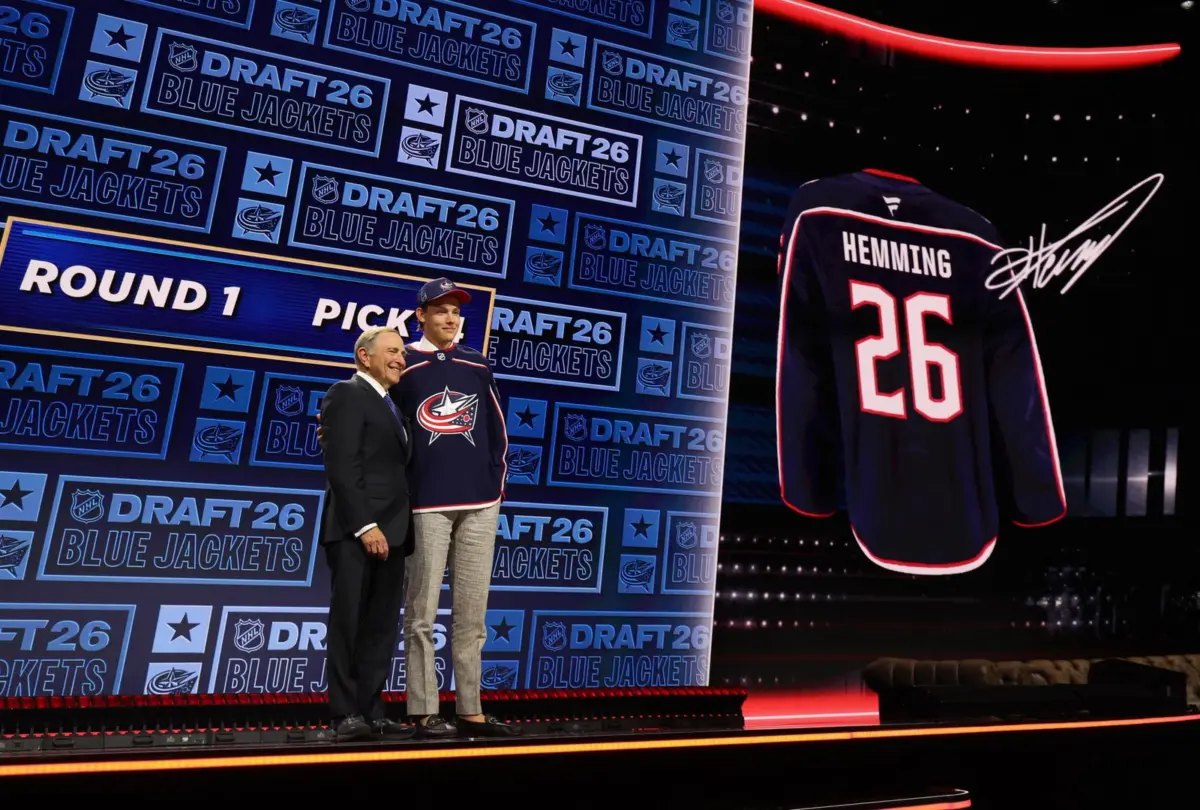
Crucially, this defensive foundation is being marshaled by underclassmen on the blue line. Chase Reid, the No. 7 overall selection in the 2026 draft, and Tommy Bleyl, taken 31st overall, are logging heavy minutes—averaging roughly 22 and 19 minutes of ice time per game, respectively. Watching them dictate play, one would hardly guess they are experiencing their first taste of college hockey.
"Our buy-in has been good," Nightingale said of his team’s defensive consciousness. "It’s just, you come to the rink, a certain hunger level, you got to play with, right? That comes out in different forms, whether it be a puck battle, but I also think execution, too. It’s finding that balance between playing hard and still being able to execute. So, lots to work on, for sure. Obviously, that’s my job, at the end of the day, to help these guys get better."
Offense by Committee and Looking Ahead
While the defense finds its footing, the Spartan offense has maintained a healthy average of four goals per game, even after being blanked in Durham. Interestingly, that offensive output is arriving almost entirely by committee, spearheaded by the roster’s more experienced skaters. Out of MSU’s 16 total goals scored thus far, only four have come off the sticks of the freshman class, courtesy of Jack Hextall (twice), Ethan Belchetz, and Reid.
As the season progresses and younger players settle firmly into their expanded roles, that offensive production is expected to diversify further. For now, boasting 11 different goal-scorers through four games is an encouraging sign of depth. Furthermore, hard-fought battles like the loss to New Hampshire provide invaluable teachable moments, serving as stark reminders that complacency comes with a heavy price at this level of competition.
"I thought there were some sequences where we did some good things, and the positive is playing in games like this, right?" Nightingale reflected. "It’s easier up 5-1, and everyone looks sweet. I mean, that’s not real hockey, right? So, you want to play in these type of games, these type of environments."
No one realistically expected the floor for Michigan State hockey to drop below elite status entering this season, and the soaring expectations housed inside Munn Ice Arena continue to look entirely justified. When a roster features this many moving parts and unproven variables, validation only arrives once the team takes the competitive ice.
Growth in hockey is rarely a linear trajectory, but even amid early-season adjustments and the bitter taste of a weekend shutout, the outline of another formidable Spartans squad is already coming into sharp focus.