
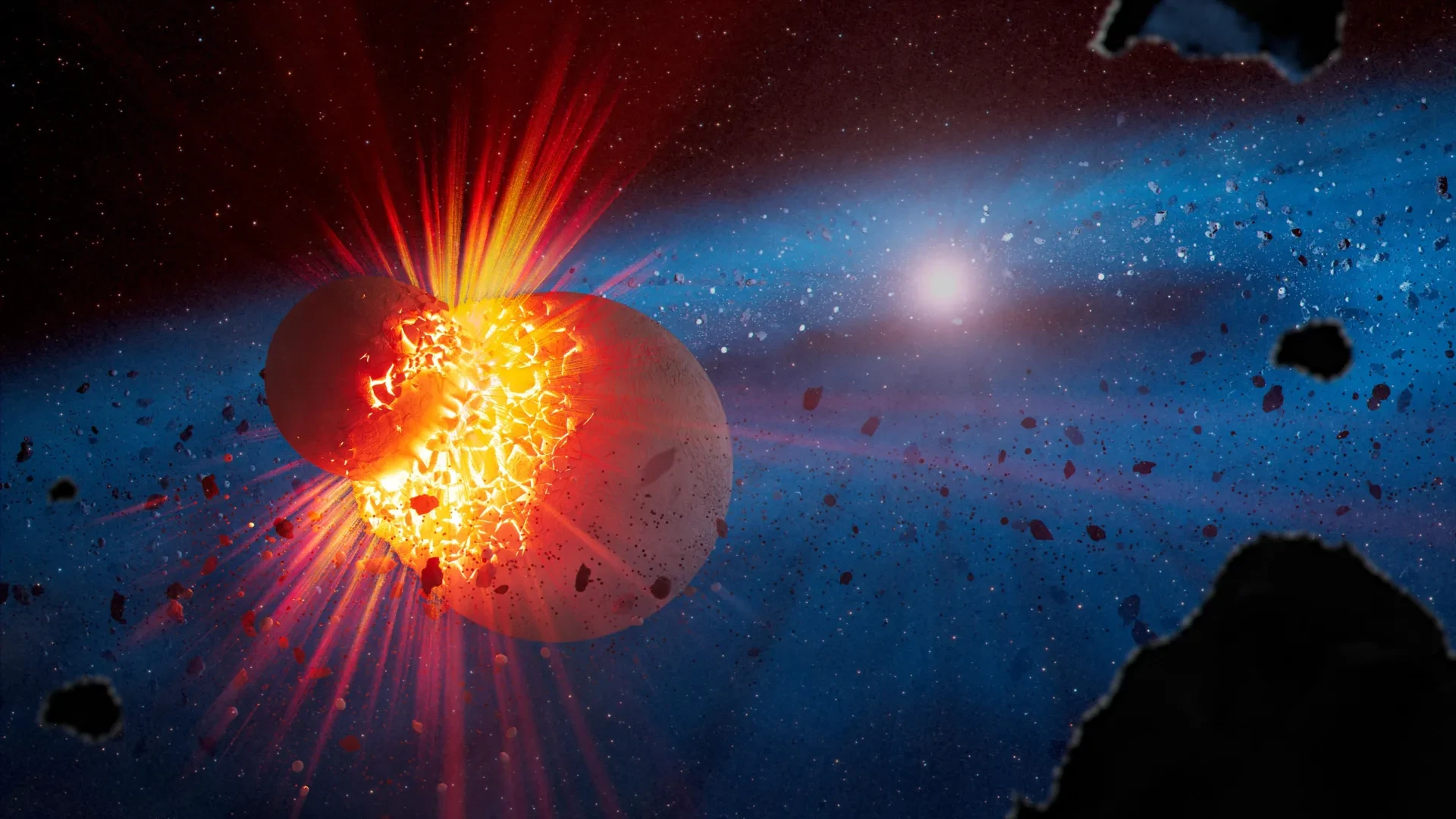
Long before the Earth became the blue-and-white marble we call home today, it was forged in the fires of a chaotic cosmic billiard game. Scientists have long theorized that one of the most defining moments in our solar system’s infancy was a colossal, catastrophic collision between the young Earth and a Mars-sized planetary body known as Theia. This unimaginable impact likely vaporized colossal quantities of molten rock, hurling blazing debris far out into the vacuum of space. Over millions of years, some of that wandering debris gradually accreted and coalesced to form our Moon, a celestial companion that now serves as a crucial stepping stone as NASA’s Artemis program returns humans to lunar soil, prepares for future crewed missions to Mars, and shapes the broader future of deep space exploration.
That ancient, violent impact fundamentally transformed our planet, setting the stage for the conditions that eventually allowed life to flourish. Now, capitalizing on technological leaps in modern astronomy, a team of researchers is using NASA’s premier James Webb Space Telescope (JWST) to peer deep into distant, young star systems that appear to be experiencing similarly tumultuous, epoch-defining events in real time. By studying these active stellar laboratories, astronomers can measure the sheer energy of these planetary impacts, piece together how rocky planets form from raw cosmic materials, and watch the tumultuous evolutionary stages that worlds undergo during their infancy.
The team’s groundbreaking findings were officially published on October 1 in The Astrophysical Journal, marking a significant milestone in our understanding of planetary system architecture.
Webb Targets Rare Extreme Debris Disks
The environment surrounding a star is never static; it evolves dramatically over vast stretches of time as the stellar system matures. Young stars typically begin their lives surrounded by a juvenile, gas-rich protoplanetary disk—a swirling, flattened cradle of gas and dust where newborn planets reside and gather mass. As the system grows older and matures, that dense environment eventually dissipates and transitions into a gas-poor debris disk, a sparser collection of leftover rocky fragments and dust.
During its years of highly productive operations, NASA’s now-retired Spitzer Space Telescope studied a vast array of these debris disks and eventually identified a rare and unusual category known as extreme debris disks. Unlike ordinary systems, these extreme disks contain exceptionally large concentrations of warm dust packed closely to their parent stars, occupying roughly the same orbital regions where rocky, terrestrial planets orbit in our own solar system.
To investigate these rare and puzzling systems in unprecedented detail, an international team of astronomers led by Kate Su of the Space Science Institute in Boulder, Colorado, turned the infrared gaze of the James Webb Space Telescope toward them.
Theoretical models of planetary formation have long suggested that extreme debris disks should be relatively common features in maturing stellar systems. However, actual observations have consistently told a radically different story. Based on all the astronomical data gathered by researchers up to this point, scientists estimate that only about 1% of all young stars display observable, unmistakable signs of lingering in this volatile stage. It is a fascinating realization that our own solar system very likely passed through a similar high-energy, chaotic phase while it was still in the process of forming its planets.
Even though these systems are remarkably uncommon across the cosmos, the researchers successfully assembled a carefully curated sample of 21 extreme debris disks for this comprehensive study. Five of these targets were drawn from archival observations captured by the Spitzer Space Telescope, while the remaining 16 were directly targeted and studied using the advanced capabilities of the James Webb Space Telescope. Within the Webb sample, 12 of the disks were observed for the very first time, while four were targeted as follow-up observations of systems that had been previously examined by Spitzer.
"This is the first time we have gathered enough systems to truly understand this subclass that we call extreme debris disks," said Kate Su, lead author of the newly published research paper. "Before Webb, we had limited information. We knew that they are weird and very different from the typical cold debris disks that we know, like Vega and Fomalhaut. Now that we have more data, we can pin down what these disks represent for planet formation and evolution."
Dust Reveals the Nature of Planetary Collisions
Through meticulous analysis, the researchers officially confirmed that extreme debris disks share three distinct and defining characteristics. First, their microscopic dust grains are noticeably smaller than those found in standard protoplanetary disks or more typical, older debris disks. Second, they contain unusually high concentrations of warm dust glowing brightly in infrared light. Third, their overall infrared brightness fluctuates and changes irregularly over time. Both the James Webb Space Telescope and its predecessor Spitzer played critical roles in revealing these unique features by capturing high-resolution mid-infrared spectra.
To gain a clearer understanding of what physical mechanisms might be producing these unusual traits, the researchers closely examined the specific minerals present within the dusty disks. Their detailed spectral analysis revealed that the observed systems could be cleanly divided into two broad chemical groups: silica-rich disks and silica-poor disks.
To put these materials into a familiar earthly context, volcanic glass such as dark, smooth obsidian serves as a prime example of a silica-rich material. On the other hand, the silica-poor mineral known as forsterite can be found closer to home as shimmering green sand grains scattered across certain unique beaches in Hawaii.
Whether a given stellar disk is rich or poor in silica can reveal profoundly important secrets about the colossal planetary collision that originally created its vast cloud of debris. This distinct chemical division may also help explain why certain disks fluctuate much more dramatically in their infrared brightness than others.
"To just see their mid-infrared emission and beautiful spectral features with Webb, which allowed us to identify their compositions, was the most exciting thing for me," said Agnes Kospal of the Konkoly Observatory in Budapest, Hungary, and a coauthor of the study. "We have no other way to study these planetary embryos directly because they are too small."
Mars-Sized Worlds May Be Smashing Together
When breaking down the chemical data of the sample, the researchers discovered that roughly one-third of the disks are silica-rich. The scientific team notes that these specific systems most likely formed in the aftermath of exceptionally energetic collisions between massive, Mars-sized planetary bodies. Impacts of this immense scale would unquestionably be powerful enough to completely vaporize a substantial fraction of solid rocky material, turning entire planetary mantles into glowing vapor and pulverized dust.
Conversely, the remaining two-thirds of the studied disks are silica-poor. These systems appear to be the direct result of lower-energy collisions, which could include glancing impacts between smaller, Moon-sized planetary objects that lack the sheer kinetic punch of a Mars-sized smashup.
Furthermore, the research team uncovered a striking and important age difference between the two distinct groups. Silica-rich disks have exclusively been identified surrounding stars that are younger than 300 million years old. On the other hand, silica-poor disks occur around stars spanning a much wider, older range of ages and tend to exhibit much stronger, more erratic changes in their overall brightness over time.
The team suggests that this intense variability likely stems from the rapid, chaotic evolution of newly created cosmic debris. As the physical orbits of the pulverized material shift and evolve, and as secondary collisions continue to break down larger fragments into finer dust, the infrared brightness naturally rises and falls over measurable spans of time.
These powerful findings may ultimately help planetary scientists successfully reconstruct the hidden history of our own solar system, which theoretical models suggest could have passed through more than one distinct extreme debris disk phase during its youth.
"How rocky planets formed and giant planets evolved are part of the broader story of the solar system’s formation. It’s all one story," Su reflected. "Our work on extreme debris disks helps us bring together the big picture of what we currently understand."
Clues to the Collision That Formed the Moon
State-of-the-art computer simulations strongly suggest that terrestrial planets, including our own Earth, should naturally emerge within the first few hundred million years after a solar system begins its long process of formation.
This theoretical timeline lines up remarkably well with the actual ages of the silica-rich extreme debris disks observed by the astronomers so far. It is also entirely consistent with prevailing scientific estimates that both the Earth and the Moon formed roughly 100 million years after the birth of the Sun, with our lunar satellite being forged directly from the fiery debris of a catastrophic impact between Earth and a Mars-sized interloper.
Beyond the origin of the Moon, scientists remain intensely interested in exploring whether our own Sun might have once passed through a silica-poor extreme debris disk phase in its ancient past.
If these older, silica-poor disks and their seemingly random, unpredictable periods of changing infrared brightness are indeed driven by orbital instability, the observed pattern would be broadly compatible with the famous Late Heavy Bombardment hypothesis regarding our solar system’s evolution.
Under that widely discussed evolutionary scenario, the giant planets in our solar system—such as Jupiter and Saturn—shifted significantly from their original, pristine orbital positions. As they moved, their powerful gravitational influence severely disturbed the orbits of smaller, primitive bodies throughout the system, setting off a cascade of catastrophic collisions and producing brief, violent epochs filled with massive quantities of dust. This ancient upheaval would look remarkably similar to the dynamic phenomena that modern astronomers are now observing directly in distant extreme debris disks using the James Webb Space Telescope.
"Of course, there’s many things we still don’t know about these disks," noted Attila Moor of the Konkoly Observatory, another coauthor of the new research. "We expect no silica-rich systems among older extreme debris disks. We only have three disks in our sample that fit that age criteria, so it’ll be nice to observe more of these systems to confirm our hypothesis."
Operating from a million miles away in space, the James Webb Space Telescope continues to stand as the world’s premier space science observatory. Webb is currently dedicated to solving enduring mysteries within our own solar system, looking far beyond to characterize distant worlds orbiting alien stars, and probing the mysterious structures and cosmic origins of our universe and humanity’s place within it. The Webb mission is an ambitious international program led by NASA in close collaboration with its primary international partners, the European Space Agency (ESA) and the Canadian Space Agency (CSA).