
For decades, the stock market has maintained a remarkable knack for surprising investors, routinely shattering expectations and reaching unprecedented heights. Yet, whether markets are plummeting into steep recessions that trigger fears of disappearing retirement funds or surging to super-duper-crazy record valuations, financial anxiety remains a constant fixture of modern life. When equities climb to historic peaks, investors immediately begin bracing for an inevitable, catastrophic crash. In the current economic landscape, that existential dread is predominantly centered around the frenzied, high-stakes boom of Artificial Intelligence.
For those who have managed to tune out the relentless 24-hour financial news cycle and simply focus on enjoying their daily lives, this deliberate detachment is a commendable strategy. However, understanding the broader context of the current AI phenomenon reveals a familiar narrative. Investors today worry that while artificial intelligence is unquestionably a monumental technological leap, the financial mania surrounding it is moving too fast and reaching too high. Many fear we are hurtling toward a modern, magnified version of the dot-com crash of the early 2000s—an era that served as a defining crucible for early internet professionals, launching some toward early retirement while simultaneously threatening livelihoods and citizenship applications amid the ensuing wreckage.

As financial commentators and early retirement advocates reflect on successive investment cycles, questions regarding market longevity and crash resilience inevitably surface. These themes recently took center stage at the Camp FI Midwest gathering, with plans for an expanded presentation at the upcoming Bogleheads conference. Addressing these anxieties requires looking past the daily market noise to examine the psychological roots of financial panic, the true drivers of economic prosperity, and why historical precedent suggests that panic is rarely a reliable guide for the future.
Will the AI Bubble Ruin Our Retirement?
Achieving long-term financial independence and spending over two decades in retirement brings a certain level of comfort with market volatility. Yet, conversations with peers frequently reveal a deep-seated underlying anxiety about the state of the world. When asked how anyone can remain retired and sleep soundly given current global events, the natural inclination is often bewilderment.

A comprehensive catalog of modern anxieties—ranging from volatile geopolitical figures like Donald Trump and Vladimir Putin to persistent inflation eroding purchasing power, towering national debt, and the persistent threat of escalating international conflicts in Ukraine and the Middle East—dominates the headlines. Yet, a look back twenty years reveals that this brand of existential worry is hardly a novel phenomenon.
In 2006, the worries looked remarkably similar, though the actors and specific asset classes had different names. Headlines back then featured leaders like George W. Bush, Saddam Hussein, and Osama Bin Laden, alongside a protracted war in Iraq, anxieties over national debt, and inflation concerns. Instead of an AI bubble, investors panicked over an overvalued stock market driven by a rampant housing bubble. Instead of artificial intelligence taking white-collar jobs, the prevailing fear was the mass outsourcing of labor to India and China. Economists and environmentalists were locked in fierce debates over Peak Oil, genuinely believing that rising fossil fuel demand coupled with dwindling supply would spell absolute doom for global stability.

Looking back at how those fears played out offers crucial perspective. The subsequent Great Financial Crisis—ignited by irrational exuberance over escalating home prices and dangerously leveraged mortgage-backed financial instruments—did indeed trigger the deepest economic contraction since the Great Depression. Yet, viewed through the lens of a decades-long horizon, even that historic crisis appears as a temporary dip. A $100,000 investment made prior to the crash would have still ballooned substantially over the ensuing twenty years, weathering both the financial collapse and the subsequent economic shock of the 2020 COVID-19 pandemic.
Simultaneously, broader global indicators demonstrated profound structural improvements. Over that same twenty-year span, the global proportion of people living in extreme poverty dropped dramatically from 20 percent to 8 percent. Childhood mortality rates were cut in half. The clean energy transition accelerated beyond expectations as solar panel costs plummeted by roughly 40 times, enabling solar power to dominate new electricity generation additions globally, matching the peak capacity equivalent of hundreds of nuclear power plants. Meanwhile, pure electric vehicle sales surged from near zero to a substantial share of global automobile sales, pointing toward an inevitable, fully electrified transportation sector.

Prosperity Comes from Productivity
Faced with ongoing anxieties regarding whether the current era is fundamentally different—whether the U.S. national debt has finally grown large enough to destabilize the global economy, or whether an unchecked AI superintelligence might render human labor obsolete—financial media outlets readily spin cautionary tales. However, these persistent doomsday scenarios consistently overlook a foundational economic truth: true prosperity is not generated by the financial system or the stock market, which ultimately rely on numerical abstractions tracked on computers.
At its core, prosperity stems directly from productivity.

The capitalist economic system is inherently volatile, prone to cyclical swings and periodic panics. Beneath the surface turbulence, however, real people continue to perform real work, invent practical tools, and drive tangible progress. The very concept of an economy or a financial framework is a human invention. If a financial system were to collapse entirely due to a loss of confidence in prevailing market valuations, society retains the capacity to establish new numerical baselines and resume productive labor—a mechanism successfully deployed during the 2008 financial crisis and numerous historical precedents before it.
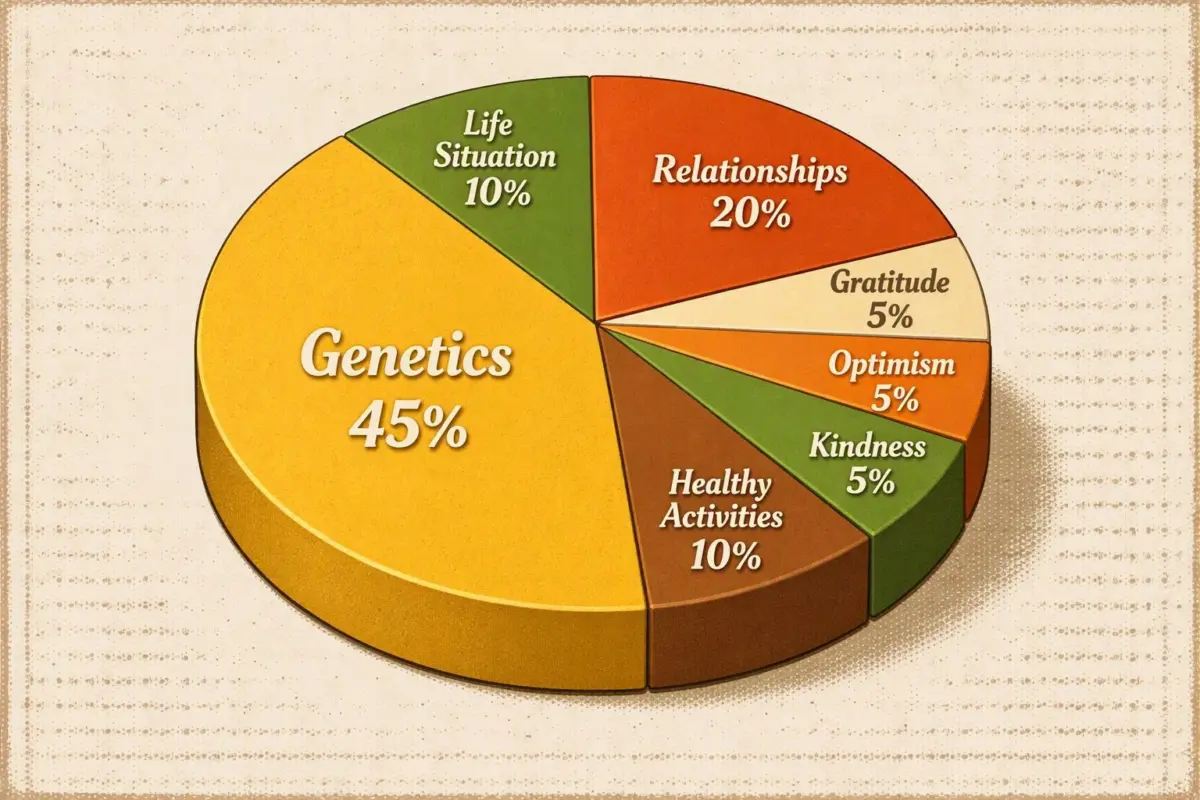
Humanity retains every productivity-enhancing tool ever invented. Standards of living, economic growth, and the viability of early retirement are fundamentally anchored to high productivity rather than speculative market sentiment. Furthermore, once societies achieve a certain baseline standard of living, human happiness largely plateaus along that specific financial dimension. Developed nations surpassed those baseline economic requirements decades ago, shifting the primary pursuit of happiness toward non-financial factors such as strong interpersonal relationships, community engagement, personal health, and cultivating a philosophy of gratitude and optimism.

Understanding and Combating Fear
The persistence of financial anxiety despite objective historical progress points to a deeper psychological reality: human beings are fundamentally danger-detection machines. Evolutionarily wired to identify threats to survival, the human brain struggles to turn off this hyper-vigilant machinery when actual physical dangers recede. Instead, the goalposts of anxiety simply shift.
When immediate threats of predators, disease, and starvation are successfully managed, anxiety migrates toward social belonging, economic scarcity, tax optimization, or complex financial regulatory thresholds like Required Minimum Distributions, where affluent retirees paradoxically stress over being forced by the government to withdraw and spend accumulated wealth.

Combating this pervasive fear requires self-awareness and rational evaluation. Recognizing the historical origins of personal anxiety—whether rooted in childhood upsettings, family scarcity mentalities, or past trauma—helps decouple emotional responses from the objective reality of the present. Identifying worst-case scenarios through deliberate analysis frequently demonstrates that even catastrophic projections rarely equate to total ruin. Taking concrete action remains the most effective antidote to fear, transforming the unfamiliar into the manageable and building personal resilience.
By intentionally curating daily information diets—specifically by reducing exposure to sensationalized news and fear-mongering media—individuals can reorient their focus toward positive behaviors, outdoor physical activity, and problem-solving. Surrounding oneself with optimistic, productive peers who prioritize purposeful living rather than persistent worrying creates an environment where a constructive mindset naturally takes root.

Everything Is an Experiment
Adopting an experimental framework for life changes—whether making minor adjustments or navigating major transitions such as changing careers, relocating, or entering early retirement—alters the psychological approach to uncertainty. Viewed through this lens, the rapid emergence of Artificial Intelligence ceases to be a source of existential terror and becomes an endlessly fascinating technological experiment.
Rather than succumbing to doom-scrolling, analyzing the technological and economic underpinnings of AI reveals its primary function: a sophisticated cognitive tool designed to supercharge human efficiency and productivity. Much like previous technological revolutions—from the advent of the internet to the widespread adoption of smartphones—artificial intelligence will inevitably boost productivity and drive broader economic prosperity while simultaneously displacing certain administrative and operational roles. Over time, these shifts typically reduce service costs, lower consumer prices, and stimulate entirely new industries and economic opportunities.

Ultimately, technological advancements like artificial intelligence present a series of choices rather than an inevitable doom. Whether viewed as an alarming disruption or a powerful catalyst for learning, adaptation, and more efficient problem-solving, technological evolution remains a constant aspect of modern progress. Acknowledging that fear is often the primary barrier to personal growth and fulfillment allows individuals to approach an uncertain economic future not with dread, but with the resilience and curiosity required to navigate whatever changes lie ahead.