
Few phrases carry as much fatigue and fascination as remarks on the unpredictability of the stock market. Over successive decades, investors have watched equities defy expectations, swinging from dramatic crashes that shrink retirement staves to record-breaking valuations that invite immediate dread. Today, that anxiety is predominantly pinned to the explosive, frenzied rise of Artificial Intelligence. As the market climbs on the back of tech-sector enthusiasm, many observers brace themselves for an impending collapse, whispering warnings of a reckoning far larger than the dot-com bubble of the early 2000s.
For those who have managed to tune out the financial drama, the modern AI narrative can be boiled down to rapid technological acceleration, massive capital investments, and a polarized debate over its long-term societal impact. While technology proponents view generative AI as the next great industrial revolution, skeptics worry the mania is moving too fast and outpacing fundamental reality. This tension resonates deeply with veterans of past market cycles, including early internet figures whose careers were supercharged by the turn-of-the-millennium boom, only to be threatened by the subsequent market correction and economic fallout.

As modern investors grapple with this latest cycle, questions regarding market longevity and retirement security have taken center stage. Financial commentators have recently taken these discussions on the road, delivering insights at events like Camp FI Midwest and preparing expanded analyses for upcoming financial symposiums such as the Bogleheads conference. These conversations consistently circle back to a central psychological and economic puzzle: How can individuals enjoy a comfortable, long-term retirement while navigating an environment saturated with macroeconomic and geopolitical anxieties?
Will the AI Bubble Ruin Our Retirement?
Achieving more than two decades of retirement brings a certain level of comfort with market fluctuations, yet it also highlights the persistent nature of public anxiety. Conversations with peers often reveal a baseline of distress regarding the state of the world, prompting questions about how anyone can sleep at night amidst mounting global pressures. Modern news cycles routinely amplify these fears, pointing to polarizing political figures, persistent inflation, escalating international conflicts in Ukraine and the Middle East, a towering United States national debt, and the looming shadow of an AI-driven market bubble.

Yet, a historical perspective offers a sobering counterweight to contemporary panic. Similar conversations took place over twenty years ago, during the economic landscape of 2006. At that time, public anxiety was fixated on an entirely different set of crises. Observers worried over political leaders of the era, conflicts in Iraq, mounting national debt, and a severely overvalued stock market driven by a dangerous housing bubble rather than artificial intelligence. Economic fears back then also included corporate outsourcing to emerging markets like India and China, alongside widespread panic over "Peak Oil"—the prevailing theory that global fossil fuel consumption would inevitably outstrip dwindling supplies with catastrophic results.
What followed those anxieties was indeed the Great Financial Crisis, triggered by irrational exuberance over real estate and a dangerous reliance on complex financial leverage. It stands as the largest economic downturn since the Great Depression. Yet, viewed through the lens of a twenty-year horizon, even that monumental crisis appears as a temporary dip within a broader upward trajectory. Capital invested wisely at that time ultimately experienced substantial long-term growth, weathering subsequent disruptions like the global market shock of 2020.

Simultaneously, the broader world experienced significant structural improvements that defied pessimistic forecasts. Extreme global poverty rates dropped markedly over a twenty-year span, and infant mortality rates were cut in half. Clean energy adoption accelerated dramatically as solar panel manufacturing costs plummeted, allowing solar generation to become a dominant source of new energy capacity globally. Meanwhile, pure electric vehicle adoption transitioned from a marginal concept to a major share of worldwide automobile sales.
These developments highlight a recurring historical pattern: public anxiety consistently focuses on immediate uncertainties, while long-term human ingenuity quietly drives systemic progress. This raises a fundamental question regarding current apprehensions—is the current AI boom fundamentally different, or are observers simply recycling familiar fears under a new technological banner?

Prosperity Comes from Productivity
Financial media thrives on cultivating cautionary tales, often portraying market indices and economic systems as fragile houses of cards. However, these narratives frequently overlook a foundational economic truth: true prosperity does not originate within the abstract machinery of the financial system or the daily fluctuations of stock prices. Those metrics represent numerical reflections of underlying human activity. True prosperity is born from productivity.
The fundamental mechanics of capitalism are inherently volatile, characterized by cyclical waves of expansion and contraction. Beneath those surface waves, however, real people perform tangible labor, solve complex logistical challenges, and invent new tools that enhance human capability. The very concept of an economy or a financial framework is a human construct. If a financial system experiences a severe correction due to shifting valuations, society retains the capacity to adjust its accounting and resume productive work—a recovery mechanism demonstrated repeatedly following past crises, including the severe downturn of 2008.

Society maintains access to every historical tool invented to enhance productivity, which remains the primary driver of rising living standards, economic growth, and the feasibility of early retirement. Beyond mere economic output, however, human well-being eventually plateaus past a certain threshold of material comfort. In developed nations, basic survival and comfort requirements were surpassed decades ago, shifting the primary focus of human striving toward maximizing overall life satisfaction and personal happiness.
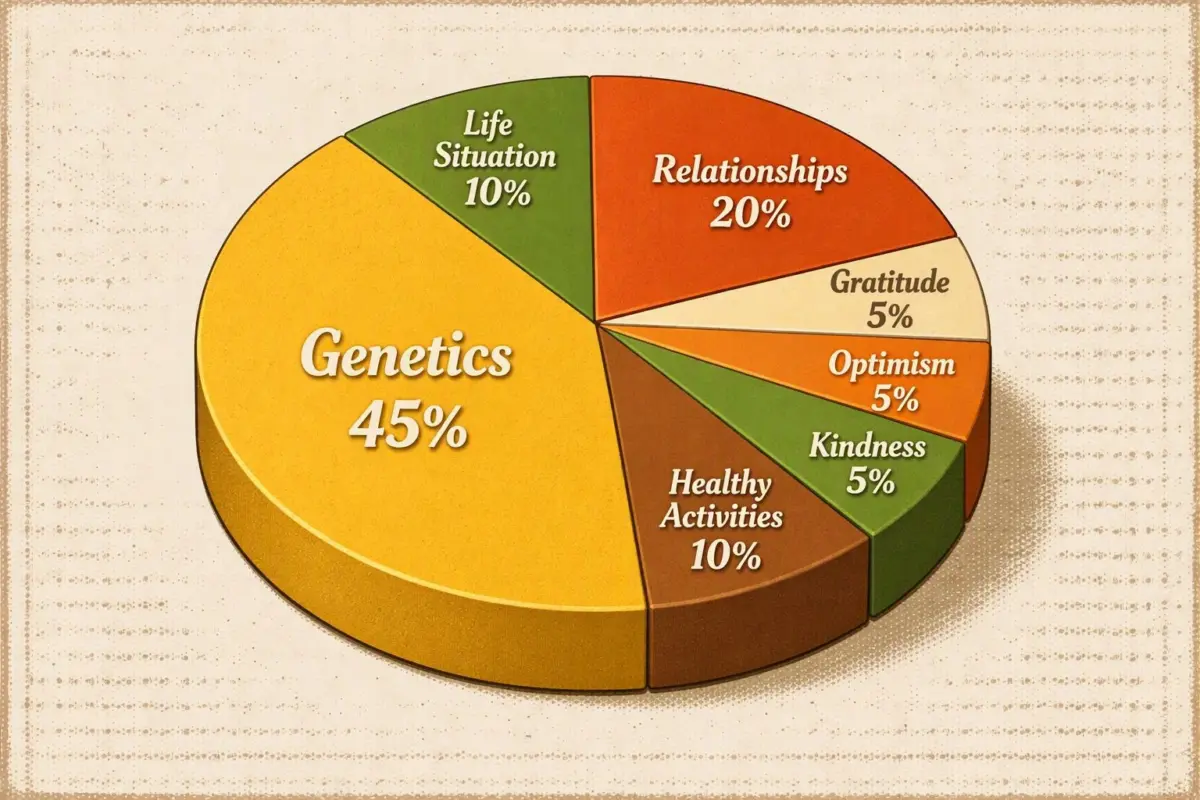
Psychological research and empirical observations suggest that wealth forms only a minor component of a person’s overall life satisfaction. Genetic predispositions play a significant role, but controllable factors—such as maintaining strong personal relationships, practicing gratitude, cultivating optimism, and engaging in regular physical activity—exert a far more powerful influence on daily happiness. Despite these comforting realities, many individuals remain constrained by chronic anxiety regarding an uncertain financial future.

Understanding and Combating Fear
The root of much financial anxiety lies not in objective economic danger, but in human evolution. As a species, humans function largely as danger detection machines. This pervasive background fear evolved as a vital evolutionary trait to protect early humans from predators and environmental hazards. However, a byproduct of this cognitive machinery is that once immediate physical dangers are mitigated, the brain continues scanning the environment for new threats, effectively shifting the goalposts of worry.
When basic survival and food security are achieved, anxiety migrates toward social belonging, economic status, and the maintenance of lifestyle standards. Among affluent populations, this psychological phenomenon can manifest as hyper-focus on neighborhood property standards, tax optimization strategies, or anxieties surrounding government-mandated retirement account distributions. Recognizing the irrationality of these fears represents the first step toward reclaiming mental peace.

Overcoming pervasive financial dread requires examining personal history and identifying the origins of scarcity mindsets. Upbringing, childhood experiences with economic instability, or past trauma often condition individuals to perceive threats that do not reflect their current objective reality. Articulating these fears and examining worst-case scenarios analytically helps defuse their emotional power. Extensive financial analyses consistently demonstrate that for high-net-worth individuals, the actual probability of absolute destitution remains exceptionally low.
Action serves as a primary antidote to fear. Engaging directly with unfamiliar situations transforms the abstract unknown into manageable experience, building personal resilience and practical capability. Furthermore, individuals can actively curate their mental environment by reducing exposure to sensationalized news media, which disproportionately highlights alarming narratives at the expense of balanced perspective. Aligning daily routines with human biological needs—such as physical movement, outdoor activity, and constructive problem-solving—substantially improves psychological well-being.

Approaching the AI Era as an Experiment
This pragmatic framework applies directly to contemporary anxieties surrounding artificial intelligence. Rather than viewing technological shifts through a lens of inevitable doom, observers can reframe major life and economic transitions as manageable experiments. Whether evaluating a minor lifestyle change or navigating sweeping industry transformations, the experimental mindset replaces panic with curiosity.
From a technological and economic perspective, artificial intelligence functions essentially as a cognitive productivity tool. Much like mechanical innovations that enhanced physical labor during the industrial era, AI systems amplify intellectual efficiency, lowering the cost of complex cognitive tasks and accelerating innovation. While this technological leap inevitably displaces certain traditional roles in administrative, financial, and transportation sectors—just as previous automation waves transformed manufacturing—it simultaneously lowers service costs and stimulates the creation of entirely new industries, mirroring the long-term economic impact of the internet and mobile computing.

The concentration of financial rewards among technology owners and corporate shareholders remains a valid structural challenge within modern capitalism. However, how individuals choose to interpret and adapt to these developments remains entirely within their personal control. By addressing the root causes of fear, focusing on measurable productivity, and maintaining a balanced, proactive perspective, individuals can navigate market bubbles and technological revolutions not as victims of circumstance, but as active participants in an evolving world.