
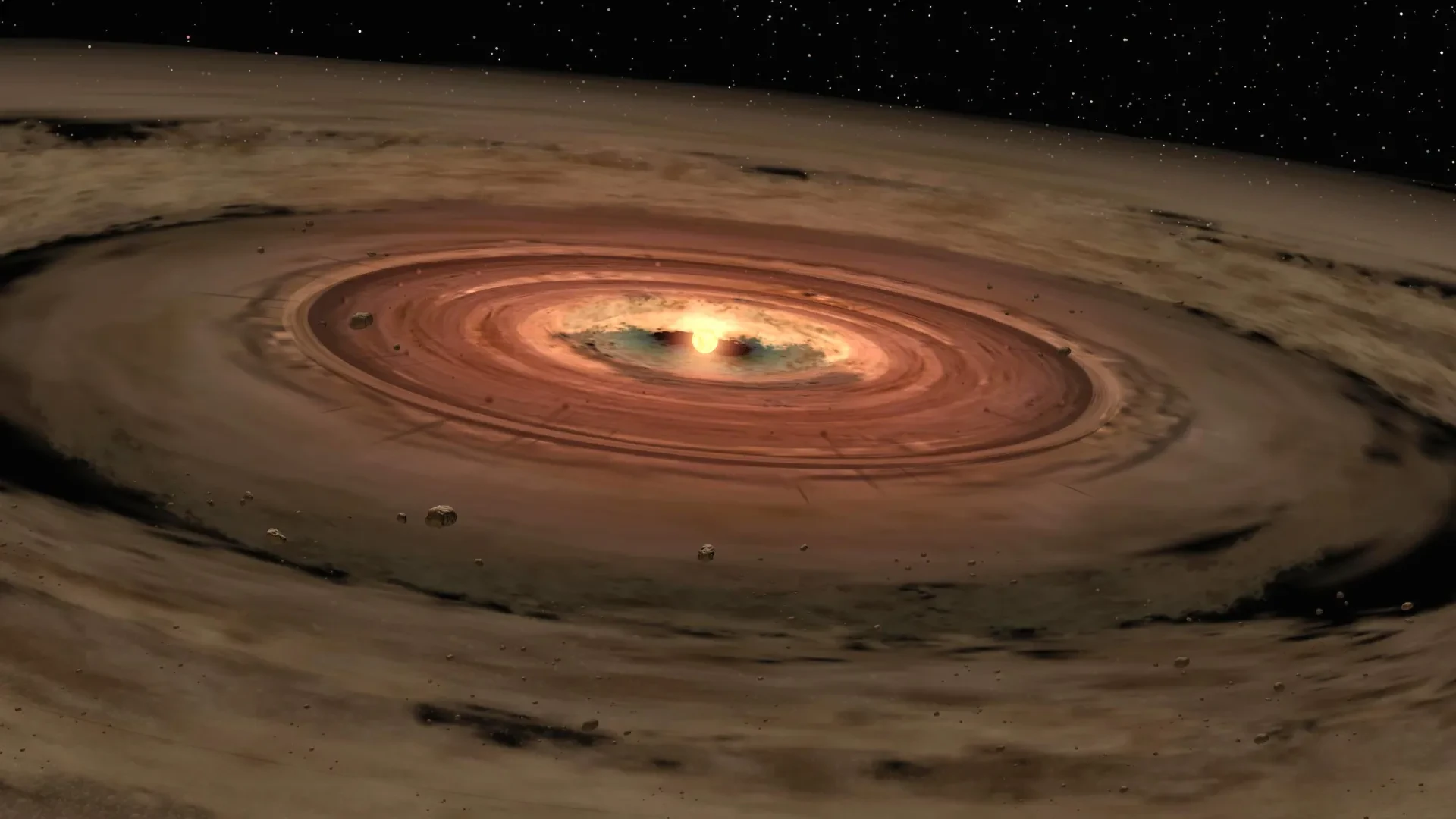
The earliest chapters of our solar system’s history were characterized by a far more selective assembly process than scientists previously understood. When the young Sun was newly formed and surrounded by a vast circumstellar disk of gas and dust, the process of gathering solid objects—such as early planets, moons, and protoplanets—depended heavily on which materials were available. According to new research, the infant solar system showed an immediate and profound preference for one specific type of material over another, reshaping our understanding of how planetary bodies first came together.
As the solar system began assembling its earliest solid objects, two major types of material were readily available within the protoplanetary disk. One category consisted of chondrules, which are millimeter-sized pieces of rock formed at high temperatures in the scorching inner regions of the solar nebula. The other category was matrix, a cold, fine-grained dust that was abundantly rich in water ice and organic material. For decades, planetary scientists have sought to understand how these two distinct components were mixed, sorted, and incorporated into the first generation of solid bodies, known as planetesimals.
Now, groundbreaking research led by Yale University indicates that the solar system strongly favored the heat-formed rocky material almost immediately after the birth of the system, setting a distinct precedent for how the building blocks of planets were gathered.
Researchers have uncovered the first direct geochemical evidence showing that chondrules were already being preferentially incorporated into solid bodies during the very first million years of the solar system’s history. Until the publication of this new study, scientists had only been able to document this type of material sorting in meteorite objects that formed considerably later—specifically, two to four million years after the solar system first began to take shape.
The study, which sheds fresh light on the primordial conditions of our cosmic neighborhood, was published on September 18 in the scientific journal Nature Astronomy. The international team behind the work includes lead author Damanveer Grewal, an assistant professor of Earth and planetary sciences in Yale’s Faculty of Arts and Sciences, along with co-authors Zhongtian Zhang of Princeton University and Joanna Drążkowska of the Max Planck Institute for Solar System Research in Germany. Funding for the research was provided by Yale University.
The Solar System Was Selective From the Start
The implications of the new findings point to an assembly line that was discerning from its earliest moments.
"Our work shows that this assembly process was remarkably selective from the very beginning," said Damanveer Grewal, discussing the team’s methodology and conclusions. "The earliest bodies in the outer Solar System were built from 83% to 92% chondrules, with very little of the icy, volatile-rich dust that dominates later-forming objects."
To understand the significance of this discovery, it helps to look at what chondrules actually are. These structures are small, spherical beads of rock found preserved inside chondrites, which rank among the most primitive meteorites preserved in geological collections today. Because they have remained largely unaltered since the dawn of the solar system, these tiny mineral structures offer scientists a direct physical connection to the conditions and processes that operated billions of years ago.
"You can hold them in your hand and know that they began as part of a process that started billions of years ago," Grewal reflected. "It’s a timescale that’s hard to wrap your head around."
For many years, scientists have understood that carbonaceous chondrites—which are primitive, stony meteorites containing organic compounds and water among their silicate minerals originating from the outer solar system—display a clear pattern linked to their age. Specifically, older examples tend to contain a notably greater proportion of chondrules and significantly less matrix, whereas younger carbonaceous chondrites contain more of the cold, volatile-rich dust material.
This overarching pattern long ago suggested to researchers that the regions where the first planetesimals were forming were already favoring heat-formed chondrules while selectively excluding much of the icy dust. However, proving this hypothesis for the absolute earliest phase of the solar system remained an elusive goal.
Searching for Evidence From the First Million Years
Confirming the exact sequence of events that transpired during the solar system’s first million years has historically been a daunting challenge for planetary scientists. The primary obstacle has been the complete absence of preserved, undifferentiated bodies originating from that specific epoch. Because no pristine remnants from the absolute earliest days of planet formation have survived intact in the meteorite record, scientists lacked a direct way to measure or determine the original balance between chondrules and matrix in those earliest generations of solid bodies.
To bypass this roadblock, Grewal and his colleagues approached the problem from a different angle, examining chemical clues preserved deep within iron meteorites that originated from the outer solar system.
The parent bodies represented by these iron meteorites had originally contained such massive amounts of radioactive aluminum-26 that they eventually melted completely. That intense internal heating process erased the physical structures—such as distinct chondrules or matrix grains—that would have normally revealed what those ancient bodies originally contained.
Even though the original physical architecture was destroyed by melting, the chemical signatures of the materials remained intact. The research team realized that the chemistry of these iron meteorites still preserved crucial, readable information regarding the initial mixture of ingredients that formed the parent bodies.
Specifically, the researchers identified two independent chemical tracers associated with the matrix material. The first tracer was sulfur, an element known to be highly concentrated within the fine-grained matrix. The second tracer was the oxidation state of iron, which serves as a reliable chemical indicator of how much water ice and oxidized dust had been successfully incorporated into the original body when it first coalesced.
Meteorites Reveal a Chondrule-Rich Beginning
Armed with these two independent chemical tracers, the research team set out to reconstruct the original compositions of the ancient parent bodies. Through meticulous calculation and chemical modeling, they determined that the matrix accounted for a mere 8% to 17% of the original material making up these bodies. This represents an even smaller proportion of matrix than has ever been measured in any known, surviving chondrite meteorites.
By logical extension, if the matrix comprised only a small fraction of the mass, the remaining material must have been overwhelmingly dominated by chondrules.
"Both tracers independently tell the same story: these early planetesimals were remarkably matrix-poor," Grewal noted. "That convergence is what makes the result robust."
These findings may also provide a neat solution to a long-standing mystery within the broader meteorite record. For years, scientists have puzzled over the fact that very old chondrules are surprisingly uncommon in our collections today, even though geological models indicate they must have been abundantly produced and widely available during the solar system’s earliest history.
According to Grewal’s analysis, the explanation is straightforward: many of those ancient chondrules were rapidly swept up and incorporated into the very first generation of planetesimals. Because those early bodies subsequently underwent extensive internal melting, their original physical structures were destroyed, rendering the oldest individual chondrules much harder to find in surviving meteorites recovered on Earth today.
Reconstructing the Birth of Planetary Bodies
The results of the Yale-led study paint a vivid picture of a dynamic and highly organized early solar system. They indicate that the complex process of separating, sorting, and selecting planetary ingredients began almost instantaneously, as soon as solid bodies started to form out of the primordial nebula. Rather than simply mixing chondrules and icy, volatile-rich dust evenly throughout the disk, the young solar system showed a powerful, systematic bias toward chondrules in some of its earliest-forming planetesimals.
These tiny, ubiquitous beads of rock served as the fundamental building blocks from which the planets, moons, and other major bodies of our solar system were eventually assembled over millions of years. With this new geochemical evidence, scientists have gained a clearer window into how that process operated at the very beginning, confirming that the sorting of planetary ingredients was underway from day one.