
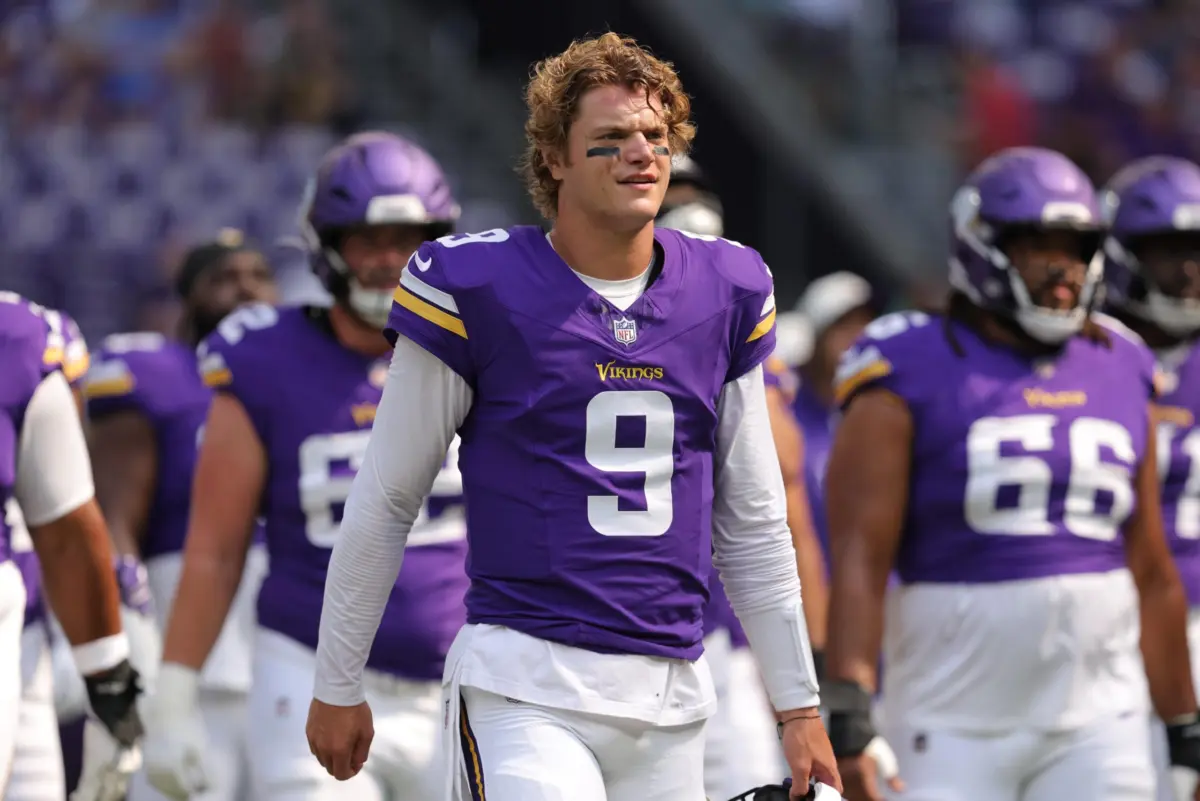
The New York Giants have fortified their quarterback room following a devastating blow to their season, acquiring former first-round pick J.J. McCarthy from the Minnesota Vikings.
Just one week after the franchise lost promising young quarterback Jaxson Dart for the remainder of the year due to a severe knee injury requiring surgery, the Giants moved swiftly to address their sudden roster vulnerability. New York sent an unconditional fifth-round pick in the 2027 NFL Draft to Minnesota in exchange for McCarthy, a 23-year-old signal-caller who endured a tumultuous summer in the Twin Cities. McCarthy lost not only the primary training camp battle for the starting job to Kyler Murray but ultimately slipped further down the depth chart, losing the backup role to veteran Carson Wentz.
Dart’s season-ending injury immediately sparked widespread speculation across the league regarding how the Giants would pivot. Rather than handing the offensive keys entirely to veteran journeyman Jameis Winston for the duration of the campaign, New York’s front office opted to explore the trade market. While the Giants managed to grind out a narrow victory against the Tennessee Titans, bringing their record to a competitive standing, the offense has noticeably lacked rhythm and explosiveness since losing Dart under center. Compounding matters further, the Giants also recently lost star pass rusher Brian Burns for the season due to his own knee injury, placing mounting pressure on the offensive unit to perform and control the tempo of games moving forward.
With the trade officially finalized, analysts and front offices are weighing in on the transaction. Here is a closer look at how each party involved grades out in this surprising early-season deal.
New York Giants: A-
Following Dart’s unfortunate injury, questions swirled around the league regarding which backup quarterbacks might realistically be made available on the trade block ahead of the annual NFL Trade Deadline. Many observers initially dismissed the viability of a deal, citing the inherent risks teams face when parting ways with valuable depth at the most important position on the field. Yet, the Giants managed to beat the rush and secure McCarthy well ahead of the deadline.
Giving up a fifth-round draft selection for a cost-controlled quarterback with ten career NFL starts under his belt at just 23 years of age represents a calculated, highly defensible gamble. Even if the move amounts to a classic metaphorical "dart throw," McCarthy possesses untapped physical upside that first-round pedigree traditionally implies.
Furthermore, New York offensive coordinator Matt Nagy brings a documented history of quarterback development to the table, dating back to his tenure with Mitchell Trubisky and the Chicago Bears. While Trubisky ultimately failed to live up to the lofty expectations attached to being selected second overall in the 2017 NFL Draft—notably picked eight spots ahead of Patrick Mahomes—Nagy successfully maximized Trubisky’s skill set and guided the Bears to a playoff appearance. If Nagy can engineer a similar stabilization process during a trying season where the Giants have lost their original starting quarterback, the acquisition will look like a masterstroke. Should the experiment fall short, the price paid was merely a mid-round draft pick.
Minnesota Vikings: A
For the Minnesota Vikings, this transaction provides a clean resolution to two distinct organizational challenges.

First and foremost, the trade effectively extinguishes lingering speculation surrounding McCarthy’s long-term future with the franchise and eliminates any potential quarterback controversy for the remainder of the season. When a team invests a premium first-round draft choice in a young quarterback, public and internal expectations dictate that the player will eventually see meaningful playing field time, even when a seasoned veteran like Murray is brought in to lead the offense.
Through the opening three weeks of the season, the Vikings sit at an unblemished 3-0 and claim the top spot in the competitive NFC North. While Murray’s performances have experienced normal fluctuations, defensive coordinator Brian Flores’ unit has operated at an elite level. Over a rigorous three-week stretch, the Minnesota defense has thoroughly flustered established signal-callers including Jordan Love, Caleb Williams, and Baker Mayfield. Surrendering an average of just 13.7 points per game, the Vikings defense currently ranks second across the entire National Football League. Advanced metrics, including Expected Points Added, illustrate a defensive unit performing at historic early-season efficiency.
This iteration of the Vikings features a bona fide playoff-caliber defense that primarily requires stability and sound management from the offensive side of the ball. Given the immense offensive talent surrounding the position, deploying a steady veteran hand like Murray aligns better with Minnesota’s immediate championship ambitions than the unpredictable volatility McCarthy displayed across his ten career NFL starts.
Additionally, the trade delivers a significant financial benefit to Minnesota’s ledger. By parting ways with McCarthy while he remains on his rookie contract, the Vikings manage to clear crucial financial flexibility. According to reports from insider Tom Pelissero, executing the trade now saves the organization nearly $5 million in combined cash expenditures and salary cap space. For a young player needing a fresh start elsewhere, the parting of ways proves mutually beneficial from a fiscal and roster-building perspective.
J.J. McCarthy: A
The landscape shifts positively for J.J. McCarthy as well, offering him a fresh canvas after a challenging chapter in Minnesota.
While his tenure with the Vikings yielded occasional flashes of high-level play—highlighted by a memorable fourth-quarter comeback victory over the rival Chicago Bears at the onset of last season—a cohesive rhythm never truly materialized for the young quarterback in the Upper Midwest. Professional sports frequently demand a change of scenery to unlock potential, and McCarthy now receives that precise opportunity.
He steps into an established football organization under the broader umbrella of the Giants’ leadership structure, which includes ties to the Harbaugh coaching tree. While McCarthy may not immediately step into the starting lineup—given that he will need time to absorb Nagy’s offensive playbook—the environment offers a stable platform to demonstrate his capabilities. With Dart already holding a prominent place in the franchise’s long-term plans, McCarthy may not permanently usurp the starting role in New York once Dart recovers, but this trade stands as his clearest runway yet to audition for future starting opportunities across the professional football landscape.