
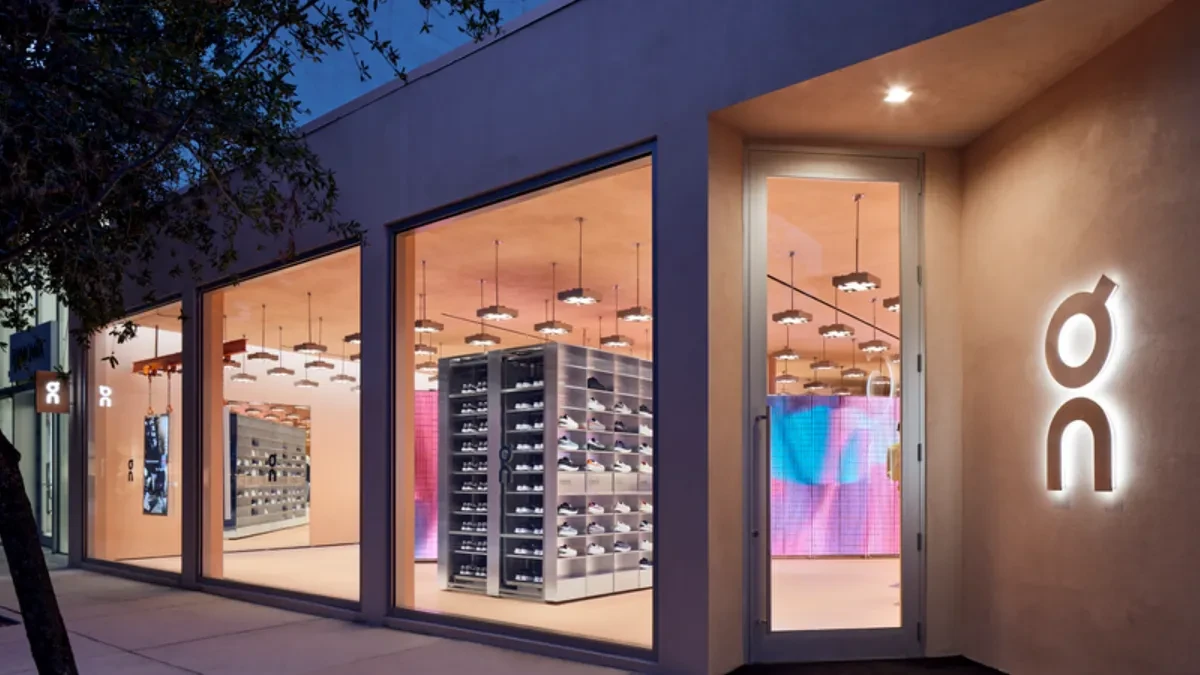
Athletic footwear and apparel brand On is looking ahead to an ambitious three-year growth trajectory, banking heavily on a strategic entry into the global soccer market and high-profile partnerships to sustain its momentum. However, Wall Street analysts are questioning whether the company’s lofty financial targets are realistic in a rapidly shifting retail landscape marked by a broader slowdown in athletic industry fundamentals and increased consumer price sensitivity.
During the company’s investor day presentation, executives outlined a series of expansion plans designed to propel the brand through high-teens growth over the next three years. The brand announced a $1 billion share buyback program alongside a projection for net sales to reach 5.6 billion Swiss francs, translating to approximately $6.8 billion. Company leadership emphasized that high-visibility moves, such as securing a partnership with superstar athlete Kylian Mbappé—who was lured away from industry heavyweight Nike—will provide the necessary catalyst to capture fresh market share and expand consumer awareness across multiple product categories.
Despite the bullish outlook presented by On’s executive team, external financial analysts remain cautious. Market observers point out that the brand’s rapid expansion is beginning to face headwinds as overall sales growth normalizes following years of explosive post-launch momentum.
In a note to clients, Jefferies analysts led by Randal Konik highlighted that On’s sales growth has notably decelerated from 36% down to 13% over the course of six consecutive quarters. Furthermore, the brand is anticipating third-quarter constant currency growth to come in at approximately 17%.
According to Jefferies, setting long-dated targets against a backdrop of a decelerating base raises the operational hurdle rather than lowering it. Konik noted that guidance credibility, rather than grand vision, is what financial markets are actively testing. Jefferies projects On to grow at a more conservative 3% rate from 2026 to 2027, estimating a 2027 EBITDA margin of 14.8%, which falls roughly 700 basis points short of the company’s internal 2029 goals.
Closing that widening gap requires the company’s business model to inflect almost immediately, according to Konik, especially within a promotional United States retail market where brands often lean heavily on markdowns and paid digital traffic to sustain volume. Expressing a preference for a more conservative baseline, Konik remarked that they would rather see a beatable bar than an overly bold one.
Similar caution was expressed by Needham analyst Tom Nikic, who predicted that On would likely target a low-teens compound annual growth rate over the next three-year cycle, while cautioning investors against being overly swayed by bullish corporate forecasts. Nikic noted that the external economic and retail environment has become significantly more challenging, impacting athletic industry fundamentals broadly and weighing heavily on investor sentiment.

At the same time, Needham acknowledged the strategic prudence of On’s operational discipline. Nikic credited the company for taking the smart approach by reining in wholesale sell-in and deliberately avoiding the widespread promotional discounting that has become pervasive across the broader athletic footwear and apparel sector, a move that ultimately protects the long-term health and equity of the brand.
During the investor day presentations, On’s leadership team doubled down on the core pillars of their strategy, highlighting a steadfast reliance on science-based innovation and deep collaborations with high-profile brand partners. Beyond athletes like runner Hellen Obiri, the company has leaned into cultural relevance through partnerships with influential figures such as actor Zendaya.
The centerpiece of On’s aggressive new growth strategy, however, is its formal entry into the competitive soccer category. By successfully signing global icon Kylian Mbappé away from Nike, On has immediately established elite credibility in a sport that commands massive global viewership and consumer spending.
Chief Design Officer Thilo Brunner addressed the intense public interest surrounding the brand’s forthcoming athletic footwear for the sport, noting that the internet is already abuzz with artificial intelligence-generated concepts predicting what On’s soccer cleats might look like. According to Brunner, public speculation has come remarkably close to reality, which he interprets as proof that On has successfully forged a distinct, highly recognizable design language that consumers intuitively understand and anticipate.

The product development team has been working closely with Mbappé, soccer legend Thierry Henry, and player Sydney Schertenleib to engineer performance-driven products tailored specifically to the demands of the new category. Beyond the direct sales generated by soccer gear itself, Chief Marketing Officer Alex Griffin pointed out that entering soccer will generate powerful knock-on effects across the entire brand portfolio. The heightened visibility and cultural footprint of the soccer initiative are expected to drive consumer discovery and growth in adjacent categories, including lifestyle footwear and everyday apparel, helping On maintain its cultural cachet as it scales toward its multi-billion-dollar long-term financial objectives.