
There is a dress on display at the Smithsonian Institution’s National Museum of African American History and Culture that tells a story far larger than its physical fabric. It is a pharaonic black velvet scoop-neck evening gown featuring a straight skirt adorned with gold sequins and geometric embroidery, topped off by a black chiffon scarf with coordinating paillettes. Dating back to 1961, it is a piece of vintage couture worn by Ophelia DeVore, a visionary widely recognized as America’s first Black model. DeVore formed her breakthrough eponymous charm school and the game-changing Grace Del Marco modeling agency, helping make household names of luminaries like Diahann Carroll, Dorothea Church, Gail Fisher, Trudy Haynes, Beah Richards, Richard Roundtree, Sue Simmons, Audrey Smaltz, Susan Taylor, Cicely Tyson, and Helen Williams, among many others.
Yet, that remarkable dress is not the only thing that makes the exhibit compelling. Tucked at the bottom of the garment’s display placard is a curious subheading: The Roots of New York Fashion Week.
"With her Grace Del Marco models, DeVore created innovative fashion shows in Bryant Park in New York City," the placard reads. "Each summer during lunchtime, her multicultural models walked the runway in Bryant Park. The shows were so impressive that white marketers decided to appropriate the shows, adding tents and inviting top designers worldwide to show their fashions."
What makes the text provocative—not least of all because of the Smithsonian’s touchstone status in contemporary debates surrounding diversity, equity, and inclusion—is that its claim is uncharacteristically vague. What years? What models? What designers? What marketers? The museum’s media specialist in its public affairs office could not answer, and declined phone interview requests.

Apart from the Smithsonian, the Bryant Park precedent is missing from both of DeVore’s New York Times obituaries. It is omitted from a summary of her life by Emory University, the caretaker of her personal archives, and even from The Color of Beauty, an exhaustive, intimate 18-chapter biography by her sister’s great-granddaughter. Even television programs like The View gave DeVore’s epic life just 57 seconds of airtime. Meanwhile, broader Fashion Week memory loss persists: DeVore is not mentioned anywhere on the Council of Fashion Designers of America website, and Vogue made only a single passing reference to her charm school with no acknowledgment of her pioneering runway shows. This institutional amnesia cuts straight to the core of diversity initiatives’ recurring problems: tokenism over representation, and celebration over true empowerment.
Buoyed by historical oversight and cultural bias, the endurance of this amnesia over Bryant Park’s early Black fashion shows mirrors similar decades-long minimizing of events like Central Park’s "Black Woodstock," a 1969 concert that was largely ignored until Questlove’s documentary Summer of Soul brought it to light. Yet forgetting or minimizing Black achievement is not always malicious.
"Ophelia DeVore lived a long life—she died at 92—and these shows were maybe a blip to her," says Gabrielle Dudley, an archivist at Emory University who specializes in the Civil Rights era. Later in life, from age 50 until her passing, DeVore took on a second career as the owner and publisher of The Columbus Times, a Black newspaper in Georgia she inherited after her second husband’s death.
"In the Black fashion community, it was something that was very much looked forward to. It was very significant," Dudley continues. "Pero the historical context is that this was an era where Black people were breaking barriers almost every day—and not just being a credit to their race, but also an asset to their race. So many Black people were doing it that of course someone was doing it in the fashion industry."

Even for DeVore herself, Dudley notes, in a life spanning nearly a century filled with countless achievements, it is difficult to shine a light on every single milestone. She may have simply grown tired of telling the story and pushing against the grain—a phenomenon that frequently occurs within Black women’s archives.
Biographies and retrospectives often gloss over her work as an image consultant for the governments of Haiti and Nigeria, or the Fashion and Beauty Centre she opened in Swaziland in 1985 with Zenami Mandela, daughter of Nelson Mandela, while he was still imprisoned under apartheid in South Africa. Her circle of friends and mentors included Julian Bond, Louis Farrakhan, Jesse Jackson, Martin Luther King Jr., Coretta Scott King, and Betty Shabazz. Ophelia DeVore simply did a tremendous amount of living.
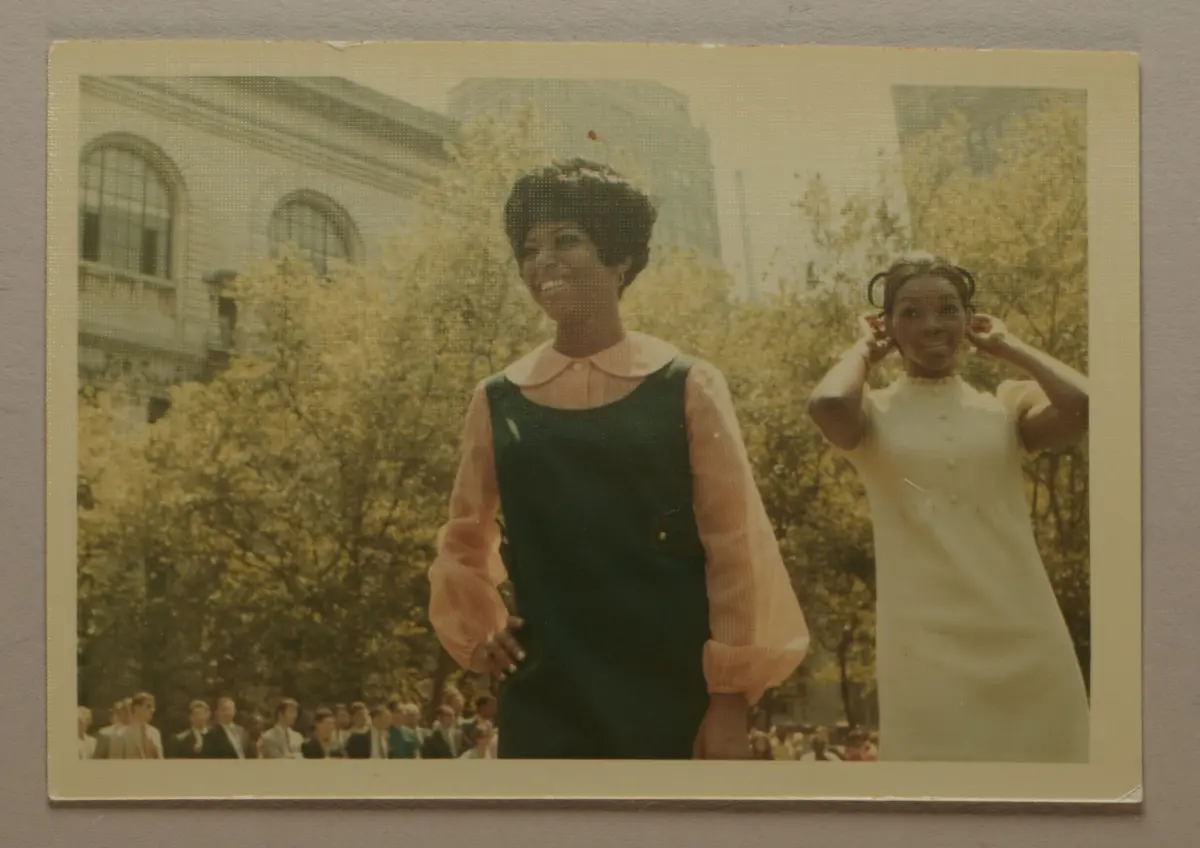
An investigation into DeVore’s forgotten or half-remembered success reveals that, as early as 1969—twenty-four years before formal white-tented events took over the space—DeVore was producing runway shows in Bryant Park. They were hailed as "fashion extravaganzas" by The Amsterdam News, New York’s Black newspaper of record, which ironically also omitted this history in its own obituary for DeVore.
"Featured in the fashions in the park were noted Black, Oriental, and Spanish-speaking male and female models, both adults and children," reads an article from September 1970. "They paraded garments contributed by major manufacturers, fashion houses, accessories firms, and designers. Ophelia DeVore commentated."

Institutional erasure of DeVore’s accomplishments persists in subtle ways. Emory University, for instance, maintains a policy of waiting 15 business days to digitize even a single image from its extensive DeVore archive. In Emory’s 13 years of stewardship, an archivist notes that it has digitized only one image of DeVore. Such gatekeeping suppresses her legacy while amplifying systemic biases against the visibility of Black women’s historical success. After DeVore’s family interceded, Emory digitized select records, though top-priority requests, including its solitary DeVore portrait, remained withheld.
Nevertheless, DeVore’s daughter Carol, now 83 and living in Georgia, fondly remembers co-commentating alongside her mother at that 1970 show.
"That was her idea to bring some excitement to fashion—and to lunchtime. It was a lot of fun," she says. "The fashions we had were very unique. So this was something people wouldn’t see ordinarily, even fashion-wise, and not just because the fashions were on Black models."
A review of flyers, handwritten logistics, and family photographs from the weeklong shows in 1969 and 1970 reveals participation from major brands like Butterick, Gay Gibson, and Pandora Frocks, alongside an international show in partnership with TWA. There was menswear by Oleg Cassini—a designer favored by Jacqueline Kennedy—and Federico Pio, wigs by Jacqueline Lee, and a day set aside exclusively for Black designers. An exuberant soundtrack was provided by a Chicano garage band from California called The Premiers, alongside radio hits including The Jones Girls’ single "My Own Special Way." Beneath their relaxed, open-air vibe, the shows were meticulously planned, complete with City Hall permits and scheduled rain dates.

Fashion Week did not simply arrive at Bryant Park on its own accord. DeVore brought it there.
"My mother didn’t just promote things to sell. She saw value in people," Carol reflects. "She called Black people ‘Black diamonds’ and said it was her job to polish those Black diamonds."
As early as 1949, DeVore elevated showroom exhibits by modeling a gray Persian lamb fur coat by John T. Vidal, America’s premier Black furrier at the time, as part of a fashion cruise and dance. By 1955, she was hosting ABC’s Spotlight on Harlem, New York’s first television show produced by and for Black Americans. Being multiracial herself, DeVore also launched a pioneering cosmetics line tailored to non-white skin. In 1959, one of her models, Cecelia Cooper, became the first American and first Black woman to win the Miss Festival beauty contest at the Cannes Film Festival, a feat repeated by another of her models the following year. These victories made the Grace Del Marco agency the first choice for Christian Dior’s push into international sales; from Del Marco’s roster, Dior chose Helen Williams.
Amid this mounting momentum, DeVore’s life came to a violent halt in 1952 due to a car accident in a Detroit snowstorm. Friends pulled her broken body from a flaming wreckage just moments before her new Buick Special exploded. She awoke from a coma two weeks later in a body cast from the neck down, her legs crushed, shoulders broken, one arm dislocated, and teeth shattered.

"The only thing holding me together was the brand-new girdle I had worn," she later told her family. She spent nine months bedridden, including five months in hospital traction.
"She had one good hand and she used it to sign contracts from her hospital room," says Alina Mitchell, author of The Color of Beauty. "She was so determined. It’s so inspiring to me. Imagine being stuck in a hospital for months and using that time to think up ways to improve the fashion industry."
Fashion Week, much like fashion itself, is a collaborative and ever-evolving enterprise. Its earliest modern iteration began in 1903 when a New York specialty clothing shop called Erlich Brothers held what is regarded as America’s first in-store fashion show. The concept was formalized into a citywide tradition as "press week" at the Plaza Hotel in 1943 by fashion publicist Eleanor Lambert. However, those early iterations lacked the Black community’s sense of iconoclastic rebellion and sartorial agency.
"You could do things back then. You could just do things—could be the first of things. You don’t think of it at that time. You’re so busy integrating," recalls fashion icon Bethann Hardison. "The struggle was a wonderful fight because we knew what we had on our side. We were gangsters, revolutionaries, Buffalo soldiers. But it wasn’t one note. Del Marco knew how to change over decades, over generations."

On the heels of New York’s fresh "Black is beautiful" cultural energy, Paris developed its own fashion week in 1973, Milan in 1975, and London in 1984. As a pioneer of mainstream Black beauty, DeVore changed the industry not only by introducing models with different skin, hair, and backgrounds, but by integrating Black culture into the very fabric of the runway. Suddenly, models walked differently, engaged audiences differently, spoke up differently, and negotiated their work differently.
Ordinary people also passed through DeVore’s charm school and modeling agency. MaryLouise Patterson attended the charm school in the 1950s when she was 15 years old.
"It was like I was going from being a little girl to being a young woman—lady is probably the correct term, a young lady rather than young woman," she says, noting the special refinement and manners she acquired.
Patterson says DeVore’s charm school was the first time she felt truly beautiful. Instead of pursuing modeling, she went on to become one of America’s most graceful pediatricians.

"I always wanted to present myself in the best light and Ophelia DeVore gave me that sense, that awareness," she says. "She helped me meet my best self and understand the importance of that. It has carried me through."
Reflecting on her philosophy, DeVore was remarkably kind toward those who walked through her doors. "They did not have to be the most beautiful, the best dancer, or the most talented. All they had to be was the best representation of themselves. My philosophy was there was no such thing as an ugly person, only a lazy one."
The Grace Del Marco agency and charm school shuttered in 2006. The frenetic glamour of Bryant Park’s fashion tents ended in 2010, and DeVore passed away in 2014. While fashion has a deep-rooted knack for revivals, her legacy—having served 40,000 hopefuls across seven decades—remains both enduring and incomplete.
Emory University’s possession of her archives has inspired college courses on Black beauty, the power of self-love, and resisting racism. Student discussions translate into academic papers, dissertations, and books, expanding broader public knowledge. With a life like DeVore’s, Dudley notes, the amazement never truly leaves.

"She knew she was elevating Blackness in the fashion industry and in our world, and she probably thought she was doing that in an incremental way," Dudley says. "Pero we get the privilege of looking back and knowing, wow, she really did so much."
When most creators produce their magnum opus—a novel, a symphony, a painting, a film, a skyscraper—society encourages the pride of creative provenance, allowing the artist to emblazon their name in paint, ink, or stone. Yet history is often less generous when a creator’s greatest achievement is baked into the very concept of culture and beauty itself. Knowing this, DeVore deeply desired remembrance. Explaining why she named her charm school after herself, she spoke with absolute clarity: "I had a gut feeling I was on the brink of something huge and I wanted the world to know I was behind it."