
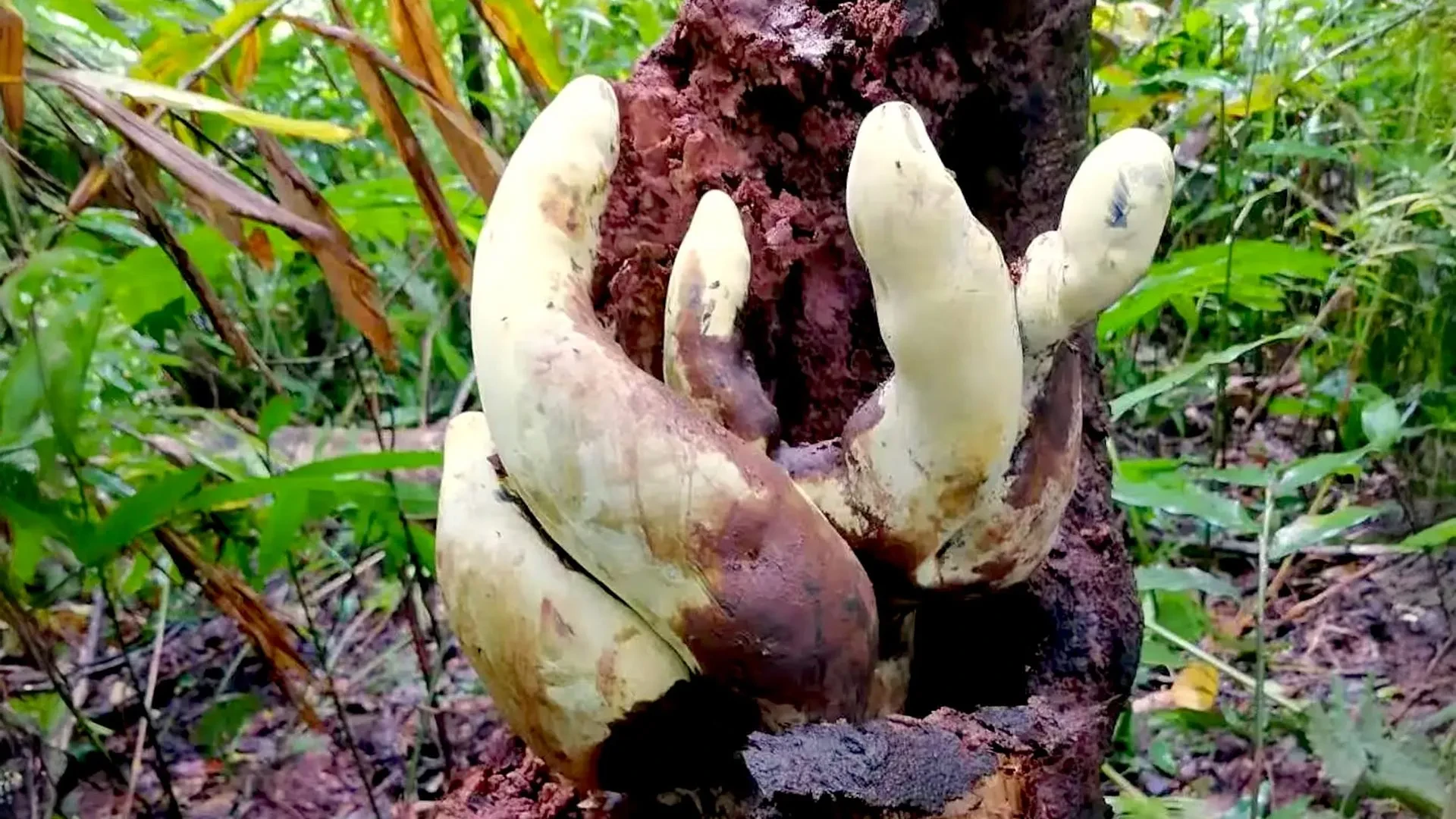
Deep within the lush and biodiverse forests of China’s Yunnan province, an extraordinary scientific discovery has come to light. Researchers exploring the region have identified a massive, previously unknown fungus that is dramatically challenging long-held assumptions within the scientific community regarding just how large certain fungal species can grow. The newly cataloged species, formally named Dianjunus rex, produces upright reproductive structures that can reach an astonishing 50 centimeters—or roughly 20 inches—in height and tip the scales at up to 2.2 kilograms, which translates to nearly 4.9 pounds.
These massive dimensions are not merely an anatomical curiosity; they officially represent the largest known fruiting bodies ever recorded among fungi belonging to the phylum Ascomycota. The finding has sent ripples through the mycological community, offering a fresh perspective on the hidden depths of ecological diversity thriving in East Asian forest ecosystems.
"This remarkable species represents a new fungal family, Dianjunaceae, and provides a rare window into the evolution of extreme fungal body forms," noted Dr. Indunil C Senanayake, an associate professor at the Germplasm Bank of Wild Species of the Kunming Institute of Botany in China and the corresponding author of the study, which has been published in the scientific journal Frontiers in Fungal Biology. "The discovery illustrates how much fungus biodiversity remains to be discovered in East Asian forests."
A Giant Fungus Hidden in China’s Forests
The groundbreaking discovery was made by a dedicated team of researchers from the Kunming Institute of Botany while they were conducting comprehensive ecological surveys across several distinct forest environments scattered throughout Yunnan province. Their rigorous fieldwork spanned multiple microclimates and habitats, including temperate coniferous forests near the localities of Damaidi and Yipinglang, as well as dense tropical rainforest environments near Nanbang.
During these surveys, the team stumbled upon unusually large, pale, whitish reproductive structures. In mycological terms, these prominent features are known as ‘stromata’. The massive growths were observed emerging directly from the woody roots of Chinese cork oak trees. More specifically, they pushed their way upward from the rhizosphere—the complex, nutrient-rich region of soil immediately surrounding plant roots. At first glance, the sheer scale of these structures made it clear they belonged to an exceptionally unusual, unidentified member of the ascomycete group of fungi.
To understand the full scope of what they had found, it helps to look at the sheer scale of the group to which it belongs. Ascomycetes make up the largest major phylum of fungi known to science, encompassing more than 64,000 officially recognized species. However, unlike the familiar umbrella-shaped mushrooms commonly encountered on forest floors, ascomycetes generally do not produce true, traditional mushroom caps and stems. Instead, their defining characteristic is the production of spores within microscopic, sac-like structures that are embedded either inside or directly upon the surfaces of their fruiting bodies.
Recognizing the potential significance of their find, the scientists carefully collected physical samples from the site and preserved vital reference specimens within the official research collections of the Kunming Institute of Botany. To go beyond a simple physical description, the team also successfully cultivated spores under controlled laboratory conditions. This allowed them to closely examine the living fungus’s distinct physical characteristics, observe its growth patterns, and sequence its complete genome, including a detailed look at its protein-coding genes.
Meet D-Rex, a Record-Breaking Fungal Giant
When the genetic sequencing data was combined with a meticulous examination of the fungus’s physical and microscopic features, it quickly became apparent that the researchers had uncovered far more than just a new species. The genetic divergence was so profound, and the structural differences so distinct, that the organism could not be accommodated within any existing taxonomic groups. It was sufficiently different from all known fungi to warrant the creation of an entirely new genus and a brand-new family, Dianjunaceae, positioned within the broader fungal order Xylariales.
The researchers chose the species name Dianjunus rex to honor both its impressive physical stature and its geographic origins, drawing specific inspiration from the ancient Dian kingdom that once flourished in the region. Among the research team and within subsequent academic discussions, the fungus has quickly earned the catchy nickname ‘D-rex’, a moniker that highlights its apex status and exceptional physical proportions when compared to its closest relatives.
Intriguingly, the genetic and evolutionary analysis revealed that the closest known relative to this new giant is Graphostroma platystoma, a relatively inconspicuous fungus that typically grows on dead hardwood trees throughout various regions of the Northern Hemisphere. Notably, Graphostroma platystoma has long held the distinction of being the sole representative of its own specialized family, Graphostromataceae, making the addition of the Dianjunaceae family a major update to the higher-level classification of these organisms.
Members of the broader order Xylariales are widely recognized by biologists for their biochemical capabilities. They are known to produce a diverse array of specialized chemical compounds and potent enzymes designed to break down complex, rigid molecules found within plant tissues, such as cellulose and lignin. Based on this lineage, researchers strongly suspect that similar powerful enzymatic pathways allow ‘D-rex’ to efficiently decompose dead wood, extracting necessary nutrients from deeply embedded forest organic matter to sustain its massive growth.
A 65-Million-Year Connection to Dinosaur Extinction
Beyond its physical size and genetic uniqueness, one of the most intellectually compelling aspects of the discovery relates to the ancient evolutionary timeline of the newly identified fungal family.
To peer back millions of years into the past, the scientists employed a sophisticated analytical technique known as a ‘molecular clock’. By comparing the newly sequenced DNA of Dianjunus rex against genomic information gathered from hundreds of other fungal species whose evolutionary timelines have already been established, the team was able to calculate a reliable estimate for when the Dianjunaceae lineage first diverged and appeared on Earth.
The results of this molecular dating suggest that the lineage originated approximately 65 million years ago. This date places the birth of the family at a remarkably specific moment in Earth’s history—roughly one million years after the catastrophic Cretaceous-Paleogene mass extinction event. That devastating global cataclysm wiped out the non-avian dinosaurs alongside an untold number of other animal and plant species, fundamentally reshaping terrestrial ecosystems across the globe.
The coincidence of this timeline raises a compelling scientific hypothesis: the enormous, sudden environmental upheavals and ecological shifts that followed the mass extinction may have helped create unprecedented, highly favorable conditions for the ancestors of this unusual fungus to thrive and evolve.
"This timing raises an intriguing possibility. After the mass extinction, forests experienced dramatic changes, including the sudden availability of large amounts of dead plant material," Dr. Senanayake explained, pointing to the profound ecological restructuring of the era. "For wood-associated decomposing fungi, such environmental disruption may have created new ecological opportunities."
Why Does Even a Fungus Grow So Large?
Despite having the genetic blueprint and a timeline of its origins, scientists are still grappling with a fundamental biological question: how and why did Dianjunus rex evolve such an extraordinary, unprecedented size?
Before this discovery, the tallest known ascomycete fruiting bodies topped out at approximately 20 to 30 centimeters in height. By reaching up to 50 centimeters, the newly identified giant stands substantially taller than any previous record holder in its phylum, redefining the biological limits of the group.
One of the leading hypotheses proposed by the research team centers on the mechanics of spore dispersal. Fungi rely heavily on the successful release and transport of their microscopic spores to reproduce and colonize new territory. By extending its reproductive structures high above the cluttered forest floor, Dianjunus rex may be positioned advantageously to catch passing air currents, allowing its spores to travel significantly further through dense, obstructing vegetation than would be possible closer to the ground.
At the same time, however, building and maintaining a towering biological structure requires a massive investment of metabolic energy and physical resources. The researchers suggest that such an extreme evolutionary strategy would only make biological sense in specific environments where the long-term ecological benefits of superior spore dispersal outweigh the very real metabolic costs required to construct such a heavy, large body.
"A fruiting body which towers above surrounding vegetation and debris could have better dispersal of spores by wind in dense forests. However, such a large structure requires substantial energy investment, suggesting that this strategy likely evolved only where the ecological benefits outweighed the costs," hypothesized Senanayake.
China’s Forests May Harbor More Undiscovered Fungi
Ultimately, the unexpected discovery of Dianjunus rex serves as a powerful reminder of how much of the natural world remains hidden, particularly within the complex subtropical and tropical forests of China.
Scientists believe that the geographic region is exceptionally well-suited to drive the evolution of unusual and specialized fungal species. This is due to a unique combination of factors: the area contains a wide variety of distinct microhabitats, has experienced relatively stable climatic conditions over long stretches of time, and supports intricate, highly evolved relationships among a vast array of living organisms.
Yet, despite these favorable ecological conditions, many fungi residing in these ecosystems have historically received very little scientific attention. Rugged, remote, and difficult terrain often complicates field expeditions, while the seasonal appearance and frequently hidden, cryptic nature of fungal reproductive structures make individual species notoriously difficult to locate and study. Furthermore, historical mycological research has tended to focus heavily on species with immediate commercial, agricultural, or practical value, leaving wild, forest-dwelling groups largely unexplored.
Armed with these insights, the research team anticipates that continued, systematic exploration of these complex forest environments will lead to the discovery of additional species, potentially unearthing even more unexpected physical forms and evolutionary histories that science has yet to document.
"This region combines exceptional habitat heterogeneity, climatic stability, and complex biotic interactions that promote fungal diversification," Senanayake concluded. "Historically, however, fungal diversity in these ecosystems has been underestimated due to logistical difficulties in field sampling, the seasonal and cryptic nature of fungal fruiting, and a historical emphasis on economically important fungi."