
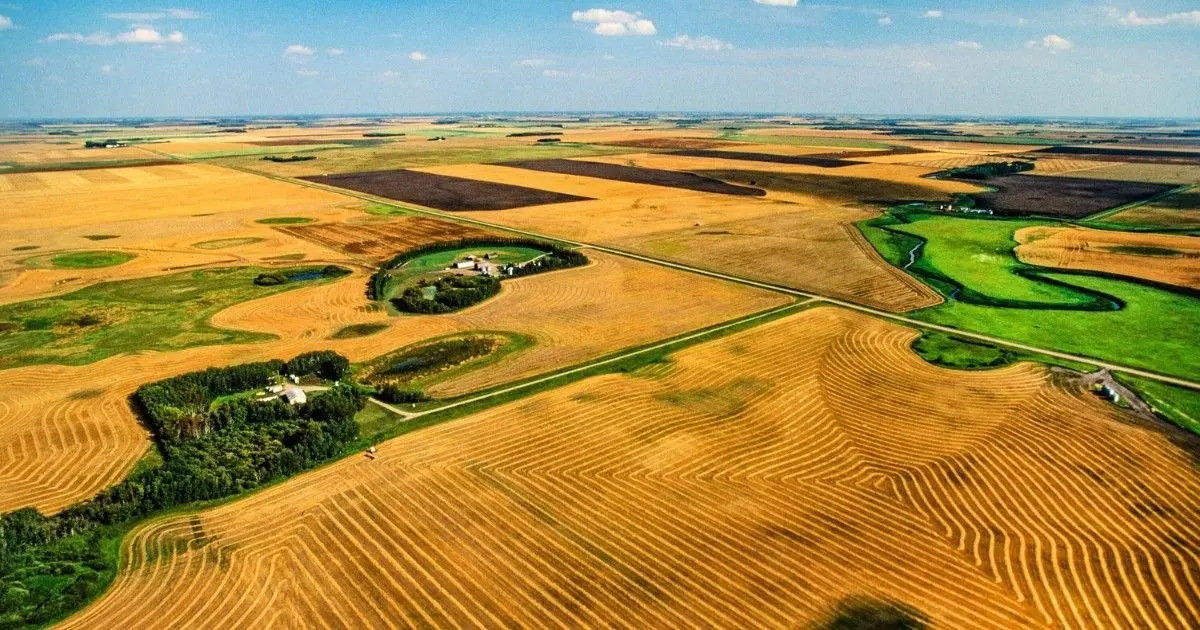
Saskatchewan’s agricultural landscape is undergoing a notable transformation, driven by an aging farming population, complex succession challenges, and mounting global financial pressures. These converging factors have pushed farmland listings in the province to a five-year high, reshaping a market that has long been characterized by tight inventory and fierce competition. Yet, even as the volume of available properties expands, land values continue to hold their ground, defying broader national trends of slowing appreciation.
According to the Fall 2026 Commercial Real Estate Report released by Remax Canada on October 27, Saskatchewan recorded 317 farm properties listed for sale. This figure marks a steady upward trajectory from previous years, up from 286 listings in 2025 and just 208 listings in 2022.
Industry experts point to generational turnover as the primary catalyst behind the growing inventory. Jeff Chapple, broker-owner of Remax Revolution Realty in Esterhazy, Saskatchewan, believes that an aging demographic of producers, compounded by a widespread lack of formal succession planning, is fueling the surge in listings.
Chapple, who spent much of his life working in agriculture before transitioning into real estate in 2018, notes that the traditional pathway of passing family farms down intact through successive generations is becoming increasingly rare. In many cases, the children of aging producers have moved away to pursue higher education and alternate career paths in urban centers, leaving their parents without an obvious or willing successor to take over the family enterprise.
“There’s still a lot of older farmers here who still think their 50-year-old kids are coming home to farm,” Chapple observes. While some families have successfully implemented structured succession plans to transition ownership and management, he believes that many operations have deferred these difficult conversations, leaving properties vulnerable to being sold on the open market when retirement finally arrives.
The Remax report similarly identifies generational turnover as a key variable capable of introducing substantial acreage to the market. However, both analysts and brokers note that the exact timing and cumulative volume of future listings remain difficult to predict.
Why Prices Remain Elevated
The rise in market inventory coincides with a broader national cooling of farmland appreciation. According to the mid-year farmland values review published by Farm Credit Canada (FCC), the value of cultivated farmland across the country increased by 3.8 percent nationally during the first half of 2026. This represents a moderation compared to the six percent growth recorded during the same period in the previous year.
In Saskatchewan, however, values have continued a steady, if slightly more measured, climb. Provincial farmland values rose 2.6 percent over the six-month period and 6.7 percent year over year. Meanwhile, market data shows that the median selling price for farm parcels of 80 acres or larger reached $2,612 per acre over the 12-month period ending in September, representing an increase of more than 58 percent since 2022.
Despite the influx of new properties entering the market, Chapple emphasizes that Saskatchewan farmland remains a highly resilient and attractive asset class. He draws a direct comparison to precious commodities, noting that agricultural land commands strong confidence from buyers.
“Farmland’s a very strong asset. It’s a lot like owning gold,” Chapple says. He explains that neighboring farmers are often the most motivated purchasers in the market because land immediately adjacent to their existing footprint carries intrinsic, operational value. “Land is worth more when it’s next door to you,” he adds.
Furthermore, Chapple believes that Saskatchewan farmland continues to offer relatively attractive entry points compared to other agricultural regions across Canada. He recalls that affordable land values originally motivated his own move to the province from Ontario in 2007.
While the buyer pool for agricultural land has historically alternated between speculative investors and active agricultural producers, Chapple notes that farmers currently represent the dominant purchasing force. Several consecutive years of robust commodity prices allowed many producers to significantly pay down debt and accumulate substantial cash reserves, positioning them well to expand their operations when opportunities arise.
“Commodity prices, maybe, aren’t as strong right now, but agriculture is a long game,” Chapple notes. He adds that while both large and smaller farming enterprises are participating in the market, well-capitalized larger producers are often able to expand their acreage at a faster pace due to their stronger financial positioning.
Rising Inventory and Mounting Pressures
At the same time, shifting economic currents are creating a complex environment for market participants. Julie Davidson, a broker with Royal LePage Next Level in Regina, agrees that established farmers looking to scale up their operations remain the primary buyers. However, she points out that escalating input costs, high borrowing expenses, and general economic uncertainty are causing some producers to pause and reevaluate their expansion strategies.
Davidson notes that she is familiar with farmers who have deliberately delayed purchasing plans in the hope that land prices might moderate. At the same time, soaring land values, elevated interest rates, and high startup expenses are creating formidable barriers for the next generation of farmers attempting to establish themselves in the industry.
“You can’t just buy land and hope to make a go of it,” Davidson says, emphasizing the narrow margins and financial acumen required to survive in modern agriculture. She adds that unpredictable weather patterns and challenging harvest conditions have further strained the finances of certain producers, potentially limiting their purchasing power in the near term.
Compounding these local market pressures is the high-profile insolvency of Monette Farms, one of North America’s largest agricultural operations. The court-supervised sale of assets belonging to the massive farming enterprise has directly contributed to the expansion of available inventory in Saskatchewan.
Court documents indicate that the 350,000-acre operation became insolvent in April after accumulating $829.5 million in maturing loans. A court-approved process to sell approximately 274,000 acres of farmland located across Canada and the United States was subsequently initiated in June. Recently, company owner Darrel Monette sought an extension of creditor protection through November 25 as management and court officers continued working to finalize complex asset sales.
Could Prices Soften in 2027?
Looking ahead to the coming year, industry perspectives diverge slightly regarding where farmland values are headed. Chapple does not anticipate a sharp or substantial correction in Saskatchewan land values, even if inventory levels remain elevated. Instead, he views overall access to financing as the primary factor that will dictate market activity moving forward.
“Lending is more difficult whether it’s residential lending, commercial, or farm,” Chapple notes, highlighting tighter credit conditions across the broader economy. Over the next five years, he anticipates that larger packages of agricultural land will inevitably change hands as generational ownership transfers accelerate, setting the stage for renewed competition between institutional investors and established producers.
Davidson maintains a slightly more cautious outlook for the near-term market cycle, suggesting that the current volume of listings could exert downward pressure on pricing.
“I think because of the current inventory, I think that we might see prices come down a little bit,” she says.
While she expects steady underlying demand from expanding local farming operations to persist, Davidson suggests that values could experience a modest contraction or plateau through 2027 as the market absorbs the elevated inventory.