
For anyone who feels a sudden flash of irritation at the premature arrival of pumpkin spice displays and Halloween decorations during a sweltering 85-degree week in September, there is a quiet comfort in holding the line. Recognizing that there are seemingly infinite months ahead to spend shivering, longing for hearty stews, and wishing for heavier layers provides all the reason needed to resist rushing the calendar. Confronted by early advertisements for wool coats and heavy autumn wares, the instinct to grit one’s teeth and insist there is still a full week of summer left is a shared sentiment among those not yet ready to bid the warm weather farewell.
Embracing summer cooking for as long as seasonal produce remains available—particularly tomatoes—is a deliberate choice to savor the ingredients that vanish too quickly when the cooler months roll in. Tomatoes, deeply missed throughout the long winter, deserve a place in the kitchen long after the first autumn apples arrive on store shelves.

This culinary stubbornness is entirely about the produce, of course, and bears no relation to any complicated personal feelings regarding children transitioning into new school milestones, such as middle school or the final year of high school. The focus remains squarely on the bounty of the late-season harvest and finding new ways to highlight its vibrant flavors.
The inspiration for celebrating late summer often stems from classic dishes like rice-stuffed tomatoes, where short-grain rice absorbs pure, clear-noted tomato sauce. That memorable flavor profile frequently sparks new culinary ideas, such as translating those classic components into a standalone dish. A simplified tomato risotto achieves an uncluttered purity by relying on grated tomato pulp, a touch of onion, garlic, and a splash of wine. To ensure the final dish tastes intensely of the tomatoes themselves, water is used in place of traditional broth, letting the natural fruit juices take center stage.

This approach departs from conventional culinary rules regarding risotto preparation, echoing a broader philosophy that long-held mandates about cooking technique are often flexible. Traditional requirements—such as constant stirring, heavy amounts of butter, cheese, and rich broths—frequently turn out to be entirely optional.
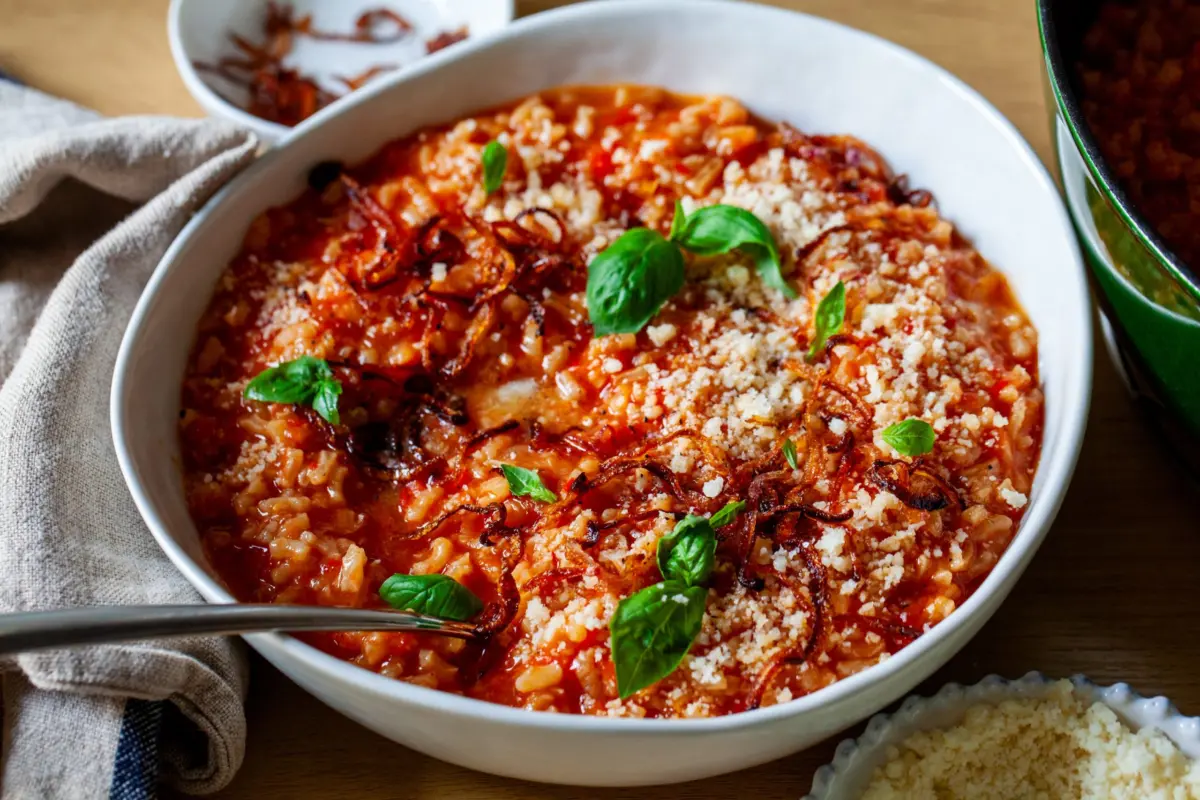
Adding a final layer of texture to the dish introduces an alternative to standard savory toppings like pan-crisped prosciutto, salami, or bacon. Instead, thinly sliced red onions are "frizzed" early in the cooking process until they reach a state of deep golden crispness. Half of these onions are folded directly into the baking risotto, while the remainder are reserved to be sprinkled over the top just before serving. This technique imparts a distinct fragrance, architectural depth, and a gentle balance of flavors that suits an insistently late-summer meal.

The dish can be finished with torn basil leaves, a grating of parmesan, and a final knob of butter or a drizzle of extra-virgin olive oil. Alternatively, the recipe adapts easily to a fully vegan preparation using only olive oil, fresh basil, and the frizzled onions, offering a depth of flavor that ensures nothing is missed.
Tomato Risotto with Frizzled Red Onions
The preparation begins by heating the oven to 350 degrees Fahrenheit. To prepare the risotto base, tomato halves are pressed cut-side against the large holes of a box grater, extracting the flesh and juices while reserving the outer skins for disposal. This process yields approximately two and a half to three cups of fresh tomato pulp.

In a four-quart Dutch oven or a deep, oven-safe saucepan equipped with a lid, three to four tablespoons of olive oil are heated over medium-high heat. Sliced red onion is added and cooked, with occasional stirring, until softened. Cooking continues until the pieces transform into a deeply golden brown and mostly crisp texture, which takes about eight to ten minutes. Half of these onions are transferred to a paper towel-lined plate, seasoned with salt, and set aside.
Minced garlic is introduced to the onions remaining in the pan and cooked for approximately one minute, seasoned with salt, freshly ground black pepper, and a pinch or two of red pepper flakes. Unrestrained by convention, uncooked rice is added directly to the pan to toast gently in the aromatic oil, onion, and garlic mixture for three minutes. White wine is poured in and cooked down until it completely evaporates.

The freshly grated tomato pulp is then added alongside two cups of water. The mixture is seasoned generously—initially with two teaspoons of kosher salt, adjusted to taste later, along with several grinds of black pepper. Once brought to a simmer, the heat is turned off.
Covered securely with a lid, the pot is transferred to the preheated oven and baked for twenty-five to thirty minutes, or until the majority of the liquid is absorbed while maintaining a slightly moist appearance. Checking the pot halfway through ensures the liquid is not depleted too quickly; if the contents look dry, an additional half-cup of water can be incorporated.

To finish, the pan is removed from the oven and placed on a cooling rack or trivet. After removing the lid, the mixture is stirred for about two minutes until it achieves a creamy, characteristic risotto texture. Seasonings are adjusted with additional salt and pepper according to personal preference. Two to three tablespoons of butter, or an equivalent amount of olive oil, are stirred in to enrich the dish. Finally, the risotto is scattered with toppings such as parmesan, torn basil, and the reserved frizzled onions before serving.