
For anyone who experiences a familiar wave of irritation upon spotting the early-season specter of pumpkin spice—or, worse yet, Halloween decor—during an 85-degree week in September, solace can be found in the kitchen. It is a sentiment shared by those who recognize that there are seemingly infinite months ahead to spend shivering, longing for hearty stews, and seeing no reason to beckon the colder seasons any sooner than necessary. When confronted with digital advertisements for heavy wool coats and garments one simply refuses to acknowledge before absolute necessity dictates, the instinct to grit out a defiant reminder through a glowing screen—"there’s another week of summer!"—resonates deeply with those determined to hold onto the season.
The reality, of course, is that fighting against the premature cultural shift toward autumn can feel remarkably lonely. Yet, a steadfast commitment to embracing summer cooking for as long as summer produce remains available—tomatoes in particular—serves as a delicious form of resistance. For many home cooks, the vibrant taste of fresh tomatoes is missed far too much throughout the long winter months to simply throw them out of rotation the moment the first apple arrives on grocery store shelves.

This culinary stubbornness, naturally, has nothing at all to do with projecting complicated personal feelings about one child starting middle school and another entering their senior year of high school onto dwindling summer produce. Not even a little. Instead, the focus remains squarely on the bounty of the season and finding innovative ways to celebrate it before it fades away.
The inspiration for celebrating late-season tomatoes often traces back to classic culinary touchstones, such as traditional rice-stuffed tomatoes. The most compelling element of those dishes is invariably the way short-grain rice absorbs a clear-noted, pure tomato sauce, a flavor profile so captivating it inspires entirely new standalone recipes. In the pursuit of a tomato risotto as simple and uncluttered as possible, traditional heavy stocks can be bypassed entirely in favor of grated tomato pulp, a bit of onion and garlic, and a modest splash of wine. To ensure the dish truly tastes of the fresh fruit it highlights, even water can be used in place of conventional broth, keeping the flavor profile remarkably clean and direct.

This approach leans into a broader culinary philosophy regarding risotto: many of the rules traditionally taught as mandatory turn out to be entirely optional. Longstanding dogma surrounding the process—including the absolute requirement for warm broth, constant and unceasing stirring, and heaps of butter and cheese—can be relaxed or discarded. By embracing simpler techniques, such as an oven-baked method, the preparation becomes significantly more approachable without sacrificing the final texture and depth of flavor.
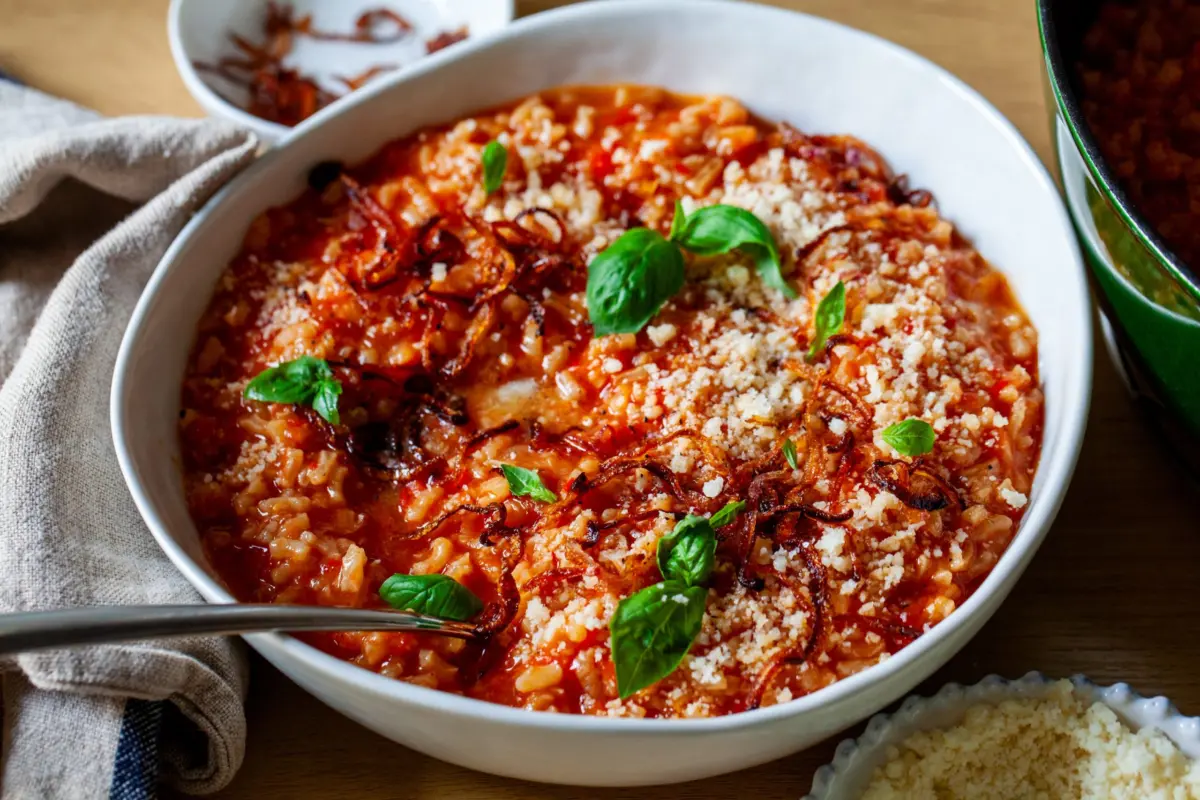
The only remaining question is how to garnish such a dish without resorting to the most obvious and heavy-handed toppings, such as pan-crisped prosciutto, salami, or bacon. The solution emerges in the form of thinly sliced red onions that are "frizzled" early in the cooking process. By cooking them until they are deeply golden brown and mostly crisp, half can be folded directly into the baked risotto while the remaining half is reserved to be sprinkled generously on top just before serving. This technique imparts a distinct fragrance, welcome depth, and a gentle kiss of contrasting flavor to a dish that proudly anchors itself in the fading days of summer.

To complete the presentation, the risotto can be finished with fresh basil leaves, a dusting of parmesan, and a final knob of butter or a delicate drizzle of olive oil. Alternatively, the dish can be kept entirely plant-based by relying solely on olive oil, fresh basil, and the frizzled onions. With so much natural flavor packed into every bite, the absence of heavy dairy or meat goes completely unnoticed, proving that late-summer cooking at its best requires nothing more than honoring the ingredients at hand.
Tomato Risotto with Frizzled Red Onions
To prepare the dish, the oven is first preheated to 350 degrees Fahrenheit. The risotto begins by halving fresh tomatoes and pressing their cut sides firmly against the large holes of a box grater, extracting the flesh and juices into a bowl while reserving and discarding the outer skins. This yields approximately two and a half to three cups of fresh tomato pulp.

In a four-quart Dutch oven or a deep, oven-safe saucepan equipped with a lid, three to four tablespoons of olive oil are heated over medium-high heat. Thinly sliced red onion is added and cooked, stirring frequently, until it softens and eventually transforms into deeply golden brown, mostly crisp pieces. About half of these frizzled onions are transferred to a paper towel-lined plate, seasoned with salt, and set aside.
Minced garlic is then introduced to the onions remaining in the pan, cooking for approximately one minute before being seasoned with salt, freshly ground black pepper, and a pinch or two of red pepper flakes. Uncooked risotto rice is added directly to the pan, allowing it to toast gently in the seasoned oil, garlic, and onions for about three minutes. A splash of white wine follows, cooked down until it completely evaporates.

The reserved grated tomato pulp is poured into the pan alongside two cups of water. The mixture is seasoned generously—starting with two teaspoons of kosher salt, followed by additional salt to taste and plenty of freshly ground black pepper. Once the entire mixture reaches a gentle simmer, the heat is turned off.
A lid is securely placed on the pot before transferring it to the preheated oven. The risotto bakes for twenty-five to thirty minutes, or until the vast majority of the liquid is absorbed while retaining a slightly moist appearance. A quick check halfway through the baking time ensures the liquid is not disappearing too rapidly; if the pan looks dry, an additional half-cup of water can be introduced.

Upon removing the pan from the oven, it is placed on a trivet or cooling rack. After removing the lid, the mixture is vigorously stirred for two minutes until it achieves a creamy, traditional risotto consistency. Final adjustments to seasoning are made, and two to three tablespoons of butter or olive oil are stirred in to enrich the texture. The dish is finished by scattering the reserved frizzled onions across the top, alongside freshly grated parmesan and torn basil leaves, before serving immediately.