
For anyone who feels a familiar twitch of irritation at the sudden, premature appearance of pumpkin spice displays and Halloween decorations during an 85-degree week in September, there is solace to be found in the kitchen. It is an annual cultural whiplash: advertisements for heavy wool coats and autumnal paraphernalia crowd screens while weeks of summer warmth still stretch ahead. For those who understand that the long, cold months of shivering and longing for heavy stews will arrive in due time—and that there is no logical reason to summon them a moment too soon—the defense mechanism is simple. You hold onto the season’s remaining produce, refusing to yield to the calendar until the very last possible moment.
Embracing summer cooking for as long as actual summer produce lasts, particularly tomatoes, becomes an act of culinary preservation. The sorrow of missing peak-season tomatoes all winter long makes it entirely unappealing to throw them out of the rotation the moment the first autumn apple arrives in the market. This fierce loyalty to the garden’s waning bounty has nothing to do with the complex, bittersweet emotions of watching children grow—such as the transition of one child starting middle school and another entering their senior year of high school. That emotional complexity is entirely separate from the state of the vegetable crisper.

At the heart of this late-summer rebellion is a focus on pure, unadulterated tomato flavor, inspired by classic culinary traditions like rice-stuffed tomatoes. The magic of those dishes often lies in the way short-grain rice absorbs a clear-noted, pure tomato sauce, a flavor profile so compelling it lingers in the memory and inspires new creations. Translating that concept into a standalone dish means stripping away unnecessary complications. To achieve a tomato risotto as simple and uncluttered as possible, the process relies on grated tomato pulp, a foundational base of onion and garlic, and a generous splash of wine. In a departure from traditional risotto methods, water is used instead of broth to ensure the dish tastes purely and intensely of fresh tomatoes.
This approach leans into a broader culinary philosophy regarding risotto: many of the rules traditionally taught as mandatory turn out to be entirely optional. The dogma surrounding risotto often dictates constant stirring, mountains of butter and cheese, and rich, simmering broths. Yet practical experience demonstrates that excellent results can be achieved by questioning these rigid guidelines. The only real indulgence added to this summer iteration is a carefully considered crisp topping, steering away from predictable options like pan-crisped prosciutto, salami, or bacon in favor of something more aromatic.

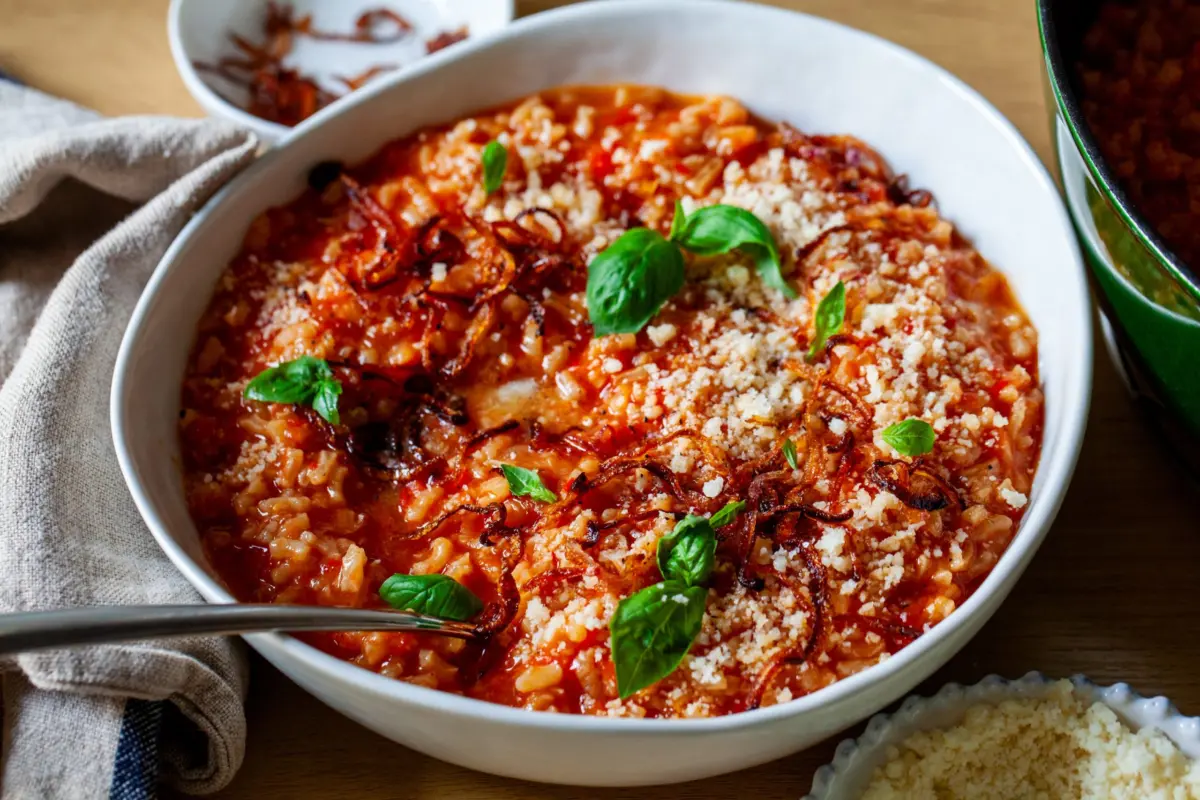
Instead of heavy meats, the dish features thinly sliced red onions that are "frizzled" early in the cooking process. Half of these crispy onions are folded directly into the risotto as it cooks, while the rest are saved to be sprinkled generously on top just before serving. This technique infuses the dish with fragrance, depth, and a gentle hint of cooler flavors that complement the insistently late-summer profile of the meal. The final presentation can be customized with torn basil leaves, parmesan cheese, and a finishing knob of butter or a drizzle of high-quality olive oil. Alternatively, the recipe can easily remain entirely vegan, relying solely on olive oil, fresh basil, and the sweet, savory crunch of the frizzled onions. The resulting depth of flavor ensures that nothing is missed, regardless of dairy or meat additions.
Tomato Risotto with Frizzled Red Onions
The preparation begins by preheating the oven to 350 degrees Fahrenheit. For the risotto base, fresh tomatoes are halved and grated by pressing the cut side firmly against the large holes of a box grater, extracting the flesh and juices while discarding the outer skins. This yields approximately two and a half to three cups of fresh tomato pulp.

In a four-quart Dutch oven or a deep, oven-safe saucepan with a lid, three to four tablespoons of olive oil are heated over medium-high heat. Sliced red onion is added and cooked, stirring frequently, until it softens and continues on to become deeply golden brown and mostly crisp, which takes roughly eight to ten minutes. Half of these onions are then transferred to a paper towel-lined plate, seasoned with salt, and set aside for the final garnish.
Minced garlic is introduced to the remaining onions in the pan and cooked for about one minute, seasoned with salt, freshly ground black pepper, and a pinch or two of red pepper flakes. Uncooked risotto rice is then added to the pan, allowed to toast gently in the aromatic oil, garlic, and onions for three minutes. A splash of wine is poured in and cooked until it evaporates, followed by the reserved grated tomato pulp and two cups of water. The mixture is seasoned robustly—typically starting with two teaspoons of kosher salt, followed by more to taste, alongside a generous amount of black pepper. Once the mixture comes to a gentle simmer, the heat is turned off.

The pot is covered with a tight-fitting lid and transferred directly to the oven, where the risotto bakes for twenty-five to thirty minutes, or until the majority of the liquid is absorbed while retaining a slightly fluid appearance. A quick check halfway through the baking time ensures the liquid is not disappearing too rapidly; if the pot looks dry, an additional half-cup of water can be introduced.
Upon removal from the oven, the pan is placed on a trivet or cooling rack. After removing the lid, the mixture is vigorously stirred for two minutes until it achieves a creamy, traditional risotto consistency. Final adjustments to seasoning are made with additional salt and pepper as needed. Two to three tablespoons of butter or olive oil are stirred in to enrich the texture. Finally, the dish is scattered with optional toppings such as grated parmesan and torn basil, crowned with the reserved crispy frizzled onions, and served immediately while the lingering warmth of summer still feels entirely appropriate.