
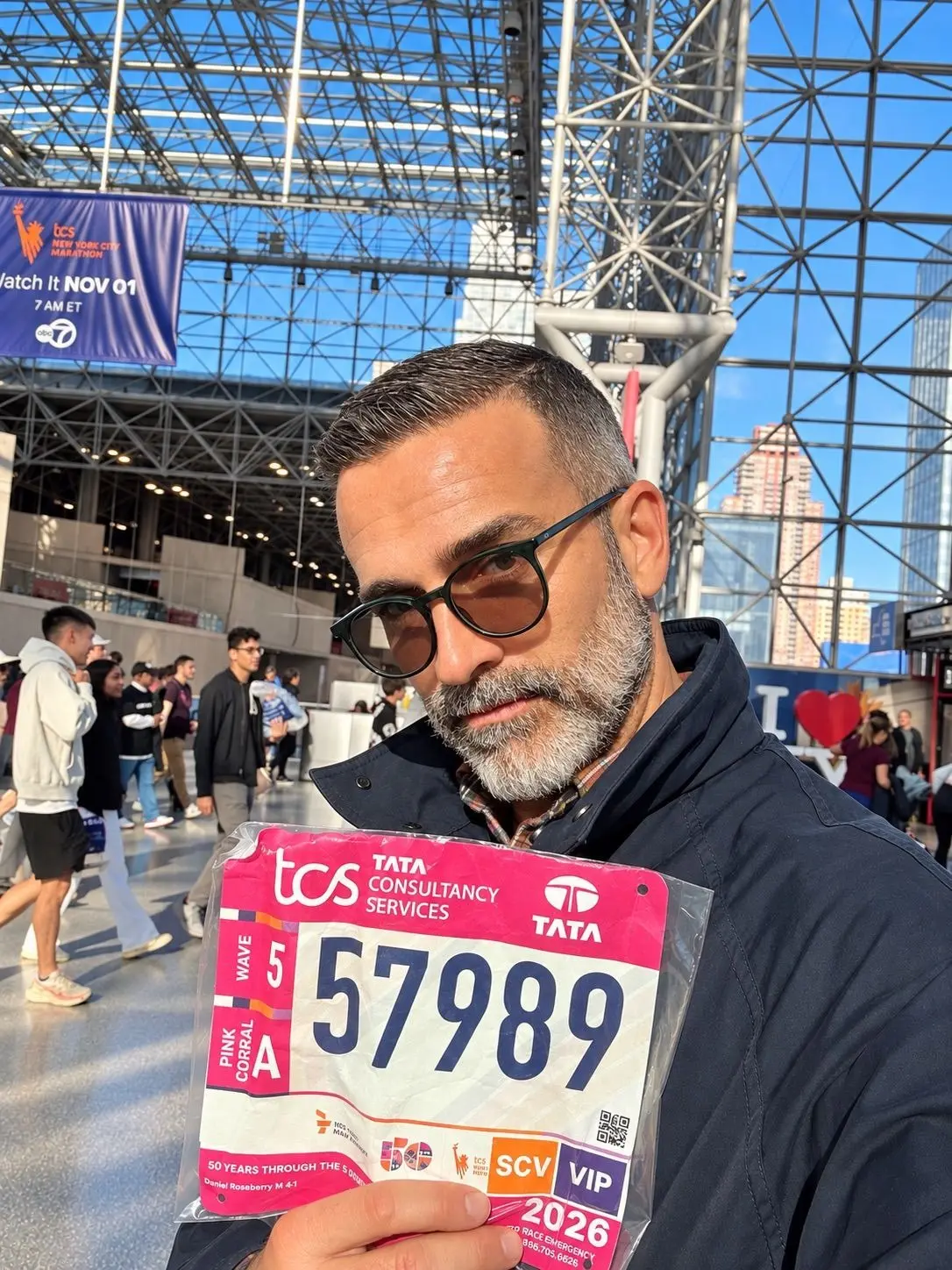
Marathon Sunday was a sensory blur of motion and color, but Daniel Roseberry, the creative director of Schiaparelli, remembers a handful of moments with striking clarity. There was the dappled light filtering across the grueling 26.2-mile course, and the rhythmic, steady sound of sneakers striking pavement as he crossed over a bridge and the wall of crowd noise temporarily receded. There was the absolutely perfect autumn weather, and above all, the overwhelming surge of emotion he felt upon spotting his friends and family stationed along the sidelines, cheering him forward with unbridled enthusiasm.
"There are no words to describe it," Roseberry tells Vogue of running the New York City Marathon, marking his debut across the historic distance. "This day will stay with me for a long time."
The irony of the milestone is that at this exact time last year, the celebrated designer had no intention whatsoever of tackling the arduous course. But last Christmas, while spending the holiday season in Paris, Roseberry went out on an impulsive run along the Seine, the city’s iconic central waterway. While he was certainly no stranger to the magic, architecture, and romance of the French capital—where he has lived and worked since 2019—that specific run opened his eyes to his surroundings in entirely new and profound ways. Something fundamental awoke inside him. Ten months later, he found himself standing among nearly 60,000 participants in the New York City Marathon, crossing the finish line with an impressive official time of 4 hours and 24 minutes.
"It was just the perfect day," Roseberry reflected just a few hours after completing the race, his finisher’s medal still draped securely around his shoulders. He had already celebrated with some well-earned post-race pizza and pasta, with a second celebratory dinner of Shake Shack waiting in the wings, and he was eagerly anticipating some much-deserved downtime in Therabody recovery boots. "It really reconnected me to my love of this city."

Roseberry’s race day began in the dead of night at 3:30 a.m., followed by a 5:00 a.m. bus ride out to Staten Island, the traditional starting point of the race before it winds its way northward through all five boroughs to its grand conclusion in Central Park. "It was pin-drop silent on the bus," he recalls of the early morning transit. "But you can sense everyone’s energy. It’s like this pent-up anticipation." Because he was assigned to the final wave, which did not step off until 11:30 a.m., he faced a five-hour wait at the start village after arriving, letting the nervous tension build before beginning his personal journey.
Upon setting off, runners immediately face the race’s opening trial: the four-mile-long Verrazzano-Narrows Bridge, which features a demanding two-mile climb and a 174-foot elevation gain, standing as the highest ascent of the entire course. Once he descended from the bridge, the legendary crowds that line the New York route began to materialize in full force. "The city really shows up, and it’s beautiful," Roseberry says. "All these people cheering for you, and they don’t know you. They’re cheering your name, telling you you can do it. It really carries you and is a beautiful representation of humanity at its best. It transcended every expectation I had."
Remarkably, Roseberry accomplished this endurance feat with just two months of dedicated training. He began his preparation in September while concurrently managing the intense workload of designing his spring ready-to-wear collection. To get race-ready, he collaborated with Jonathan Fins, his trainer of two years, to structure a physical program that built securely upon his existing fitness foundation. Roseberry’s baseline routine was already deeply rooted in strength training, mobility work, and calisthenics—qualities that allow him to not only craft shockingly glamorous haute couture and ready-to-wear garments but also perform a deeply impressive 24 consecutive pull-ups.
The running regimen itself was truncated and intense. In September, Fins introduced a weekly long run that incrementally increased in distance, ultimately peaking at 33 kilometers, or roughly 20 miles, before tapering off to ensure his body was fully rested ahead of the main event. This strategy aligns with common marathon practices for first-time runners, who frequently reserve the full 26.2-mile distance strictly for race day itself.
For Roseberry, the rigorous training process offered a welcome psychological break from his daily professional responsibilities, where he is perpetually the one steering the ship and making the ultimate decisions. "Most days, everyone’s looking to me for answers," he notes. "With this, I was able to put myself into the care of another person."

Heading into the weekend, Roseberry kept his performance expectations modest and flexible. He had no specific finish time etched in his mind. "I just want to finish, and be able to walk," he half-joked during a FaceTime conversation the day before the starting gun sounded. Later, however, he acknowledged that he had successfully achieved one major personal objective: he navigated the entire 26.2-mile course without walking a single step.
The designer specifically chose New York as the backdrop for his inaugural marathon because his professional schedule already required him to be in the city to accept the Leader in the Arts Award at the Hirshhorn Gala on Monday. With Halloween festivities seamlessly bleeding into Marathon Sunday, he quickly realized it was one of the most vibrant, electric weekends of the entire year to be in the five boroughs. "It just had to be New York," he says.
During his weeks of preparation, Roseberry developed a distinct rhythm for his miles. He would typically spend the first half of his training runs conversing—and occasionally friendly bickering—with Fins, before switching over to a pop-heavy playlist for the second half, where artists like Olivia Rodrigo, Taylor Swift, and Rosalía sat in heavy rotation. Though he carefully curated an epic song cycle for the actual marathon itself, he ended up listening to it for a mere 15 minutes. "It didn’t feel like it was in the spirit of the day," he explains. "I wanted to be in the moment, honor it, and take it all in. I wanted to be present with the other runners, and with the people who came to watch."
As one might expect from a major fashion designer, Roseberry was exceptionally particular about his race-day kit. He laced up in Asics Gel-Kayano running shoes paired with Nike socks, wore open-weave cotton tank tops from Sunspel, and protected his eyes with inexpensive, sporty wraparound sunglasses that he had purchased in multiple colors at a Dick’s Sporting Goods in Maine over the summer.
Beyond the physical accomplishment, the rigorous process of training for and completing a marathon provided Roseberry with fresh philosophical insight into his creative work as a designer. "It had me thinking about the body in different ways," he reflects. "How could it not? And I like that the marathon is this thing with a defined beginning and end; it’s a closed loop. There are so many things always going on in fashion, but I’d like to take that mentality into my work."

On the morning of the race, Roseberry recorded a voice note reflecting on the profound personal significance of his two-month transformation. "The thing I keep coming back to is this physical transformation is so important to me," he said. "It feels so vital because it’s a physical manifestation of an inner transformation that’s been happening over the past year."
He added candidly, "I think for four decades I had been completely, in many ways, living for the approval of other people and living in total abandonment of myself, and my body, for sure. I think this marathon has significance because it’s the first real thing to be envisioned, worked and trained for, and completed in a radical, new way of thinking. The transformation isn’t transforming into somebody different or somebody new or something better. It’s about remembering what my body was always capable of in the first place. I feel like I met this body, like it’s a person, that I re-met a year ago. And the last eight weeks of training have been a way of honoring that relationship going back into my life."
Given how deeply the experience resonated with him, it came as little surprise when, during his post-race debrief, Roseberry let slip a comment about the future. When asked directly if he plans to run again next year, his response was immediate and definitive: "Oh, yeah. Early on in the race, like mile four or five, I called my friend and told her, ‘We’re so doing this next year.’"