

The value of the S&P 500 index has surged by approximately fifty-seven percent over the past two years, more than doubling over the past five. For millions of investors stashing their retirement savings into index funds, this rapid ascent has fundamentally altered net worth calculations. Individuals who felt they were only halfway to their retirement goals during the COVID-19 era may find they have suddenly surpassed the finish line. Meanwhile, long-term retirees are encountering a new psychological phenomenon, eyeing up expensive properties and experiencing the classic sensation of money burning a hole in their pockets.
This unprecedented trajectory has sparked an urgent debate across financial circles: Is this extraordinary growth real, or is it an inflated bubble built on financial illusion? The underlying anxiety is captured in concerns frequently raised by everyday investors watching the market break record after record. The core worry points directly to artificial intelligence, with observers asking whether the intense hype surrounding AI has created a massive bubble that leaves retirement portfolios acutely vulnerable to a catastrophic future crash.
To properly evaluate the current financial landscape, analysts suggest going back to the absolute roots of what a stock represents. At its core, owning a stock is a business arrangement that functions identically to owning a rental house. When an individual owns a rental property, their primary entitlement is the collection of monthly rent. After covering expenses related to the property, the remaining balance constitutes the net profit.

If the average sale price of rental houses within a specific region skyrockets while tenants continue paying the exact same monthly rent, the situation looks impressive on paper. However, that inflated paper value holds little practical meaning unless the property is sold. Even then, selling means the investor must turn around and purchase another replacement rental property at the identical inflated market price.
An investor’s actual cash flow remains stagnant unless they can actively increase the profitability of the rental business. Landlords achieve this by building a basement apartment, executing strategic renovations, streamlining operating expenses, or implementing other measures to boost net earnings. When that property is eventually sold to a new investor, the purchase price should logically be anchored to that projected future income stream.
Consider a property generating two thousand dollars per month, totaling twenty-four thousand dollars annually. If that house sells for two hundred forty thousand dollars, the incoming investor is acquiring a business operating at a price-to-earnings, or P/E, ratio of ten. Conversely, if a seller convinces a buyer to hand over four hundred eighty thousand dollars for that exact same property, the transaction occurs at a P/E ratio of twenty. While this represents a windfall for the seller, it translates to a significantly less favorable outlook for the incoming investor.

Translating this dynamic to the broader stock market reveals a striking parallel. An investment of one hundred thousand dollars placed into the market in 2019, with dividends continuously reinvested, would have grown substantially by 2025, yielding a return exceeding one hundred fifty percent. Yet over that exact same timeframe, the aggregate share of company earnings generated by that identical basket of stocks experienced a much more modest increase of roughly forty-two percent.
Consequently, the overall price-to-earnings ratio of the market has climbed from approximately twenty in 2019 to roughly thirty today. Modern stock market participants find themselves in the exact position of rental property investors discovering that housing prices have doubled while rental income has barely budged. This compressed margin inherently suggests that future income derived from portfolios purchased at today’s elevated P/E ratios will be lower compared to buying assets during a market downturn. Basic mathematics dictates that while owning these assets remains profitable, future returns will reflect the higher initial purchase multiples.
The Driving Force of Sector-Specific Growth
A critical nuance in valuation involves anticipated earnings growth. If a real estate investor considers an overpriced property but knows a major corporate campus is breaking ground nearby, rental demand and income are projected to climb rapidly. Under those circumstances, paying a premium for future earnings is justifiable.

This principle explains why individual company stock prices jump on positive corporate news. During the pandemic era, surging demand for home exercise equipment drove Peloton sales upward. Investors briefly assumed the shift was permanent, propelling the stock higher before reality reasserted itself, sales normalized, and the share price retreated.
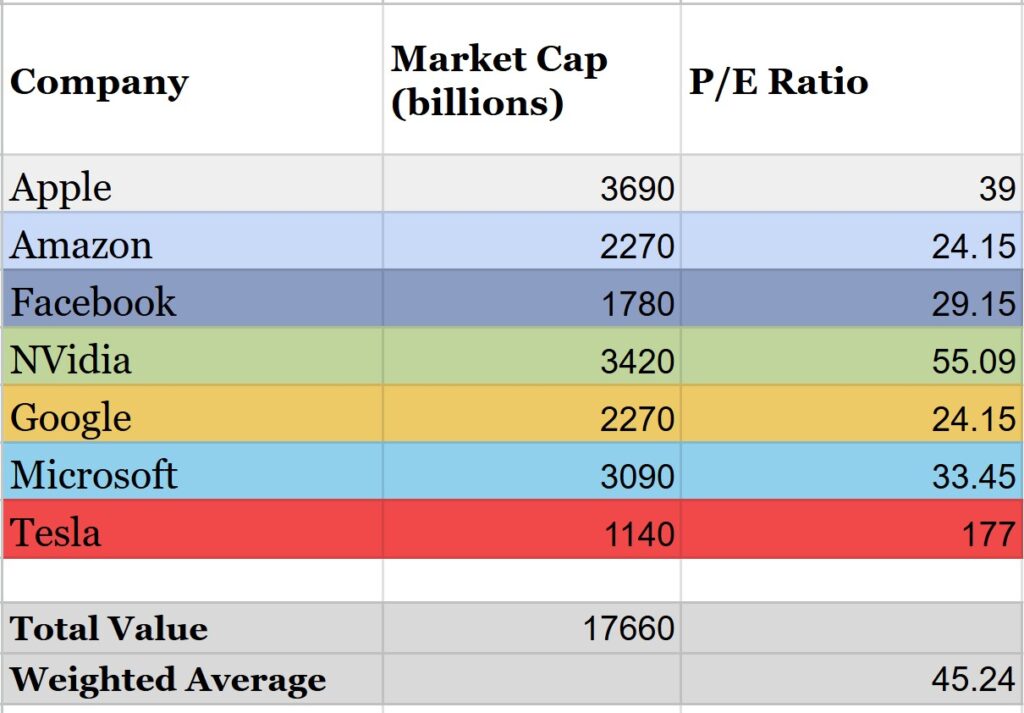
When the entire market rises uniformly, however, it raises questions about whether macroeconomic growth projections have fundamentally accelerated. Delving into the composition of the S&P 500 index reveals that recent market expansion has not been distributed evenly across all sectors. Approximately three-quarters of the recent growth stems from just seven dominant technology corporations, frequently labeled the Magnificent Seven: Apple, Nvidia, Microsoft, Amazon, Alphabet, Meta, and Tesla.
These high-profile, highly profitable entities have captured investor imagination through aggressive growth and technological dominance. Collectively, they account for more than twenty-five percent of the total market capitalization—amounting to roughly 17.66 trillion dollars—and trade at significantly higher valuation multiples, with a weighted average P/E ratio hovering around forty-five. Excluding these seven giants and evaluating the remaining 493 companies in the index yields a much more moderate P/E ratio of twenty.
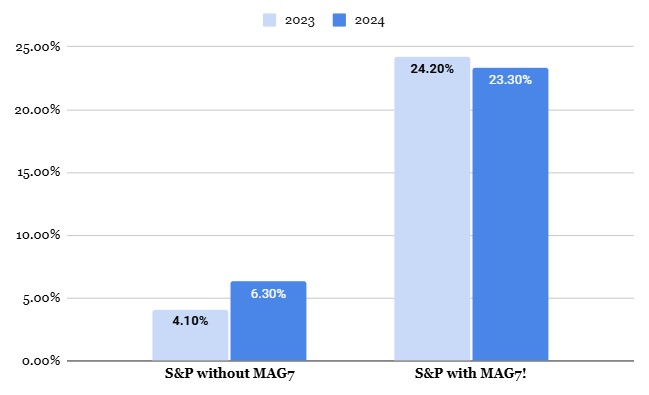
This divergence illustrates that while investors anticipate a generally healthy domestic economy, market pricing reflects an expectation that major technology firms will continue capturing disproportionate share and income growth well into the future.
The Artificial Intelligence Phenomenon
The driving catalyst behind the current dominance of mega-cap technology firms is the sudden, accelerated advancement of artificial intelligence. Recent breakthroughs have equipped software with human-like reasoning capabilities across an expanding array of disciplines, igniting widespread corporate enthusiasm.
Six of the Magnificent Seven members are committing hundreds of billions of dollars toward the construction of massive data centers filled with advanced supercomputers. The remaining member, Nvidia, occupies a central position as the primary manufacturer of those specialized processors, commanding exceptional pricing power and shipping hardware at unprecedented volumes.
This infrastructure buildout represents the foundational tier of the current boom. Further down the operational chain, enterprises across nearly every industry sector are betting that AI will usher in a transformative era of enterprise productivity and accelerated profit generation. Corporations are already utilizing advanced algorithms to analyze extensive legal documents, write and debug software code, assist in medical diagnostics, optimize drug discovery, and develop robotic automation.
The overarching thesis driving market valuations is that humanity stands on the precipice of an infinite, highly intelligent digital workforce capable of operating continuously. Proponents argue this technology effectively eliminates historical constraints centered on finite human intelligence and labor availability. While industry observers note that the transformative potential of AI is substantial, questions persist regarding precise timelines, cost overruns, competitive pressures, and the ultimate realization of projected corporate profit margins.
Historical Context and Long-Term Projections
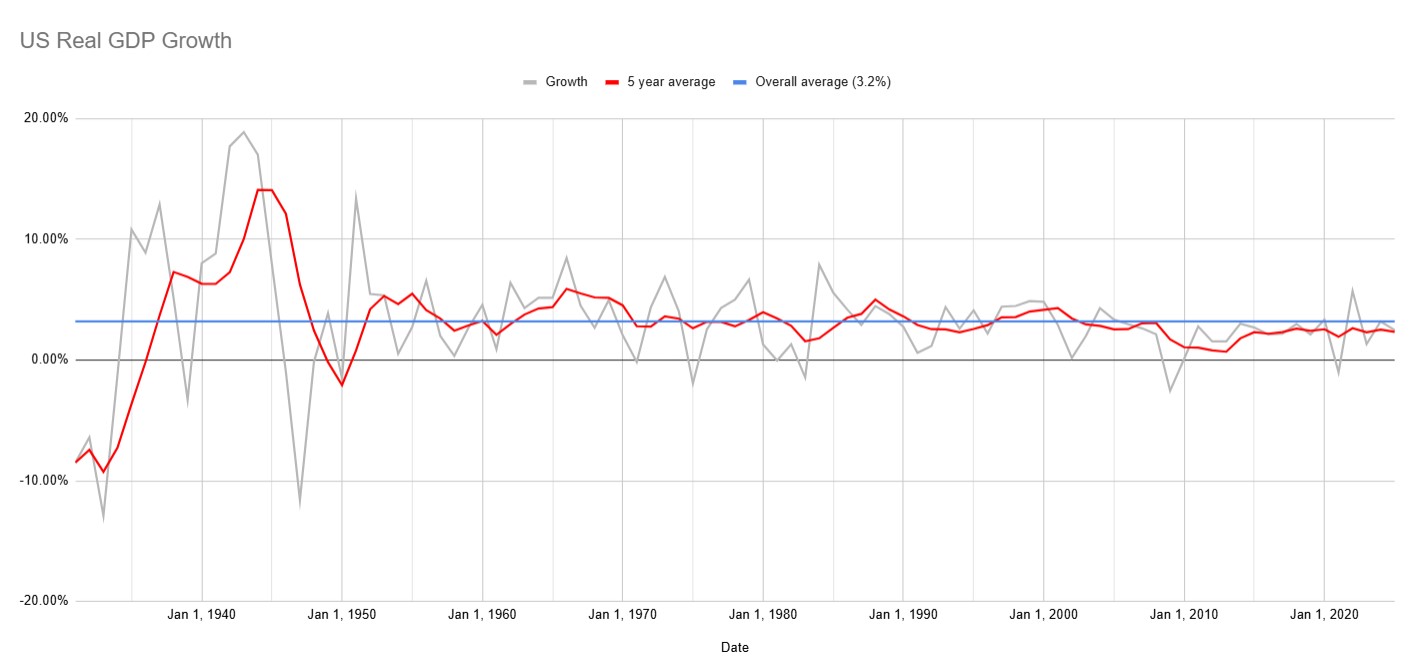
While the future trajectory remains uncertain, historical economic data provides a stabilizing perspective. Over decades, United States economic growth has averaged a remarkably steady three percent annually after adjusting for inflation. Historical analyses indicate that recent decades have actually experienced slightly slower growth than the long-term average, making the current intensity of stock market valuations an outlier relative to broader historical GDP expansion.

Market veterans emphasize that attempting to time market cycles—such as liquidating portfolios entirely in anticipation of a downturn—historically proves disadvantageous for long-term investors. Even if valuations eventually normalize toward historical averages, continuous economic expansion and concurrent earnings growth suggest that portfolios will continue advancing over multi-decade horizons, albeit at a moderated pace.
Diversification strategies continue to attract attention from institutional analysts. Projections published by Vanguard suggest that international equities and fixed-income assets could potentially outperform domestic equities over the coming decade. This outlook is supported by valuation disparities, noting that international stock funds trade at significantly lower P/E ratios compared to their domestic counterparts. Despite these projections, domestic technology concentration has historically kept US markets outperforming international allocations over recent years.
Meanwhile, institutional figures such as Warren Buffett have signaled caution regarding broader market valuations. Berkshire Hathaway has maintained substantial levels of uninvested cash, reflecting a strategy centered on exercising patience when asset prices and prevailing P/E ratios offer few compelling bargains.
For individual investors evaluating personal balance sheets, discussions surrounding portfolio allocations frequently intersect with decisions regarding debt reduction. While conventional financial wisdom often favors maintaining a low-interest mortgage while directing surplus capital toward equities, rising interest rates have altered that calculus. For homeowners navigating higher borrowing costs, allocating funds toward debt elimination functions similarly to securing a guaranteed, risk-free return, offering psychological peace of mind alongside tangible financial savings.
As market discussions persist across financial forums, foundational principles remain unchanged for long-term participants. Analysts consistently emphasize maintaining discipline, tuning out daily market commentary, and focusing on long-term financial objectives while allowing economic fundamentals to play out naturally over time.